

Continuous Integration (CI) has evolved from an experimental software engineering practice into the absolute heartbeat of modern digital product development. In an era where business agility, rapid time-to-market, and unrelenting user expectations dictate market leadership, the ability to build, test, and validate software changes rapidly and reliably is no longer optional. Traditional software development cycles—marked by monolithic releases, manual testing phases, and chaotic merge days—are relics of a bygone era. Today, high-performing engineering teams rely on continuous integration to streamline workflows, eliminate silos, and maintain an unbroken chain of confidence from code commit to production readiness.
At its core, continuous integration is not merely a set of automation tools or a specialized server running background jobs; it is a profound cultural and technical commitment. It requires developers to frequently merge their code changes into a central repository, ideally multiple times a day. Each integration is then automatically verified by an automated build and test sequence. This practice fundamentally transforms how teams confront technical debt, catch regressions, and collaborate across distributed environments. By shifting quality assurance left introducing automated checks moments after code is written organizations can detect architectural flaws and logic bugs when they are cheapest and easiest to resolve.
The Foundational Pillars of Continuous Integration
To successfully implement continuous integration, teams must embrace a strict set of foundational principles. Without these core tenets, even the most sophisticated CI tooling will ultimately collapse under the weight of accumulated technical friction.
-
A centralized version control repository that serves as the single source of truth for the entire engineering organization.
-
Frequent, incremental commits to the shared trunk rather than hoarding code locally on isolated feature branches for weeks at a time.
-
Fully automated build processes that can compile, package, and containerize applications identically across developer laptops and remote servers.
-
Comprehensive automated test suites that execute rapidly and provide immediate, unambiguous feedback to the author of the code.
-
Transparent feedback mechanisms that instantly notify developers via chatops, email, or dashboards whenever a build fails or performance metrics degrade.
Embracing these pillars transforms the development lifecycle from a reactive scramble into a predictable, repeatable science. When developers trust the pipeline, they push code with confidence, experiment safely, and focus their creative energies on solving business problems rather than wrestling with deployment mechanics.
Anatomy of a Robust CI Pipeline
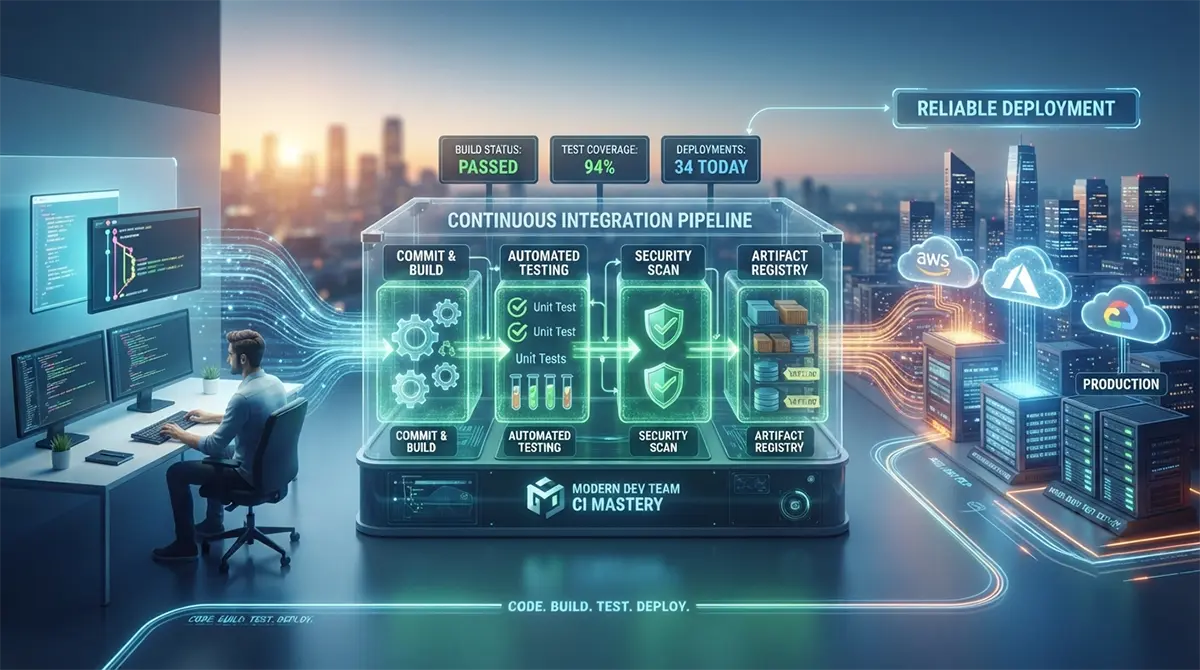
A modern CI pipeline is a carefully orchestrated sequence of automated stages designed to evaluate every commit against a battery of quality and security gates. Understanding the architecture of this pipeline is essential for designing resilient workflows that scale alongside growing engineering organizations.
The Commit Stage: Initial Validation and Linting
The journey begins the moment a developer pushes code to the remote repository. The commit stage is designed for speed, executing within seconds or a few minutes at most. Here, static code analysis tools, linters, and formatters examine the syntax and style of the code. Catching misspelled variables, formatting inconsistencies, and basic syntax errors early prevents downstream pipeline stages from wasting computational resources on fundamentally broken code.
The Build and Compile Stage: Creating Artifacts
Once the code passes initial static checks, the pipeline advances to the build stage. For compiled languages like Go, Rust, or Java, this phase compiles source code into machine code or bytecode. For interpreted languages like Python, PHP, or Node.js, this stage often involves resolving dependencies, installing package managers, and bundling assets. The objective of this phase is to produce immutable, version-controlled artifacts—such as Docker container images or compiled binaries—that will remain identical as they move through subsequent testing and deployment environments.
The Automated Testing Stage: Guarding Against Regressions
The heart of any CI pipeline is its testing suite. This stage is typically partitioned into distinct tiers to balance thoroughness with execution speed:
-
Unit tests that validate individual functions and classes in complete isolation from external dependencies.
-
Integration tests that verify how internal components interact with databases, caches, and third-party APIs.
-
End-to-end simulations that mimic real user journeys through the application stack to ensure cross-module harmony.
Trunk-Based Development vs. Long-Lived Branches
One of the most consequential architectural decisions an engineering team makes is choosing its branching strategy. While Gitflow and long-lived feature branches were once ubiquitous, modern continuous integration strongly favors trunk-based development.
In a trunk-based model, all developers merge their changes into a single central branch—the trunk—frequently, often multiple times a day. If a feature takes longer than a day to build, developers utilize design patterns such as feature flags or toggles to safely wrap unfinished code paths. These flags allow new functionality to reside safely in production codebases while remaining invisible to end users until fully polished and ready for release.
Long-lived branches, by contrast, are antithetical to continuous integration. When branches diverge from the main codebase for weeks or months, the eventual merge becomes a painful, error-prone ordeal characterized by catastrophic merge conflicts and integration hell. Trunk-based development forces teams to solve integration problems continuously rather than all at once, dramatically reducing cognitive load and accelerating feature delivery.
Accelerating Feedback Loops: The Currency of Developer Velocity
In the realm of continuous integration, time is the ultimate currency. The faster a developer receives feedback on their code commit, the more engaged they remain, and the lower the context-switching cost becomes. If a pipeline takes forty-five minutes to complete, developers will context-switch to other tasks, breaking their mental flow state and delaying the discovery of bugs.
Optimizing pipeline performance requires deliberate engineering effort across multiple dimensions:
-
Caching dependencies aggressively so that package managers do not redownload gigabytes of external libraries on every single run.
-
Parallelizing test execution across multiple worker nodes or containers to slash total wall-clock execution time.
-
Running fast, lightweight unit tests first, reserving slow, resource-intensive integration and browser-based tests for later stages.
-
Incrementally building container layers and leveraging remote build caches to avoid redundant compilation tasks.
When feedback loops shrink from hours to minutes, development velocity skyrockets. Engineers can iterate rapidly, test hypotheses in real time, and catch regressions before they leave their local development mindset.
Securing the Pipeline: Integrating DevSecOps Early
Historically, security was treated as a final gatekeeper phase, occurring just before software was pushed to production. This traditional approach created massive bottlenecks and forced teams to choose between shipping on time and maintaining rigorous security standards. Continuous integration provides an ideal platform to shift security left, embedding automated checks directly into the everyday development workflow.
Modern CI pipelines incorporate multiple layers of automated security scanning:
-
Software Composition Analysis (SCA) tools that scan third-party dependencies and open-source libraries for known vulnerabilities and Common Vulnerabilities and Exposures (CVEs).
-
Static Application Security Testing (SAST) analyzers that parse source code for dangerous patterns, such as SQL injection vectors, hardcoded API keys, and insecure cryptographic algorithms.
-
Secret detection scanners that intercept commits containing accidental credentials, private SSH keys, or cloud provider access tokens before they are pushed to public or internal repositories.
By catching these vulnerabilities during the CI phase, organizations eliminate the risk of deploying compromised code into production environments, drastically reducing their overall attack surface and ensuring regulatory compliance without sacrificing deployment speed.
Managing Database Migrations and State in CI
While stateless application code is relatively straightforward to build and test within a continuous integration pipeline, managing database schemas and persistent state introduces unique complexities. Because databases evolve alongside code, schema migrations must be thoroughly tested, backward-compatible, and seamlessly integrated into the automated pipeline.
To maintain pipeline stability and prevent production outages, teams must adopt robust database migration practices:
-
Designing migrations to be strictly backward-compatible so that older application versions can still function correctly against newly altered database schemas during rolling updates.
-
Executing migrations in isolated, ephemeral test containers during the pipeline run to verify that upgrade and downgrade scripts execute without errors.
-
Avoiding destructive schema changes—such as dropping columns or renaming tables—in a single step, instead breaking them down into multi-phase deployments that span several release cycles.
Failing to account for database state within the CI pipeline is one of the most common causes of catastrophic production failures. Treating schema migrations as first-class citizens of the build process ensures that data integrity is preserved under all operating conditions.
Artifact Management, Immutability, and Reproducibility
A cornerstone of reliable continuous integration is the strict principle of artifact immutability. Once a build artifact—whether it is a compiled binary, a Python wheel, or a Docker container image—successfully passes all pipeline verification stages, it must never be modified.
If a bug is discovered in a test environment, developers should never patch the artifact in place. Instead, the underlying code defect must be fixed at the source, triggering a brand-new pipeline execution that produces an entirely new, pristine artifact version. This guarantees complete traceability and ensures that the exact binary tested in staging is the exact binary deployed to production.
Organizations must invest in secure, high-availability artifact repositories to store these build outputs. Furthermore, maintaining reproducibility requires meticulous tracking of all environment variables, compiler flags, and base operating system images used during the compilation process. This level of rigor ensures that builds are completely deterministic and immune to the classic “it works on my machine” phenomenon.
Monitoring, Metrics, and Continuous Improvement
Continuous integration is not a static destination; it is a continuous journey of measurement, analysis, and optimization. High-performing engineering organizations treat their CI pipelines as core products, continuously tracking key performance indicators to identify bottlenecks, reduce failure rates, and enhance developer productivity.
Key metrics to monitor within any CI ecosystem include:
-
Build success and failure rates, which highlight unstable tests or flaky infrastructure components.
-
Pipeline duration trends, ensuring that execution times do not creep upward as the codebase grows.
-
Mean Time to Recovery (MTTR) for broken builds, reflecting how quickly teams diagnose and fix integration errors.
-
Deployment frequency and lead time for changes, correlating CI efficiency with overall business agility.
By maintaining rigorous visibility into pipeline telemetry, engineering leaders can make data-driven decisions about infrastructure scaling, tooling upgrades, and process refinements.
Cultural Challenges and Team Collaboration
While technology and automation form the mechanical backbone of continuous integration, human culture remains the ultimate determinant of success. Introducing CI often disrupts established habits, requiring developers to relinquish the safety of isolated, long-lived branches in favor of radical transparency and shared responsibility for the master trunk.
When a build fails, it should be treated as an immediate team emergency rather than an individual failure. Teams must cultivate a blameless post-mortem culture where broken builds are viewed as valuable learning opportunities to improve automated test suites or tighten linting rules. Furthermore, bridging the historical divide between development and operations teams ensures that infrastructure provisioning, pipeline scaling, and deployment automation are designed collaboratively from day one. In some cases, organizations seeking specialized expertise partner with external providers of DevOps Services in Dubai to accelerate their cultural and technical transformation. Regardless of whether transformation is driven internally or externally, fostering psychological safety and open communication is essential for empowering engineers to embrace the rapid, iterative cadence of continuous integration.
Conclusion: The Imperative of Modern Continuous Integration
Continuous integration has transcended its status as a mere technical best practice to become a fundamental pillar of organizational survival and growth in the digital age. By automating the journey from source code to verified artifact, engineering teams can eliminate manual toil, drastically reduce defect rates, and deliver business value to end users with unprecedented speed and confidence.
The journey toward true continuous integration maturity requires unwavering commitment, cultural alignment, and relentless optimization. From enforcing trunk-based development and shrinking feedback loops to embedding DevSecOps practices and managing database migrations safely, every component of the pipeline plays a vital role in upholding software quality. Organizations that master these principles unlock superior developer productivity, robust system reliability, and an unbeatable competitive advantage in an increasingly software-driven world.