

In the modern landscape of software engineering, application deployment velocity has reached unprecedented heights. Organizations routinely push code updates multiple times a day through automated CI/CD pipelines, containerized microservices, and Kubernetes orchestration layers. Yet, while stateless application tiers glide effortlessly from staging environments to production clusters, the database tier remains a fortress of critical state. Schema migrations, index creations, data type alterations, and cluster topology shifts continue to represent some of the most perilous moments in an engineer's operational lifecycle. A single mismanaged alter table statement can lock tables, exhaust connection pools, saturate input/output throughput, and bring a thriving enterprise to a grinding halt.
Achieving zero-downtime releases requires a paradigm shift in how database engineering interacts with modern DevOps workflows. It demands specialized tooling, battle-tested architectural patterns, and a robust ecosystem of vendors dedicated to decoupling schema evolution from application availability. When organizations speak of zero-downtime releases, they are not merely referencing high availability during routine infrastructure maintenance. They are pointing to a sophisticated capability: the ability to roll out breaking schema modifications, migrate data across storage engines, upgrade database management systems, and scale replica sets while millions of concurrent users interact with the platform without experiencing a single millisecond of service interruption.
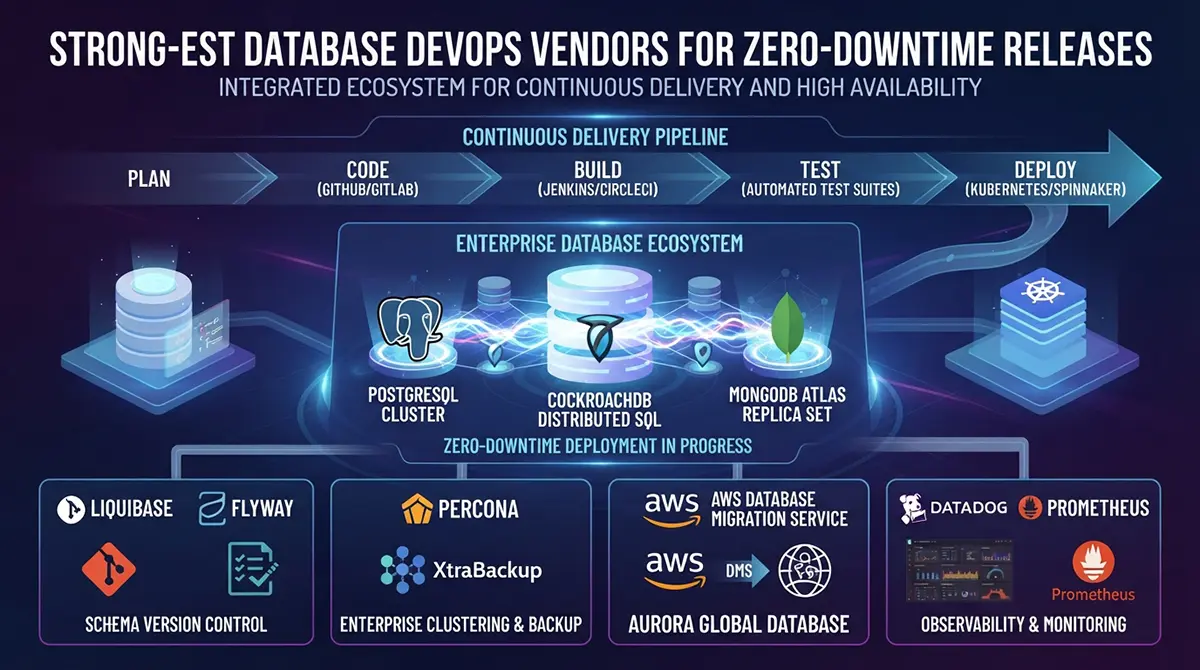
This comprehensive exploration examines the strongest database DevOps vendors, tools, and platforms enabling zero-downtime releases today. We will analyze how industry leaders handle the treacherous waters of schema evolution, distributed clustering, automated failover, and observability, equipping engineering leaders with the knowledge needed to architect resilient data pipelines.
The Architectural Anatomy of Zero-Downtime Database Releases
To understand why specific vendors excel in the realm of zero-downtime releases, one must first dissect the fundamental engineering challenges that occur when databases meet continuous delivery. Unlike stateless application code, which can be instantly replaced by spinning up a new container and terminating an old one, databases maintain persistent state, enforce strict relational constraints, and manage complex transactional locks.
When an application requires a schema change, traditional approaches involved executing direct SQL commands during a scheduled maintenance window. In modern continuous delivery environments, scheduled maintenance windows are obsolete. Users expect global availability twenty-four hours a day, seven days a week. Therefore, database changes must be broken down into backward-compatible steps, a methodology often referred to as expansion and contraction or the expand-contract pattern.
The expand-contract pattern operates across multiple distinct phases:
-
Expansion Phase: Developers introduce new database objects, columns, or tables that coexist with existing structures. Applications are updated to write data to both old and new locations or to utilize new optional fields without enforcing constraints that would break legacy code paths.
-
Migration Phase: Background data migration processes or asynchronous workers backfill historical data from legacy structures into newly created columns or tables without locking active transaction logs.
-
Contraction Phase: Once all running application instances have been updated to utilize the new schema exclusively, and data synchronization is complete, legacy columns or tables are safely removed.
Executing this intricate choreography manually across dozens of microservices and multi-region database replicas is impossible at scale. This reality has given rise to a specialized ecosystem of database DevOps vendors and tooling suites. These platforms automate schema validation, enforce safe migration patterns, orchestrate rolling database upgrades, and provide instant rollback mechanisms when anomalies arise.
Need a Reliable DevOps Partner in Dubai?
Managing servers, monitoring performance, and automating workflows can be overwhelming when you’re trying to scale your business. If you’re looking for hands-on expertise in cloud migration, server hardening, and pipeline automation, We are here to bridge the gap. Reach out to us and let’s build a resilient infrastructure tailored to your needs.
Evaluating Percona: Open Source Freedom and Enterprise Clustering Excellence
For organizations deeply rooted in the open source relational database ecosystem, particularly MySQL and PostgreSQL, Percona stands as an indomitable pillar of enterprise reliability and DevOps empowerment. Percona has built its reputation on delivering enterprise-grade performance, monitoring, and clustering solutions without locking enterprises into proprietary cloud vendor ecosystems.
When examining Percona’s contributions to zero-downtime releases, Percona XtraDB Cluster for MySQL and Percona Distribution for PostgreSQL take center stage. Percona XtraDB Cluster leverages synchronous replication through Galera clustering technology, ensuring that data is written across multiple nodes simultaneously before a transaction is committed. This multi-master architecture is fundamentally transformative for zero-downtime deployments. If a primary database node requires maintenance, kernel patching, or a rolling upgrade, traffic can be seamlessly routed to peer nodes within the cluster without risking split-brain scenarios or data loss.
Furthermore, Percona provides advanced tooling for backup and disaster recovery, notably Percona XtraBackup. In zero-downtime workflows, taking consistent physical backups without locking InnoDB tables is critical for provisioning new read replicas or staging environments before executing major schema migrations. By integrating Percona’s monitoring and management tools with automated CI/CD pipelines, database administrators can continuously track query performance metrics, identify slow-running queries that might block deployment locks, and verify replication lag before promoting new schema versions to production.
Mastering MongoDB Atlas: Fully Managed Multi-Cloud Resilience
As enterprise data architectures embrace document models, semi-structured JSON payloads, and distributed scale-out storage, MongoDB Atlas has established itself as a premier database-as-a-service platform engineered specifically for continuous availability. MongoDB’s native replica set architecture, combined with Atlas’s fully managed automation layer, makes it exceptionally well-suited for zero-downtime deployments.
MongoDB handles schema evolution inherently differently than relational databases. Because documents within a collection can possess varying structures, adding new fields or modifying application data models often bypasses the need for heavy table-locking DDL statements that plague relational engines. However, large-scale index creation, shard rebalancing, and major version upgrades still present operational hurdles. MongoDB Atlas addresses these challenges through automated rolling updates and background index building.
When an index must be created on a massive MongoDB collection to support a new microservice feature, Atlas executes the operation in the background by default, utilizing incremental index building algorithms that do not block concurrent read and write operations. Additionally, Atlas Live Migration services allow engineering teams to migrate massive datasets from on-premises clusters or alternative cloud providers to fully managed cloud environments with zero application downtime, utilizing continuous oplog tailing to synchronize data up to the exact moment of cutover.
Harnessing Liquibase and Flyway: Schema Version Control as First-Class Code
While database infrastructure vendors provide the underlying clustering and replication mechanics required for high availability, database schema migration tools provide the rigorous governance necessary to prevent deployment catastrophes. Liquibase and Flyway are the two dominant open source and enterprise engines that treat database schema changes with the same version-controlled discipline applied to application source code.
In a zero-downtime release pipeline, schema changes cannot be left to ad-hoc scripts executed by developers via terminal sessions. Every table creation, index addition, and column modification must be captured in immutable migration scripts, committed to Git repositories, and tested rigorously within automated CI/CD pipelines.
Liquibase excels in enterprise environments requiring database-agnostic schema deployments. By utilizing XML, YAML, JSON, or SQL formats, Liquibase abstracts database differences, allowing engineering teams to write change sets that adapt seamlessly across Oracle, PostgreSQL, MySQL, and Microsoft SQL Server. Liquibase introduces advanced change validation gates that inspect SQL scripts before execution, flagging dangerous operations such as adding a non-nullable column without a default value to a massive table, which would otherwise lock the table and cause application timeouts.
Flyway, on the other hand, champions a convention-over-configuration philosophy centered around plain SQL scripts. Flyway maintains a schema history table within the target database, tracking which migration files have been successfully executed and calculating checksums to ensure that historical migration scripts are never modified after deployment. By integrating Flyway into Kubernetes init containers or CI/CD deployment jobs, engineering teams ensure that database schema migrations execute in precise sequential order immediately before new application container pods are spun up. This guarantees that application code and database schemas remain perfectly synchronized during rolling deployments.
Exploring AWS Database Migration Service and Aurora Global Databases
For enterprises operating within the AWS ecosystem, Amazon Web Services offers a comprehensive suite of database DevOps services designed to achieve continuous availability and seamless data migration. At the heart of this ecosystem is Amazon Aurora, a MySQL and PostgreSQL-compatible relational database built for the cloud, which decouples compute from storage across a distributed, six-way replicated volume architecture.
Amazon Aurora enables zero-downtime scaling and patching by separating database storage nodes from database engine instances. When an engine upgrade is required, AWS can restart the database instance or fail over to a pre-warmed standby instance in seconds, while the underlying storage layer remains continuously available and mounted. Furthermore, Aurora Global Databases allow data to span multiple AWS regions with sub-second replication latency, empowering organizations to execute regional failovers and zero-downtime global deployments during major infrastructure upgrades or disaster recovery scenarios.
Complementing Aurora is AWS Database Migration Service (DMS). When organizations need to modernize their database tier, upgrade legacy database versions, or shift from self-hosted engines to managed cloud services, AWS DMS facilitates continuous data replication with zero downtime. DMS captures ongoing changes from the source database using change data capture mechanisms and applies them to the target database in real time. Once synchronization is verified, application traffic can be seamlessly switched over, eliminating the multi-hour maintenance windows that historically accompanied database migrations.
Unleashing CockroachDB: Distributed SQL for Continuous Availability
As modern applications scale globally, traditional centralized relational databases introduce severe latency and single-points-of-failure challenges. Enter CockroachDB, a distributed SQL database built on a transactional and strongly consistent consensus algorithm derived from Google Spanner. CockroachDB is engineered from the ground up to provide zero-downtime deployments and unstoppable resilience as a core architectural feature.
CockroachDB abstracts a cluster of independent nodes into a single logical database. Data is automatically sharded, replicated, and rebalanced across nodes, availability zones, and geographic regions. For DevOps engineers striving for zero-downtime releases, CockroachDB transforms how schema changes and software upgrades are managed.
When executing schema changes in CockroachDB, the database utilizes a unique non-blocking online schema change protocol based on multi-version concurrency control and generalized consensus. Schema updates are processed through a series of transitional states, allowing different nodes in the cluster to operate on slightly different schema versions temporarily while maintaining absolute data integrity. This means developers can add columns, drop indexes, and modify tables on multi-terabyte production databases while traffic flows uninterrupted. Furthermore, rolling cluster upgrades are native to CockroachDB, allowing operators to upgrade binary versions node by node without ever taking the broader database system offline.
Evaluating Datadog and Prometheus for Observability During Rolling Upgrades
Even the most sophisticated database clustering and migration tooling can fail if engineering teams lack deep, real-time visibility into the health and performance of their data tiers during a release. Observability is the vital feedback loop that transforms a blind deployment into a controlled, measurable engineering event. In this domain, Datadog and Prometheus stand out as premier observability vendors powering modern zero-downtime release pipelines.
Prometheus, paired with Grafana visualization dashboards and exporter agents such as the MySQL Exporter or PostgreSQL Exporter, provides deep telemetry into database internals. During a zero-downtime release, DevOps engineers must monitor critical performance indicators, including:
-
Connection Pool Saturation: Ensuring that rolling application deployments do not flood the database with new connection requests, exhausting available worker threads.
-
Replication Lag: Tracking the exact delay in milliseconds between primary and replica nodes to ensure read traffic is not served stale data during scale-out operations.
-
Transaction Lock Wait Times: Detecting blocked queries immediately as schema alteration scripts execute in production.
-
Disk I/O and Throughput Saturation: Measuring the impact of background data migration scripts and index builds on underlying storage subsystems.
Datadog elevates this observability by offering turnkey database monitoring integrations that automatically correlate application trace data with database query execution metrics. Through Datadog APM and Database Monitoring, engineering teams can trace a slow user request directly back to an inefficient SQL query introduced in the latest release. By setting up automated anomaly detection and alerting rules in Datadog or Prometheus, pipelines can automatically halt a rolling deployment or trigger a rollback if database error rates or latency spikes exceed predefined safety thresholds.
Vendor Comparison Framework: Choosing the Right Tooling Stack for Your Enterprise
Selecting the ideal database DevOps vendor and tooling stack for zero-downtime releases requires a rigorous evaluation of your organization’s architectural constraints, data models, compliance requirements, and engineering maturity. There is no single universal solution; rather, successful enterprises curate an integrated ecosystem tailored to their specific operational needs.
When designing your evaluation framework, consider the following strategic dimensions:
-
Data Model and Engine Compatibility: Relational engines such as PostgreSQL and MySQL benefit immensely from Percona clustering, Liquibase/Flyway schema versioning, and AWS Aurora. Document-centric or highly distributed architectures align more naturally with MongoDB Atlas or CockroachDB.
-
Deployment Environment and Cloud Strategy: Multi-cloud and hybrid environments require cloud-agnostic tools like Liquibase, Percona, and CockroachDB to maintain operational consistency, whereas cloud-native enterprises maximize velocity by leveraging fully managed services like AWS Aurora and MongoDB Atlas.
-
Team Expertise and Operational Overhead: Managed services reduce the operational burden on internal DevOps teams by automating backups, patches, and failovers, while self-hosted open-source stacks offer ultimate control and customization at the cost of higher operational complexity.
-
Compliance and Data Sovereignty: Enterprises operating in highly regulated sectors must verify that their chosen vendors support robust encryption-at-rest, audit logging, and localized data residency guarantees without compromising continuous deployment capabilities.
By carefully balancing these dimensions, engineering leadership can construct a resilient database release pipeline that matches the agility of their application development teams.
Conclusion: Building a Bulletproof Culture of Continuous Database Delivery
The journey toward achieving absolute zero-downtime releases is as much a cultural transformation as it is a technological endeavor. While vendors such as Percona, MongoDB, Liquibase, AWS, CockroachDB, Datadog, and Prometheus provide the sophisticated machinery required to execute seamless deployments, the ultimate success of a continuous database delivery pipeline depends on cross-functional collaboration between developers, database administrators, and site reliability engineers.
In modern engineering organizations, databases can no longer be treated as isolated, fragile monoliths managed through manual intervention and fearful maintenance windows. By treating schema migrations as version-controlled code, embracing expand-contract deployment patterns, leveraging distributed clustering architectures, and maintaining rigorous, real-time observability, enterprises can eliminate deployment anxiety entirely.
When database updates flow as smoothly as frontend code changes, organizations unlock true engineering velocity. Innovation accelerates, customer friction vanishes, and the data tier evolves from a bottleneck of operational risk into a dynamic, highly resilient engine of continuous business growth.