
In the modern digital landscape, cloud computing has transitioned from an innovative competitive advantage to an indispensable baseline for global enterprise operations. Organizations of all sizes leverage public, private, and hybrid cloud environments to achieve unprecedented scalability, rapid deployment velocity, and computational agility. However, as business-critical infrastructure, sensitive enterprise data, and complex application stacks migrate away from traditional on-premises data centers, the fundamental architecture of cybersecurity undergoes a radical transformation.
One of the most persistent sources of confusion, misconfiguration, and security breaches in modern cloud environments lies in a deceptively simple concept: the division of security obligations between the cloud service provider and the customer. This division of labor is formally encapsulated in what the technology industry terms the Shared Responsibility Model. To build a resilient enterprise security posture, technology leaders, system architects, and security professionals must gain absolute clarity on the fundamental boundary separating security in the cloud from security of the cloud.
Defining the Perimeter: The Core Distinction
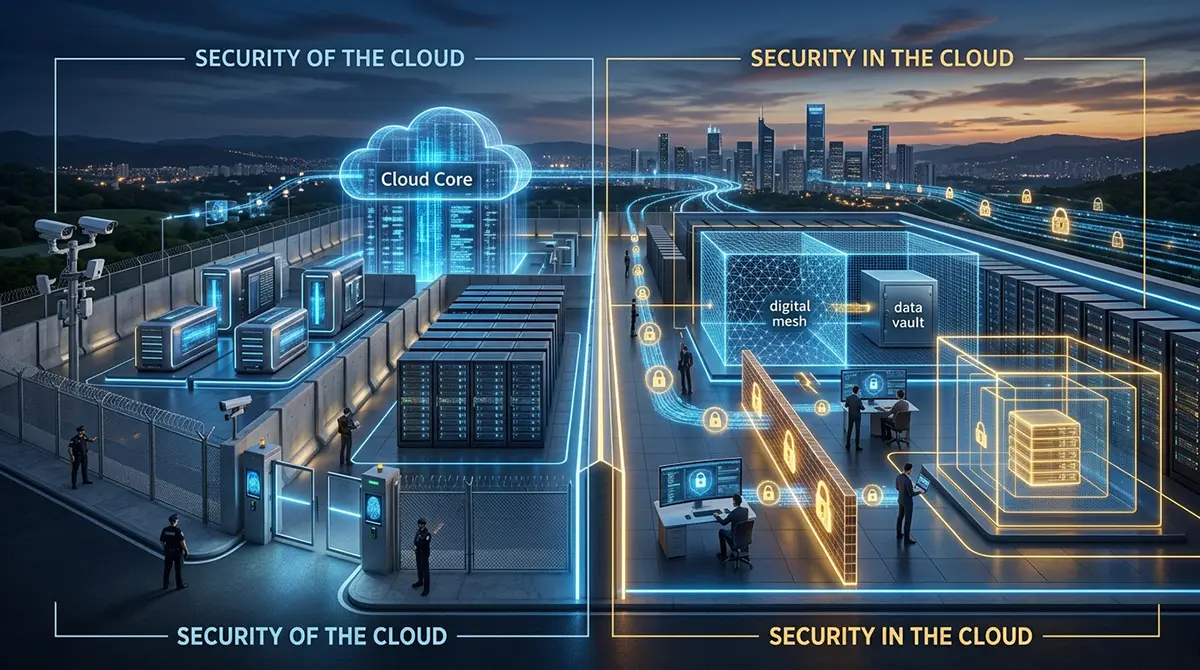
At its core, the division between security of the cloud and security in the cloud is a distinction between infrastructure governance and asset protection. The cloud service provider operates as the custodian of the underlying host platform, while the enterprise subscriber remains the absolute owner and guardian of its digital assets stored within that platform.
Security OF the Cloud: The Provider Imperative
Security of the cloud encompasses the operational, physical, and foundational security controls required to deliver a reliable, secure, and isolated cloud platform. The cloud provider assumes complete responsibility for protecting the global infrastructure that runs all of the services offered in the cloud. This global infrastructure includes the physical facilities housing the servers, the underlying host hardware, the hypervisors or virtualization software, the core storage systems, and the underlying physical network architecture.
When an enterprise utilizes a public cloud provider, it entrusts that provider with shielding the underlying facilities against physical intrusion, natural disasters, environmental hazards, and hardware-level tampering. Furthermore, the provider is responsible for ensuring the logical isolation of multi-tenant environments, verifying that one customer cannot access or alter the virtualized resources of another customer sharing the same underlying physical server. Security of the cloud ensures that the foundational building blocks of compute, storage, database, and networking remain uncompromised, resilient, and continuously available.
Security IN the Cloud: The Customer Mandate
Security in the cloud refers to the protective measures, configurations, and governance controls that the customer must implement and maintain to safeguard their own operational environment. While the cloud provider supplies a secure platform, the customer is entirely responsible for everything they place onto or connect to that platform.
Security in the cloud covers data protection, identity and access management, operating system updates on virtual instances, firewall configuration, application-level vulnerability management, client-side encryption, and network traffic filtering. If an enterprise launches a virtual machine in the cloud, the provider ensures the physical host and hypervisor are secure, but the customer is responsible for patching the guest operating system running on that virtual machine. If an enterprise leaves an object storage bucket publicly accessible, the resulting data exposure is not a failure of security of the cloud; it is a failure of security in the cloud.
The Shared Responsibility Matrix Across Cloud Service Models
The exact boundary separating customer duties from provider duties is not static. Instead, it shifts dynamically based on the cloud deployment model selected by the enterprise. The three primary cloud service abstractions, Infrastructure as a Service, Platform as a Service, and Software as a Service, each redistribute operational responsibilities across the technology stack.
Infrastructure as a Service (IaaS)
In an Infrastructure as a Service model, such as Amazon EC2, Google Compute Engine, or Microsoft Azure Virtual Machines, the cloud provider supplies the bare minimum infrastructure components: physical hardware, hypervisors, basic network routing, and physical data centers. In this architecture, the customer assumes maximum control over the environment, which simultaneously imposes the maximum burden of responsibility for security in the cloud.
Under IaaS, the customer is responsible for:
-
Installing, configuring, and updating guest operating systems.
-
Managing network security settings, including virtual private clouds, subnets, routing tables, and security group firewall rules.
-
Configuring identity and access controls for system access.
-
Implementing middleware, application runtimes, and database engines.
-
Encrypting data at rest and data in transit.
-
Setting up endpoint protection, file integrity monitoring, and intrusion detection systems on virtual hosts.
The provider remains solely responsible for the physical data center security, host hardware maintenance, hypervisor patching, and the physical network backbone.
Platform as a Service (PaaS)
Platform as a Service models, such as AWS Elastic Beanstalk, Google App Engine, or Azure App Service, abstract away the underlying operating systems, server hardware, and runtime environments. PaaS allows developers to deploy application code without managing the underlying virtual machines or infrastructure software stacks.
As a result, the boundary of security of the cloud shifts higher up the technology stack. The cloud provider takes responsibility for patching the host operating system, updating language runtimes, managing database engines, and maintaining server software resilience.
Under PaaS, the customer responsibility narrows down to:
-
Developing secure application source code and managing software dependencies.
-
Configuring application-level access controls and user authentication.
-
Classifying, managing, and encrypting customer data payloads.
-
Configuring platform API permissions and integration endpoints.
While PaaS dramatically reduces the operational overhead of server maintenance, security in the cloud remains critical. A flawed application vulnerability, such as SQL injection or broken access control, will still expose enterprise data regardless of how secure the underlying platform is.
Software as a Service (SaaS)
Software as a Service delivers complete, turnkey applications hosted and managed entirely by the vendor, such as Microsoft 365, Salesforce, Workday, or Google Workspace. In a SaaS model, the provider accepts nearly total responsibility for security of the cloud, managing everything from physical facilities and host hardware up to application code updates, database administration, and platform availability.
However, SaaS does not eliminate customer security obligations entirely. The customer still retains critical security in the cloud obligations:
-
Managing user access credentials, strong authentication mechanisms, and multi-factor authentication policies.
-
Defining data governance rules, access privileges, and role-based access control.
-
Monitoring user activity for insider threats, compromised accounts, or unauthorized data exfiltration.
-
Preventing unauthorized file sharing or data exposure to external unauthenticated users.
-
Ensuring compliance with regulatory requirements regarding data residency and storage.
Even in a fully managed SaaS solution, identity remains the ultimate security perimeter. If a user account is compromised through credential stuffing or phishing, the security of the SaaS platform itself cannot prevent an unauthorized actor from abusing legitimate access permissions.
Deep Dive: Critical Components of Security OF the Cloud
Understanding the exhaustive efforts cloud service providers undertake to guarantee security of the cloud highlights why public cloud platforms often surpass traditional on-premises security capabilities. Providers invest billions of dollars annually in physical, operational, and architectural defenses.
Physical Security and Data Center Resilience
Global cloud providers operate massive, non-descript data centers distributed worldwide. Physical protection at these facilities features multiple concentric layers of security. Physical perimeters are monitored continuously using high-definition surveillance cameras, intrusion detection sensors, vehicle barriers, and round-the-clock physical security guards.
Access inside the data center relies on strict multi-factor authentication, including biometric scans such as iris or fingerprint readers. Physical access is granted on a strict least-privilege basis to authorized hardware technicians only. Furthermore, structural resilience includes redundant power supplies, industrial uninterruptible power supply systems, backup diesel generators, advanced fire suppression systems, and climate control mechanisms designed to withstand extreme natural disasters.
Hardware and Hypervisor Isolation
The core technological pillar enabling public cloud computing is virtualization. Security of the cloud relies on robust hypervisor isolation to ensure multi-tenant security. The hypervisor manages virtual machine access to physical CPU, memory, and storage hardware, creating logical boundaries between tenant workloads.
Cloud providers spend immense engineering resources fortifying hypervisors against side-channel attacks, memory leaks, and virtual machine escape vulnerabilities. Modern cloud architectures often utilize custom hardware chips, such as specialized security microprocessors, to offload virtualization and networking functions from the main CPU. This hardware-level separation ensures that even if a guest virtual machine is fully compromised, the underlying host hardware and surrounding tenant instances remain isolated and protected.
Physical Network Infrastructure and Backbone Protection
Cloud vendors control massive global private network infrastructures, including undersea optical cables and dedicated fiber routes. Security of the cloud involves securing this physical network layer against eavesdropping, physical interception, and large-scale distributed denial of service attacks.
Providers employ automated traffic scrubbing centers and edge protection systems capable of absorbing massive volumetric DDoS attacks before malicious traffic can reach customer networks. Furthermore, traffic moving between provider facilities across global regions is automatically encrypted at the physical hardware layer, ensuring data privacy across transit links.
Hardware Lifecycle Management and Media Sanitization
When physical hard drives, solid-state drives, or server components reach the end of their operational lifespan or experience hardware degradation, cloud providers adhere to stringent media destruction protocols.
Decommissioned storage devices undergo rigorous multi-pass cryptographic wipes or physical destruction using industrial shredders, degaussers, or punch presses. These protocols adhere to strict government and international standards, such as NIST SP 800-88, ensuring that residual customer data can never be recovered from retired physical hardware.
“Don’t let cyber threats compromise your growth scale confidently with trusted website security maintenance dubai.”
Deep Dive: Core Requirements of Security IN the Cloud
While cloud providers protect the underlying foundations, enterprises bear full responsibility for securing their operational footprints. Neglecting security in the cloud is the single leading cause of cloud security incidents globally.
Identity and Access Management (IAM)
Identity is the foundational perimeter of cloud security. In a cloud environment, network perimeters become permeable and software-defined, making identity verification the primary mechanism for access control.
Security in the cloud requires enterprises to enforce strict Identity and Access Management policies:
-
Adopting the Principle of Least Privilege, granting users, applications, and cloud services only the minimal permissions necessary to execute their duties.
-
Enforcing multi-factor authentication across all user accounts, root credentials, and administrative roles without exception.
-
Replacing long-lived API keys and static access tokens with short-lived, temporary security credentials and IAM roles.
-
Performing routine access reviews and audits to eliminate orphaned accounts and unnecessary permission creep.
Data Protection and Cryptographic Controls
Data remains the ultimate value asset of any organization. Protecting data within cloud environments requires robust lifecycle encryption, rigorous data classification, and disciplined key management.
To achieve effective data protection in the cloud, enterprises must:
-
Encrypt all sensitive data at rest across object storage, block volumes, databases, and file systems using strong cryptographic algorithms such as AES-256.
-
Encrypt all data in transit using TLS 1.3 protocols for communication between clients, microservices, and external APIs.
-
Manage encryption keys securely using dedicated Key Management Services (KMS) or Hardware Security Modules (HSM), ensuring key access policies are strictly separated from data access policies.
-
Implement data loss prevention controls to monitor and prevent unauthorized exfiltration of sensitive information such as personally identifiable information, financial records, or intellectual property.
Network Configuration and Perimeter Defense
Although physical networking is managed by the provider, logical network topology and firewall configurations remain firmly in the customer domain. Misconfigured virtual firewalls and exposed network ports represent major security vulnerabilities.
Effective cloud network security requires:
-
Designing multi-tier Virtual Private Cloud topologies with strict separation between public-facing subnets, internal application subnets, and isolated database subnets.
-
Implementing security groups and network access control lists that follow zero-trust principles, explicitly denying all inbound and outbound traffic by default and allowing only necessary ports and IP ranges.
-
Deploying Web Application Firewalls to inspect HTTP and HTTPS traffic for application-layer attacks, such as cross-site scripting, SQL injection, and bot attacks.
-
Establishing secure connectivity between on-premises data centers and cloud environments through encrypted VPN tunnels or dedicated private network connections.
Workload Protection and Vulnerability Management
Cloud workloads, whether virtual machines, containerized applications, or serverless functions, require continuous monitoring and security maintenance.
Customers must implement robust workload protection mechanisms:
-
Automating operating system and application security patching to eliminate known vulnerabilities rapidly.
-
Scanning container images for embedded software vulnerabilities, hardcoded secrets, and outdated libraries prior to deployment in production environments.
-
Utilizing Endpoint Detection and Response tools customized for cloud environments to detect anomalous behavioral patterns, malicious process execution, or unauthorized privilege escalation.
-
Implementing immutable infrastructure practices, replacing modified server instances with fresh, pre-tested golden images rather than patching running systems directly.
Common Misconceptions and Costly Security Failures
Despite clear documentation from major cloud providers, structural misunderstandings regarding the Shared Responsibility Model remain widespread. These misconceptions often result in severe security breaches, regulatory non-compliance, and catastrophic financial losses.
The Passive Security Fallacy
One of the most dangerous misconceptions is the assumption that migrating workloads to a major cloud vendor automatically renders those workloads secure. Enterprise leaders often mistakenly believe that because the cloud provider possesses world-class security certifications, all applications hosted within that cloud automatically inherit those identical security guarantees.
This assumption overlooks the essential distinction between platform security and workload security. A cloud vendor can maintain the most secure data center infrastructure in the world, but if an enterprise deploys an application with default passwords, open storage buckets, and unpatched operating systems, that application will be compromised. The cloud provider secures the house, but the tenant is responsible for locking the front door and arming the internal alarm system.
The Storage Bucket Exposure Phenomenon
Perhaps the most frequent cloud security incident involves publicly exposed cloud storage repositories, such as Amazon S3 buckets or Azure Blob containers. In almost all high-profile incidents where enterprise databases or confidential customer records were leaked via open storage buckets, the incident was caused by customer misconfiguration rather than a flaw in the cloud platform.
Cloud providers design storage services with secure-by-default settings, typically restricting external access entirely. However, during development or operational troubleshooting, customer engineers sometimes alter access policies to permit public access, subsequently forgetting to restore secure configurations. This classic failure highlights how security in the cloud requires continuous configuration auditing and automated policy enforcement.
The Credential Sprawl Hazard
In cloud environments, infrastructure is provisioned and managed programmatically using code, scripts, and automation pipelines. Consequently, developers frequently utilize access keys, secret tokens, and API credentials to authenticate programmatic requests.
A major vector of security compromise occurs when developers accidentally embed hardcoded API keys or cloud administrative credentials directly into software source code repositories, which are then published to public code platforms. Attackers operate automated scripts that continuously scan public repositories for exposed cloud credentials. Once acquired, these credentials allow malicious actors to compromise the customer cloud environment within seconds, launching unauthorized cryptomining operations or exfiltrating sensitive corporate data.
Strategic Framework for Mastering Cloud Security
To navigate the intricacies of the Shared Responsibility Model successfully, modern enterprises must adopt a proactive, structured framework for cloud governance and security operations.
Implement a Zero Trust Architecture
Modern cloud security strategies must operate under the assumption of Zero Trust: never trust, always verify. Because cloud environments lack a traditional physical perimeter, location inside a network no longer implies trustworthiness.
Under a Zero Trust model:
-
Every access request, whether originating from inside or outside the network perimeter, must be explicitly authenticated, authorized, and encrypted before access is granted.
-
Micro-segmentation is implemented to isolate workloads, preventing lateral movement by malicious actors in the event of a breach.
-
Context-aware access policies continuously evaluate user identity, device health, location, and risk metrics before granting access to sensitive cloud applications.
Embrace Security as Code and DevSecOps
To keep pace with the rapid deployment velocity of modern cloud computing, security processes must be automated and embedded directly into the software development lifecycle. DevSecOps integrates security practices into every phase of development, from initial design to production deployment.
Key practices include:
-
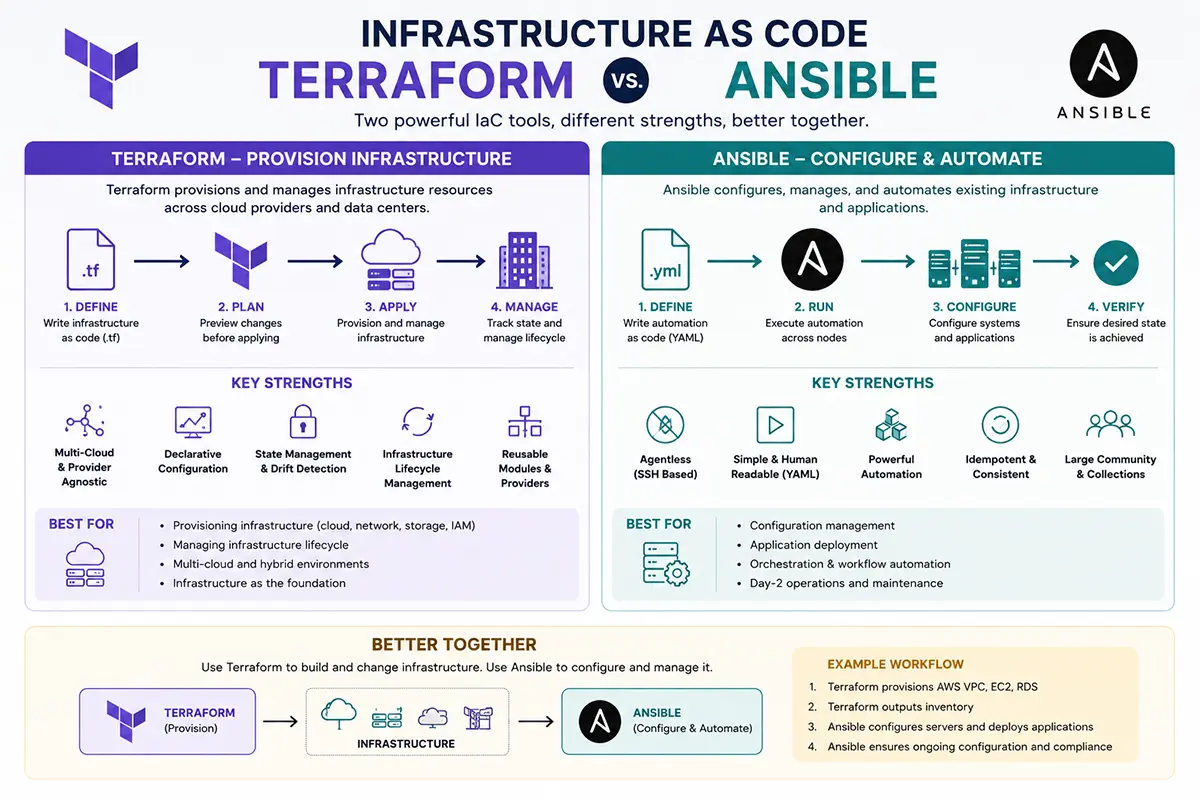
Infrastructure as Code Scanning: Using automated static analysis tools to audit Terraform, CloudFormation, or ARM templates for security misconfigurations before infrastructure is provisioned.
-
Automated CI/CD Pipelines: Embedding automated vulnerability scanners, secret detection tools, and compliance checks directly into deployment pipelines.
-
Policy as Code: Defining organizational compliance and security rules as software code, allowing automated systems to evaluate and block non-compliant deployments automatically.
Deploy Continuous Cloud Security Posture Management (CSPM)
Given the dynamic, self-service nature of cloud environments, resource configurations change continuously. Manual security audits and periodic penetration tests are no longer sufficient to maintain security in the cloud.
Enterprises must deploy Cloud Security Posture Management tools that continuously monitor multi-cloud environments for security risks:
-
Real-Time Misconfiguration Detection: CSPM platforms continuously scan cloud resources against security baselines, instantly identifying exposed storage buckets, overly permissive IAM roles, or unencrypted databases.
-
Automated Remediation: When a security violation is detected, automated guardrails can instantly revert unauthorized configuration changes or isolate non-compliant resources without human intervention.
-
Compliance Auditing: CSPM tools evaluate cloud configurations against industry standards and compliance frameworks, such as CIS Benchmarks, NIST, ISO 27001, HIPAA, and PCI-DSS, providing real-time compliance dashboards.
Conclusion: Achieving Synergy in Shared Responsibility
The debate between security in the cloud and security of the cloud is ultimately not a contest of competing priorities, but rather a blueprint for collaboration between service providers and enterprise subscribers.
Cloud service providers deliver unprecedented baseline platform security, physical data center protection, hardware resilience, and architectural scale. By relieving enterprises of the massive operational burden required to manage physical infrastructure, cloud providers enable organizations to focus their technical resources on core business innovation.
However, absolute security in the cloud remains the sole, non-negotiable responsibility of the enterprise. Organizations must accept that migrating to the cloud does not outsource ultimate accountability for data governance, access management, application security, or regulatory compliance. By gaining absolute clarity on the Shared Responsibility Model, adopting Zero Trust principles, integrating automated DevSecOps workflows, and maintaining continuous operational vigilance, enterprises can confidently harness the full power of the cloud while building an unassailable security posture.