
For decades, provisioning IT infrastructure was an exercise in manual precision, tribal knowledge, and administrative fatigue. System administrators would meticulously rack servers, configure networking gear, install operating systems, and manually tweak configuration files. This hardware-centric approach meant that environments were brittle, non-reproducible, and notoriously difficult to scale. When a server failed, recovery relied on backups and frantic manual intervention, introducing high risks of human error and prolonged downtime.
The advent of cloud computing fundamentally disrupted this paradigm. Suddenly, compute, storage, and networking were no longer physical constraints tied to a datacenter floor; they were APIs. Organizations could spin up thousands of servers with a single API call. However, this velocity introduced a new bottleneck. Managing cloud resources through web consoles or ad-hoc scripts created untrackable state drift, undocumented architectures, and the dreaded “it works on my staging environment” syndrome.
Enter Infrastructure as Code (IaC). By treating infrastructure definitions as code writing human-readable configuration files stored in version control systems like Git engineering teams achieved unprecedented repeatability, transparency, and auditability. IaC transformed infrastructure from a static, physical burden into a dynamic, version-controlled software artifact. Environments could now be torn down and rebuilt from scratch in minutes, ensuring consistency across development, staging, and production tiers.
Yet, as the IaC ecosystem matured, two prominent tools emerged as the titans of automation, each championing a distinct philosophy and operational model: HashiCorp Terraform and Red Hat Ansible. While both tools aim to automate infrastructure, their core design principles, execution models, and target use cases diverge significantly. Choosing between Terraform and Ansible is not merely a matter of syntax preference; it is a strategic architectural decision that impacts how organizations provision cloud resources, configure operating systems, manage state, and scale their engineering operations.
Declarative Precision versus Procedural Flexibility: The Core Philosophical Divide
To understand the fundamental tension between Terraform and Ansible, one must examine their underlying execution paradigms. These paradigms dictate how the tools interpret instructions, interact with target environments, and handle state over time.
The Declarative Philosophy of Terraform
Terraform is built upon a strictly declarative paradigm. When writing Terraform configurations using HashiCorp Configuration Language (HCL), engineers do not write procedural scripts detailing step-by-step commands to achieve a goal. Instead, they declare the desired end state of the infrastructure. For example, an engineer defines that they want a Virtual Private Cloud (VPC) with three subnets, an internet gateway, and a specific security group rule. Terraform’s engine analyzes this declaration, compares it against the current reality, and independently calculates the exact sequence of API calls required to bridge the gap.
This declarative approach abstracts away the complexities of execution order and dependency management. Terraform automatically constructs a Directed Acyclic Graph (DAG) of all resources defined in the configuration, determining which resources can be provisioned in parallel and which must wait for dependencies to resolve. If an engineer modifies a configuration—say, changing an instance type from `t3.medium` to `t3.large`—Terraform evaluates whether that change can be applied in-place or if it requires destroying and recreating the resource, alerting the operator via a detailed execution plan before any changes are made.
The Procedural and Idempotent Nature of Ansible
Ansible, conversely, originates from the configuration management and automation tradition. While modern Ansible modules strive for idempotency—meaning running the same playbook multiple times yields the same result without unintended side effects—Ansible fundamentally operates on a procedural or imperative model. Ansible playbooks are written in YAML and consist of ordered lists of tasks. Each task executes a specific module against target hosts, executing commands in the exact sequence specified by the author.
Ansible’s procedural flow gives engineers granular control over execution steps. If an author needs to install a package, configure a system service, and restart a daemon in a precise, sequential order, Ansible executes those steps linearly. However, managing complex dependencies across large distributed environments requires careful playbook authoring. While Ansible can orchestrate cloud provisioning through cloud modules (such as `amazon.aws`), its native design excels at configuring the operating system layer, managing software packages, deploying application code, and tweaking system-level configurations once the underlying infrastructure has been initialized.
Architectural Blueprints: How Terraform and Ansible Operate Under the Hood
The architectural differences between Terraform and Ansible extend far beyond their syntax and declarative versus procedural mindsets. Their execution architectures, state handling mechanisms, and connectivity models shape how they integrate into enterprise CI/CD pipelines and operational workflows.
State Management and the Terraform State File
One of Terraform’s defining architectural characteristics is its reliance on a state file (`terraform.tfstate`). Terraform uses this JSON-formatted file to map real-world resources to configuration declarations, track metadata, and cache dependency graphs. Because cloud APIs do not always provide fast or comprehensive query mechanisms for every attribute of every resource, the state file acts as Terraform’s source of truth regarding what currently exists.
This state mechanism introduces specific operational requirements:
- Remote Backends: In team environments, local state files quickly lead to race conditions, conflicting applies, and state corruption. Organizations must configure remote backends such as Amazon S3 with DynamoDB locking, Terraform Cloud, or HashiCorp Consul to securely store state and manage concurrent access locks.
- State Sensitivity: State files often contain sensitive information, including database passwords, private keys, and API tokens, necessitating strict encryption at rest and in transit.
- State Drift: If an engineer manually modifies a resource outside of Terraform via the cloud console, the state file and the real-world infrastructure diverge, requiring remediation via `terraform refresh` or state importing.
Agentless Execution and the Ansible Control Node Architecture
Ansible takes a completely different architectural route by being entirely agentless. Unlike traditional configuration management tools that require daemon agents running on every managed node, Ansible communicates with target hosts via standard remote management protocols—primarily SSH for Linux/Unix and WinRM for Windows.
The Ansible architecture relies on a control node where playbooks, inventories, and modules reside. When an Ansible playbook is executed, the control node serializes the required modules, transfers them over the connection protocol to the remote host, executes them in a temporary directory, and cleans up the artifacts, returning the output to the control node.
This agentless design offers profound operational advantages:
- Zero Footprint: There are no background daemons consuming memory on target nodes, no agent software versions to upgrade, and no persistent communication channels left open to potential vulnerabilities.
- Simplified Bootstrap: Any machine that is reachable over SSH or WinRM and has Python installed can immediately become an Ansible managed node.
- Security Isolation: Management traffic is encrypted using standard SSH security mechanisms, leveraging existing enterprise key infrastructures, bastion hosts, and jump boxes without requiring complex PKI setups for agent certificates.
Domain Specialization: Provisioning versus Configuration Management
A common pitfall in modern infrastructure engineering is attempting to force a single tool to handle every aspect of the technology stack. While both Terraform and Ansible are versatile, understanding their domain specializations prevents architectural anti-patterns.
Terraform as the Provisioning Titan
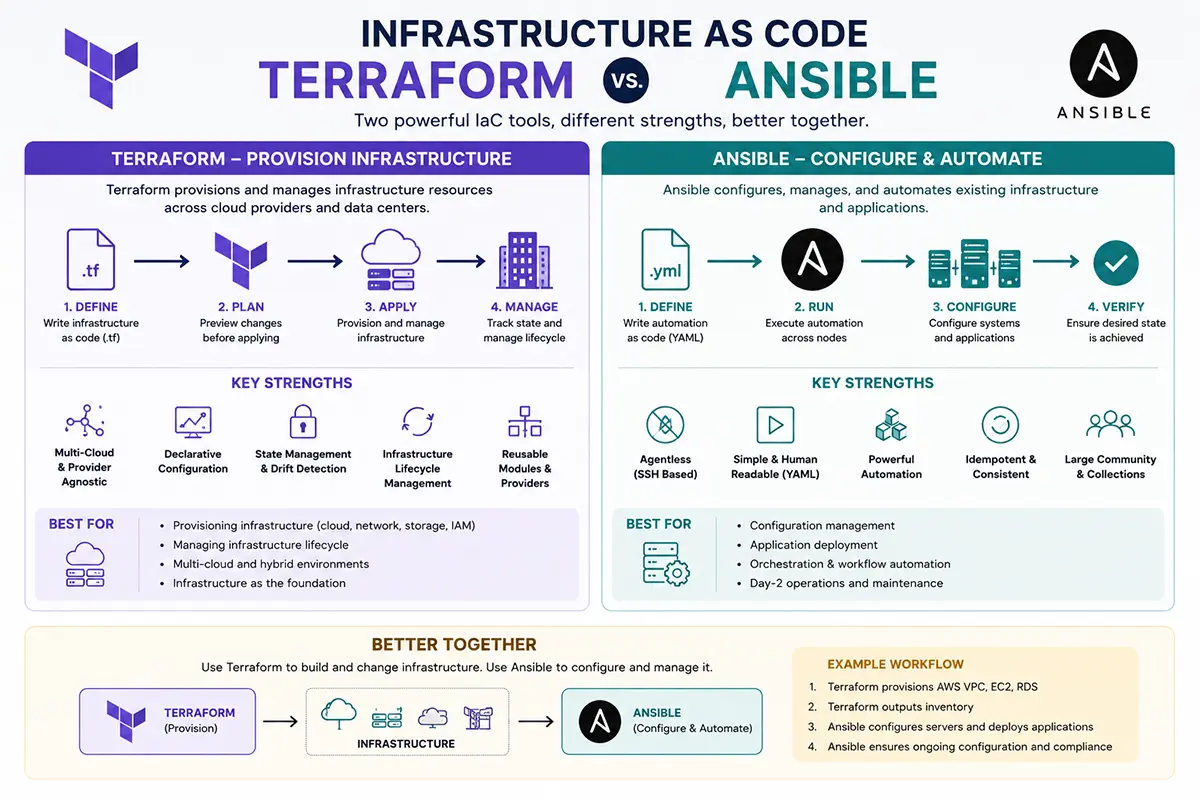
Terraform was explicitly designed for lifecycle management of infrastructure primitives across hundreds of cloud providers, SaaS platforms, and internal systems through its vast ecosystem of providers (AWS, Azure, Google Cloud, Kubernetes, GitHub, Cloudflare, etc.). Terraform excels at creating and managing the skeleton of your digital estate:
- Virtual networks, subnets, routing tables, and firewalls.
- Compute instances, auto-scaling groups, and container clusters.
- Managed databases, storage buckets, and caching layers.
- Identity and Access Management (IAM) policies, roles, and service accounts.
Terraform tracks the lifecycle of these resources from creation (`terraform apply`) to modification and eventual teardown (`terraform destroy`). Its ability to model complex dependencies across heterogeneous cloud services makes it the undisputed king of multi-cloud and hybrid-cloud provisioning.
Ansible as the Configuration and Orchestration Maestro
While Terraform sets up the empty virtual machine or container, Ansible steps in to bring it to life. Ansible’s domain encompasses configuration management, application deployment, and continuous orchestration:
- Installing and configuring system packages, security patches, and runtime environments (Node.js, Python, Java).
- Managing configuration files using Jinja2 templates, ensuring dynamic variables populate correctly based on environment tiers.
- Managing operating system users, groups, SSH keys, and system limits.
- Orchestrating rolling updates, zero-downtime deployments, and complex multi-tier application deployments across fleets of servers.
Furthermore, companies scaling their digital presence globally often engage specialized technology partners, such as firms offering DevOps Services in Dubai, to architect resilient pipelines that combine Terraform for cloud infrastructure provisioning and Ansible for application configuration and server hardening.
The Intersection and Synergy: Why Not Both?
A frequent debate in engineering forums frames Terraform versus Ansible as a mutually exclusive choice. In practice, mature enterprise architectures rarely choose one to the exclusion of the other. Instead, they leverage Terraform and Ansible in a collaborative, complementary pipeline where each tool performs the task it was uniquely engineered to execute.
The Provision-Then-Configure Pipeline
In a standard production workflow, the two tools operate in sequential harmony:
1. Phase One (Terraform): The CI/CD pipeline triggers a Terraform run. Terraform provisions the networking topology, spins up EC2 instances or virtual machines, configures persistent storage volumes, and establishes load balancers.
2. Phase Two (Dynamic Inventory): Once Terraform successfully provisions the infrastructure and outputs the IP addresses or hostnames of the new instances, it passes this metadata to Ansible via dynamic inventory plugins or CI/CD environment variables.
3. Phase Three (Ansible): Ansible takes over the newly created nodes, establishing SSH connections, installing required security monitoring agents, configuring web servers, pulling application binaries, and starting system services.
This division of labor leverages Terraform’s robust state management for static infrastructure while utilizing Ansible’s procedural flexibility and agentless reach for dynamic software configurations.
Overlapping Capabilities and Where Boundaries Blur
It is worth noting that the boundary between provisioning and configuration has blurred over time. Terraform features provisioners (`local-exec` and `remote-exec`) that can run scripts or trigger Ansible playbooks directly during resource creation. Similarly, Ansible possesses robust cloud collection modules (`amazon.aws`, `azure.azcollection`, `google.cloud`) capable of provisioning entire cloud environments from scratch.
However, using Terraform for deep configuration management (like managing individual users on fifty servers) results in brittle HCL configurations and slow execution times. Conversely, using Ansible for cloud infrastructure provisioning often struggles with state management, lacking Terraform’s precise dependency graphing, resource import capabilities, and robust dry-run planning phases. Engineers should choose the primary tool based on the dominant problem domain of the task at hand.
Deep Comparative Analysis: Key Operational Dimensions
To provide a rigorous evaluation, let us examine how Terraform and Ansible compare across critical operational dimensions that matter to enterprise engineering teams.
Syntax, Readability, and Learning Curve
- Terraform (HCL): HCL is declarative, structured, and json-compatible. It is easy to read for basic resource definitions, but complex modules leveraging dynamic blocks, conditional expressions, and intricate loops (`for`, `for_each`) can introduce a steep learning curve for developers unfamiliar with functional programming concepts.
- Ansible (YAML): YAML is notoriously human-readable and straightforward. Ansible playbooks read like procedural task lists, making them accessible to junior system administrators and developers who can pick up basic syntax within hours. However, large YAML codebases can become difficult to maintain without strict folder structures, role modularity, and linting standards.
Idempotency and Error Handling
- Terraform: Idempotency is baked into the core engine. Terraform continuously reconciles state. If an error occurs midway through an apply, Terraform stops, marks the state as tainted or locked, and requires the operator to resolve the underlying issue before proceeding.
- Ansible: Idempotency depends heavily on the quality of individual modules. While core modules are meticulously written to be idempotent, custom shell or command tasks written by users often break idempotency. Ansible allows flexible error handling strategies, such as ignoring errors on specific tasks (`ignore_errors: yes`) or defining rescue blocks for exception management.
Modularity and Ecosystem Reusability
- Terraform: The Terraform Registry offers thousands of pre-built, verified modules for standard cloud architectures. Engineers can encapsulate complex architectures into reusable modules, publishing them to private or public registries with version pinning.
- Ansible: Ansible Galaxy serves as a repository for community-contributed roles and collections. Engineers can bundle tasks, handlers, templates, and variables into structured roles that can be shared across teams and projects, enforcing organizational standards.
Dry-Run Capabilities and Safety Checks
- Terraform: Terraform’s execution plan (`terraform plan`) is one of its most powerful safety features. It provides an explicit preview of what will be added, modified, or destroyed before any API call hits the production cloud provider, minimizing accidental disruptions.
- Ansible: Ansible offers a check mode (`–check` flag), which simulates playbook execution and reports what changes would have been made. While effective for many modules, some custom scripts or complex template tasks cannot accurately predict their changes in check mode, requiring careful validation.
Enterprise Governance, Security, and Compliance as Code
As organizations scale their cloud footprints, infrastructure automation tools become the gatekeepers of enterprise security and compliance. Both Terraform and Ansible offer robust mechanisms to enforce governance policies before code reaches production.
Policy as Code with Terraform
Terraform integrates seamlessly with Policy-as-Code frameworks like HashiCorp Sentinel and Open Policy Agent (OPA). These frameworks allow security and compliance teams to write automated guardrails that inspect Terraform execution plans before they are applied. For example, an organization can enforce policies stating that:
- No S3 bucket can be created without server-side encryption enabled.
- Security groups must never expose SSH ports (port 22) to the public internet (`0.0.0.0/0`).
- All compute instances must include mandatory cost-allocation tags (e.g., `Environment`, `Owner`, `CostCenter`).
If a proposed Terraform plan violates these rules, the pipeline fails automatically, preventing non-compliant infrastructure from ever being provisioned.
Security Hardening and Compliance with Ansible
Ansible excels at enforcing security compliance at the operating system level. Security teams utilize Ansible to execute continuous auditing, vulnerability patching, and configuration hardening across active server fleets. Frameworks like Red Hat Insights and automated Security Content Automation Protocol (SCAP) validation can be deployed via Ansible playbooks.
Organizations routinely use Ansible roles to implement Center for Internet Security (CIS) benchmarks across Linux and Windows servers. By running these playbooks periodically via automated cron jobs or CI/CD schedules, security teams ensure that servers do not drift from their hardened baseline over time.
Performance, Scalability, and Distributed Execution
When managing thousands of resources or tens of thousands of servers, performance and scalability become paramount operational concerns.
Terraform Scaling and Concurrency
Terraform executes graph-based processing, evaluating resource dependencies and running parallel threads to communicate with cloud APIs concurrently. For large monolithic Terraform states, however, plan and apply times can grow significantly, leading to state locking contention. To mitigate this, enterprise architectures advocate for state sharding—breaking down monolithic infrastructure code into smaller, decoupled workspaces or component layers (e.g., networking state, database state, application cluster state) managed independently.
Ansible Scaling and Execution Speed
Ansible scales horizontally through its control node architecture. For massive environments managing tens of thousands of servers, standard sequential SSH execution becomes too slow. Ansible solves this through several mechanisms:
- Forks: Increasing the `forks` parameter in `ansible.cfg` allows Ansible to manage multiple hosts simultaneously in parallel threads (default is 5, but can be scaled up significantly based on control node resources).
- Ansible AWX / Automation Controller: For enterprise-grade scaling, organizations deploy Red Hat Ansible Automation Controller (upstream AWX), providing a centralized web UI, role-based access control (RBAC), API scheduling, credential management, and clustered job execution across distributed worker nodes.
Making the Strategic Choice for Your Engineering Organization
Selecting between Terraform and Ansible—or deciding how to combine them—requires a thorough assessment of your organization’s technical landscape, team competencies, and operational objectives.
When to Lead with Terraform
Your organization should prioritize Terraform if:
- Your primary infrastructure footprint resides in public clouds (AWS, Azure, GCP) or multi-cloud environments where declarative API provisioning is essential.
- You require strict state tracking, execution dry-runs (`terraform plan`), and dependency graphing to manage complex resource relationships.
- You want to implement robust Policy-as-Code governance before infrastructure changes are applied.
- Your engineering culture embraces declarative software design patterns.
When to Lead with Ansible
Your organization should prioritize Ansible if:
- Your primary challenge is configuring operating systems, managing software packages, hardening servers, and deploying applications across existing servers.
- You operate legacy bare-metal infrastructure, hybrid datacenters, or virtual machine environments where agentless SSH/WinRM connectivity is preferred.
- Your team prefers procedural YAML task lists and simple, step-by-step automation scripts.
- You need an orchestration engine to coordinate rolling updates, software upgrades, and operational runbooks across distributed fleets.
Conclusion: Harmonizing Automation for Modern Infrastructure Excellence
The debate between Terraform and Ansible is not a contest with a single victor, but rather a reflection of the diverse dimensions of modern infrastructure engineering. Terraform dominates the realm of cloud provisioning through its declarative state management and dependency graph intelligence. Ansible reigns supreme in configuration management and application orchestration through its agentless architecture and procedural flexibility.
Rather than viewing these tools as adversaries, forward-thinking engineering teams embrace their synergy. By pairing Terraform’s precision in provisioning cloud foundations with Ansible’s mastery in configuring operating systems and deploying applications, organizations construct robust, resilient, and highly scalable automation pipelines. In an era where agility and reliability dictate market leadership, mastering both Terraform and Ansible empowers engineering organizations to build, scale, and govern their digital futures with absolute confidence.