
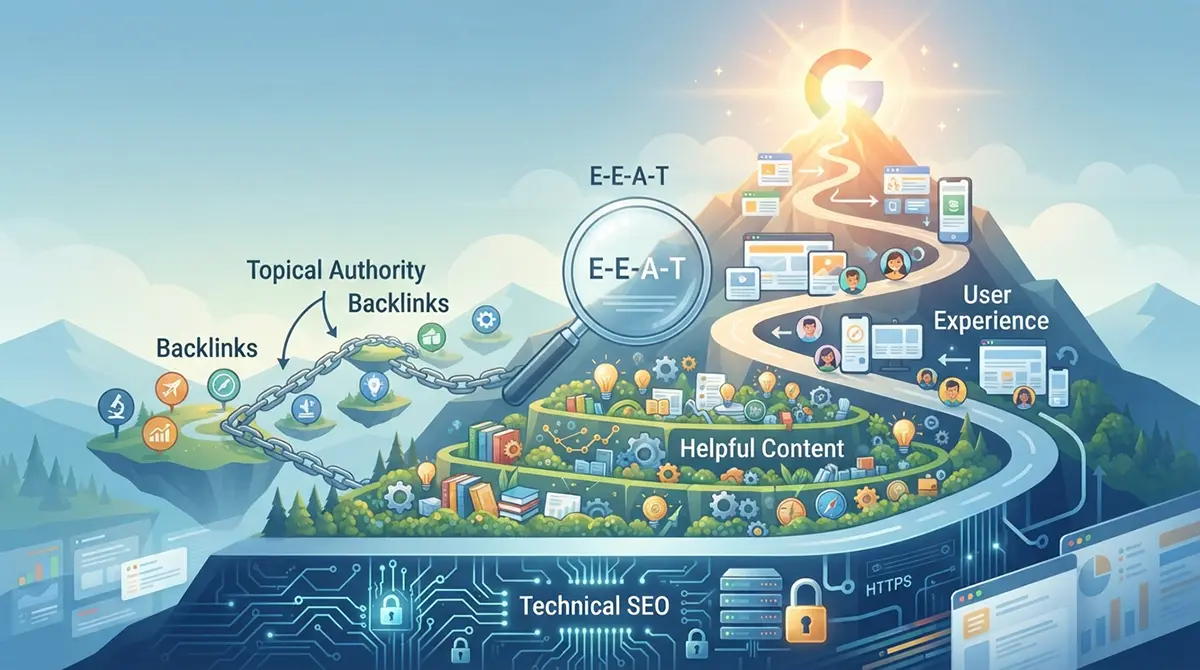



Understanding what drives visibility on search engine result pages requires looking past outdated shortcuts and keyword-stuffing tactics. Google has transformed its underlying technology from a simple string-matching utility into an intelligent evaluation ecosystem. Modern search algorithms evaluate a web page through multiple layers of automated scrutiny, measuring everything from micro-interactions to deep contextual authority.
Digital properties aiming for long-term organic growth must shift away from trying to trick an algorithm and instead focus on satisfying the complex needs of human users. Google rewards websites that consistently demonstrate absolute trustworthiness, unmatched topical depth, technical precision, and flawless user experiences. Recognizing the exact mechanisms that influence these algorithms allows content creators and site owners to build resilient strategies that weather frequent core updates.
The Evolution of Content Quality and Helpful Information Systems
At the heart of modern search engine optimization lies the absolute dominance of genuinely helpful content. Google’s dedicated systems are explicitly engineered to reward material created to inform, assist, or delight people, while filtering out pages built solely to manipulate search rankings.
Creating high-performing content requires moving beyond surface-level summaries. Comprehensive material naturally covers sub-topics, addresses common user follow-up questions, and integrates unique insights that cannot be found on every competing site. Content effort, original research, proprietary data points, and clear explanations play vital roles in signalling true document quality to automated crawlers. When an article or landing page completely satisfies a user query without forcing them to bounce back to the search results page, Google notes that positive interaction as a powerful indicator of superiority.
Furthermore, content freshness remains a dynamic multiplier. For time-sensitive queries, news, or rapidly changing industries, the recency of information dictates visibility. Even evergreen topics benefit significantly from periodic reviews, expanding details, updated statistics, and structural refinements that reflect current industry standards.
Mastering Experience, Expertise, Authoritativeness, and Trustworthiness
The evaluation framework known as E-E-A-T serves as a foundational pillar for how Google assesses the credibility of both the content creator and the website itself. While not a direct algorithmic code snippet on its own, E-E-A-T is reflected through numerous proxy signals that automated systems measure continuously.
Demonstrating first-hand experience means showing that the author has actually tested a product, visited a location, or practiced the service they are writing about. Original images, personal case studies, and transparent accounts of real-world trials carry immense weight. Expertise and authoritativeness are reinforced by detailed author bios, verifiable professional credentials, external citations, and a consistent track record of publishing accurate information within a specific niche.
Trustworthiness anchors the entire concept. Websites handling sensitive topics often referred to as Your Money or Your Life topics face exceptionally strict evaluation standards regarding factual accuracy, data safety, clear contact channels, and transparent editorial policies. Building this deep layer of trust requires removing anonymous authorship and taking accountability for the information published online.
Topical Authority and Site Focus Architecture
Modern search algorithms do not merely look at individual pages in a vacuum; they evaluate the overarching thematic footprint of an entire domain. Establishing deep topical authority requires a website to focus its efforts around a core subject area rather than publishing fragmented, unrelated articles on random topics.
Search engines measure how concentrated a site is on a specific subject and track how far individual pages stray from that central theme. When a domain builds an extensive cluster of interconnected articles covering every conceivable sub-topic within an industry, Google begins to view that website as a trusted subject-matter expert. Internal linking structures act as the architectural roadmap for this authority, passing link equity and contextual relevance from broad category pillars down to specific long-tail landing pages. Diluting a domain with low-quality, out-of-focus content harms the overall site score, making it harder for core pages to rank competitively.
The Continuing Power of Strategic Backlinks and Link Quality
Despite years of algorithmic evolution, backlinks remain one of the most reliable external signals of trust and authority. However, the SEO industry has evolved past the era of mass directory submissions and comment spam. Today, the quality, contextual relevance, and editorial integrity of a backlink dictate its actual impact.
A single link from a globally recognized industry publication, a respected educational institution, or a highly relevant peer site carries more weight than hundreds of low-value links from unrelated blogs. Natural link acquisition is typically the byproduct of publishing exceptional resources, original industry data, interactive tools, or deeply insightful commentary that other writers naturally want to reference. Furthermore, the anchor text surrounding a link helps search engines understand what the target page is about, providing valuable contextual clues that reinforce topical relevance.
Ready to dominate search rankings? Visit our SEO Dubai page and let’s grow your business together.
Technical Excellence and Core Web Vitals Performance
Even the most well-written and authoritatively backed content will struggle to reach top positions if technical barriers prevent search engine crawlers from indexing the site efficiently. Technical SEO creates the healthy foundation upon which all other optimization efforts rest.
Site architecture must allow automated bots to discover, crawl, and render pages without running into endless redirect loops, broken internal links, or restrictive robots.txt directives. Secure HTTPS implementation is mandatory for protecting user data and satisfying basic security expectations.
Beyond crawling efficiency, user experience metrics known as Core Web Vitals quantify how smoothly a page performs in real-world browsing environments. These metrics measure loading performance through Largest Contentful Paint, visual stability through Cumulative Layout Shift, and responsiveness through Interaction to Next Paint. While these performance indicators act primarily as quality tiebreakers among otherwise comparable pages, sluggish load times and layout shifts directly contribute to high bounce rates and lower user satisfaction scores.
Mobile Usability and Design Responsiveness
With the vast majority of global web traffic originating from mobile devices, mobile-first indexing is the standard operating procedure for search engine evaluation. Google predominantly looks at the mobile version of a website when determining how to rank pages across all devices.
A responsive design must adapt fluidly to various screen sizes, ensuring that text remains readable without requiring awkward zooming, tap targets are appropriately spaced to prevent accidental clicks, and layout elements do not break on smaller displays. Intrusive pop-ups, disruptive full-screen interstitials, and heavy elements that obscure above-the-fold content negatively impact mobile usability scores. Ensuring a seamless, frustration-free experience for smartphone users is no longer optional for brands seeking competitive search visibility.
User Engagement and Post-Click Satisfaction Signals
Search engines continuously monitor how users interact with search engine result pages and subsequent landing pages. When a user clicks a result, stays on the page for a substantial duration, scrolls through the content, and finds what they need without needing to return to Google to try a different query, it sends a powerful positive signal to the ranking systems.
Conversely, quick returns to the search results page following an immediate click can indicate that a page failed to satisfy user intent or featured misleading title tags. Crafting compelling, accurate title tags that align directly with user intent helps set correct expectations, while structuring content with clear headings, engaging media, and scannable paragraphs keeps visitors engaged longer.
Structured Data and AI-Era Search Integration
As search engine results pages evolve to incorporate direct answers, zero-click features, and AI-driven summaries, structuring data effectively has become a critical competitive differentiator. Implementing clean schema markup such as Article, FAQ, Product, and HowTo schema helps search algorithms understand the exact context and entities present within a web page.
Content optimized for modern search visibility often incorporates concise, direct answers designed for featured snippets, supported by deep explanatory sections that satisfy broader informational needs. As artificial intelligence reshapes how information is retrieved and displayed, clarity, contextual depth, and structured markup ensure that a website’s information can be easily parsed, cited, and recommended by intelligent search assistants.
Building a Holistic Strategy for Long-Term Organic Growth
Sustained success in search engine optimization requires moving away from isolated tactics and adopting a holistic, user-centric mindset. No single ranking factor operates in absolute isolation. Document quality, topical depth, technical stability, E-E-A-T credentials, and user experience work together to form a comprehensive digital footprint.
Website owners and content creators should audit their properties regularly to identify technical bottlenecks, expand thin content clusters into comprehensive topic hubs, elevate author transparency, and ensure lightning-fast mobile performance. By aligning optimization efforts with what Google’s advanced systems actually measure genuine value, trustworthiness, and exceptional utility brands can build resilient online visibility that stands the test of time.