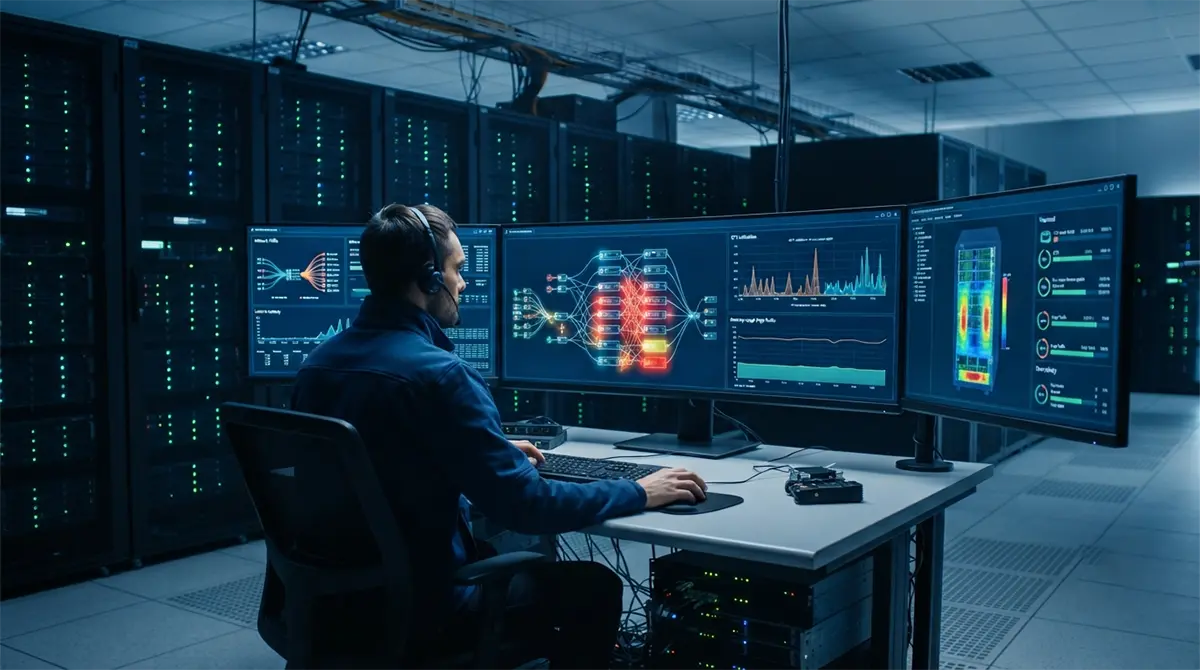
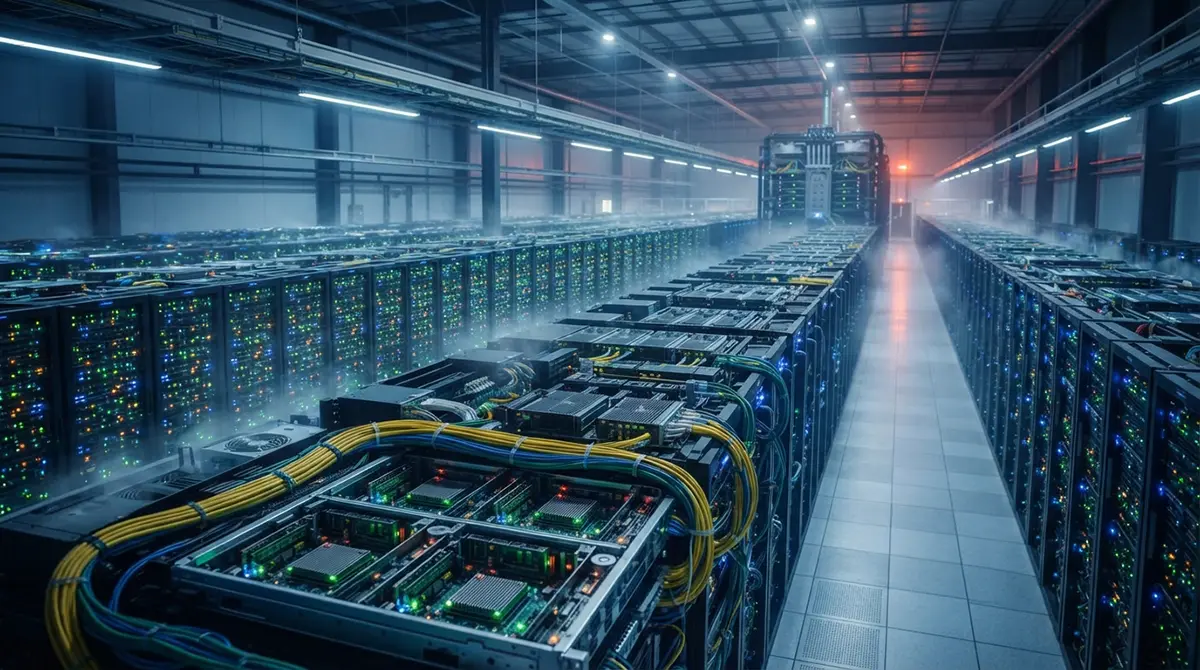



In the contemporary lexicon of technology, few terms are tossed around with as much frequency, reverence, and economic weight as compute. When tech executives announce multi-billion dollar data center expansions, when researchers publish breakthroughs in artificial intelligence reasoning, or when everyday users experience the lightning-fast generation of text and imagery, compute is the underlying protagonist. Yet, for all its prominence, compute remains an abstract concept to many. It is often visualized vaguely as massive warehouses filled with blinking lights, humming cooling towers, and miles of fiber optic cables.
To truly understand generative artificial intelligence, one must look past the conversational charm of large language models and examine the physical and mathematical reality that sustains them. Compute is not merely a buzzword; it is the fundamental currency of the digital age. It represents the raw computational horsepower required to transform meaningless strings of binary data into complex representations of human thought, creativity, and reasoning. Without compute, artificial intelligence is merely a collection of static mathematical equations frozen on a hard drive. With compute, those equations awaken into dynamic systems capable of writing code, composing symphonies, and diagnosing medical conditions.
Exploring the nature of compute requires peeling back layers of hardware engineering, software architecture, electrical physics, and global economics. It is a journey that reveals how microscopic shifts in silicon design dictate the boundaries of human imagination and technological progress.
The Silicon Engine: Understanding the Hardware Foundation
At its core, compute is the execution of arithmetic and logical operations by physical hardware. To grasp why generative artificial intelligence demands such staggering amounts of compute, one must first understand the evolution of the silicon chips that perform these calculations. For decades, traditional computing relied primarily on the Central Processing Unit. The CPU is often described as the brain of a standard computer, designed for sequential processing. A CPU typically features a small number of powerful cores optimized to handle complex instructions one after another, making it exceptionally well-suited for running operating systems, managing file systems, and executing standard application logic.
Generative artificial intelligence, however, does not operate on sequential logic alone. Instead, it relies on massive volumes of parallel matrix multiplication. Neural networks are composed of billions of interconnected artificial neurons, where data flows through layers of weights and biases. Calculating the outputs of these networks requires multiplying gigantic matrices of numbers simultaneously. This is where Graphics Processing Units and Tensor Processing Units enter the picture. Originally designed to render three-dimensional video game graphics by calculating pixels concurrently, GPUs discovered a second life as the supreme engines of machine learning.
A modern artificial intelligence accelerator contains tens of thousands of specialized processing cores designed to execute thousands of calculations in parallel. Instead of waiting for one instruction to finish before starting the next, a GPU shreds data into tiny fragments and processes them all at once. This architectural shift transformed computer science. Furthermore, specialized hardware such as Tensor Processing Units incorporate dedicated matrix multiplication units built directly into the silicon, cutting down the time required to train deep learning models from months to mere days.
-
Parallel Processing: The ability to execute thousands of mathematical operations simultaneously rather than sequentially.
-
Matrix Multiplication: The primary mathematical operation driving neural networks, involving the multiplication of large grids of numbers.
-
Hardware Acceleration: The use of specialized microchips designed to perform specific computational tasks much faster than general-purpose CPUs.
-
Memory Bandwidth: The speed at which data can be transferred between processor cores and high-speed memory modules, often acting as a major performance bottleneck.
Training Versus Inference: The Dual Engines of Compute Consumption
The compute consumed by generative artificial intelligence is broadly divided into two distinct phases: training and inference. Each phase serves a radically different purpose, utilizes different computational workflows, and places unique demands on hardware infrastructure. Understanding this duality is essential for appreciating why artificial intelligence requires such immense power resources on a global scale.
Training is the foundational phase where a model learns from vast repositories of data. During training, the system ingests terabytes of text, images, and code, adjusting its internal parameters through a process known as backpropagation. Every time the model makes a prediction, its error is calculated, and its billions of weights are tweaked slightly to improve future accuracy. This process is intensely compute-heavy and iterative. It requires massive clusters of specialized accelerators linked together by ultra-high-speed networks, running continuously for weeks or months. The sheer volume of mathematical iterations required to align a frontier foundation model makes training an extraordinarily expensive enterprise.
Inference, on the other hand, is the operational phase. It occurs when a deployed model receives a prompt from a user and generates a response. While inference requires significantly less compute per interaction than training, the scale at which it occurs makes it a massive global computational load. When millions of users concurrently query a generative artificial intelligence service, data centers must perform trillions of matrix multiplications in fractions of a second to stream text or generate images in real time.
As models grow larger and user adoption surges, the cumulative compute consumed by daily inference begins to rival or even exceed the compute consumed during initial training cycles. This reality has forced hardware engineers to design chips specifically optimized for low-latency, energy-efficient inference at scale.
Looking for Enterprise-Grade DevOps Services in Dubai?
Scaling your infrastructure, automating deployments, and ensuring 99.9% uptime shouldn’t be a bottleneck for your business. Whether you need robust CI/CD pipelines, containerization with Docker and Kubernetes, or secure cloud architecture, We can help you streamline your operations. Let’s optimize your IT environment Get in touch with us today to discuss your project.
Scaling Laws and the Mathematical Relationship Between Compute and Intelligence
One of the most profound discoveries in modern machine learning research is the existence of empirical scaling laws. These laws demonstrate a remarkably predictable mathematical relationship between the amount of compute dedicated to training a model, the size of the training dataset, the number of model parameters, and the ultimate performance of the system. In simple terms, as you increase compute, model capability increases in a smooth, predictable power-law fashion.
This realization transformed artificial intelligence development from an empirical art form into an industrial science. Researchers realized that intelligence was, to a surprising degree, a function of scale. If a laboratory doubled the amount of compute applied to a training run while proportionally scaling the dataset and parameter count, the resulting model exhibited measurable improvements in reasoning, coding proficiency, and language comprehension. This spurred an unprecedented race among technology companies to secure more computational power, leading to massive investments in chip procurement and data center construction.
However, scaling laws also present significant physical and economic challenges. Because the relationship between compute and performance follows a power curve, achieving linear improvements in capability often requires exponential increases in computational input. Pushing the boundaries of state-of-the-art intelligence demands building clusters containing tens of thousands of advanced accelerators, consuming megawatts of electricity, and costing hundreds of millions of dollars per training run. This dynamic has concentrated the frontier of artificial intelligence research within a handful of well-capitalized organizations capable of mobilizing such vast compute resources.
-
Model Parameters: The adjustable numerical weights within a neural network that determine how it transforms inputs into outputs.
-
Dataset Scale: The volume and diversity of training data required to feed hungry neural networks during the learning phase.
-
Power-Law Scaling: The mathematical observation that performance gains scale predictably as a function of increased compute and data inputs.
-
Diminishing Returns: The economic and physical reality where each subsequent leap in capability requires disproportionately larger investments in hardware and energy.
The Unseen Layer: Software Orchestration and Parallelization
Raw hardware silicon is useless without sophisticated software to orchestrate it. When people talk about compute, they frequently overlook the intricate software stacks required to harness thousands of individual processors and make them act as a single, cohesive supercomputer. Writing code for a single processor is straightforward, but distributing a training workload across a cluster of thousands of GPUs scattered across multiple server racks is an immense engineering feat.
To achieve this, developers rely on complex parallelization strategies. Data parallelism involves splitting a massive training dataset into smaller chunks, sending different chunks to different processors, and periodically synchronizing the updated model weights across the network. Model parallelism, conversely, is used when a single neural network is so massive that its parameters cannot fit into the memory of any single accelerator. In this scenario, the layers and parameters of the model are split across multiple chips, requiring constant, lightning-fast communication between processors to pass intermediate calculations back and forth.
Software frameworks like CUDA, distributed training libraries, and advanced compilers act as the invisible translators between human-written algorithms and the raw silicon execution units. They optimize memory access patterns, minimize communication bottlenecks between chips, and schedule tasks to ensure that expensive hardware accelerators spend as little time as possible sitting idle. The efficiency of this software layer can make or break a training run, determining whether a cluster operates at peak throughput or wastes millions of dollars in electricity waiting for data to arrive.
The Physical Infrastructure: Power, Cooling, and Global Data Centers
Compute is not an ethereal cloud floating in cyberspace; it is a physical reality anchored heavily to the earth by concrete, copper, and cooling fluid. The explosive demand for artificial intelligence compute has transformed the traditional data center into an industrial powerhouse, presenting unprecedented challenges in energy generation and thermal management.
Traditional data centers were designed to host standard enterprise servers that consumed a few kilowatts of power per rack. Modern artificial intelligence training clusters, packed densely with high-performance accelerators, consume upwards of forty to one hundred kilowatts per rack. This extreme density generates staggering amounts of heat. Traditional air cooling systems are increasingly inadequate for keeping these microchips within safe operating temperatures, forcing data center operators to adopt advanced liquid cooling technologies where chilled fluid flows directly over or through the processor packages.
The energy footprint of compute is equally monumental. Training a single frontier model can consume as much electricity as thousands of households use in a year. Consequently, the technology sector has become deeply intertwined with the energy industry. Major artificial intelligence laboratories are actively investing in renewable energy projects, exploring nuclear power integration, and building new facilities adjacent to power plants to secure the continuous, reliable baseload electricity required to keep their compute clusters running without interruption.
-
Power Density: The amount of electrical energy consumed within a specific physical footprint, measured in kilowatts per server rack.
-
Liquid Cooling: The circulation of specialized thermal fluids to dissipate heat from high-performance silicon chips more efficiently than air.
-
Baseload Energy: A continuous, reliable source of electrical power capable of sustaining industrial data center operations around the clock.
-
Grid Infrastructure: The electrical transmission networks and substations required to deliver massive megawatts of power to modern artificial intelligence facilities.
The Geopolitics and Economics of Silicon
Because compute is the fundamental driver of artificial intelligence capability, it has evolved from a technical asset into a critical instrument of national power and economic competition. The global supply chain for advanced computing hardware is remarkably fragile and concentrated, involving a small number of specialized companies spanning multiple continents.
The manufacturing of the advanced microchips that power artificial intelligence requires mind-boggling precision, utilizing extreme ultraviolet lithography machines produced by only one company in the world. The actual fabrication of these silicon wafers is concentrated in just a few advanced foundries, primarily located in East Asia. This geographic concentration has made semiconductor manufacturing a focal point of geopolitical strategy, trade negotiations, and export controls. Governments around the world view domestic access to compute infrastructure as a vital pillar of national security and economic sovereignty, prompting massive public subsidies and legislative packages aimed at reshoring semiconductor fabrication and research.
Economically, compute represents a massive capital expenditure cycle. Technology enterprises are committing hundreds of billions of dollars to build out infrastructure before the commercial monetization models for artificial intelligence are fully mature. This dynamic creates a high-stakes environment where the return on investment depends entirely on whether compute scaling continues to yield economically valuable breakthroughs in automation, productivity, and scientific discovery.
The Horizon of Efficiency and Future Paradigms
As the physical limits of traditional silicon scaling approach, the future of compute is shifting toward greater efficiency, architectural innovation, and alternative computing paradigms. While brute-force scaling has yielded incredible results, the escalating costs and environmental impacts of building ever-larger data centers are driving intense research into doing more with less compute.
One major frontier is algorithmic efficiency. Researchers are discovering clever ways to optimize neural network architectures, such as mixture-of-experts models that activate only a small fraction of their total parameters for any given task, drastically reducing the compute required per query. Techniques like model quantization and pruning compress large models into smaller footprints without sacrificing significant accuracy, enabling powerful artificial intelligence capabilities to run locally on consumer hardware like smartphones and laptops rather than massive cloud servers.
Looking further ahead, scientists are exploring radical departures from conventional binary computing. Neuromorphic chips mimic the biological structure of the human brain, processing information with extreme energy efficiency through asynchronous spike-based signaling. Optical computing harnesses light instead of electrical currents to perform matrix multiplications at the speed of light with virtually zero resistance heating. While these technologies are still maturing, they point toward a future where compute is no longer constrained by the thermal and electrical limits of traditional silicon.
Conclusion
Compute is the silent engine propelling the generative artificial intelligence revolution. It is a complex tapestry woven from advanced physics, microscopic silicon engineering, sophisticated software orchestration, and staggering amounts of electrical energy. Far from being a simple technical specification, compute dictates the speed of human innovation, shapes global industrial strategy, and redefines the boundaries of what machines can achieve.
As the world continues to push the limits of artificial intelligence capability, the demand for smarter, faster, and more efficient compute will only intensify. Whether through the construction of massive renewable-powered data centers, the invention of novel chip architectures, or the refinement of clever software algorithms, the quest for compute remains the defining technological endeavor of our era. Understanding compute is, ultimately, understanding the physical foundation of the digital mind.