


For decades, digital security was built upon a clear and intuitive physical metaphor: the medieval castle. Organizations constructed digital moats, drawbridges, and outer walls around their IT infrastructure. Once a user or device successfully passed through the front gate by providing valid credentials, they were granted entry to the interior courtyard. Inside this trusted corporate perimeter, users enjoyed broad, uninhibited access to databases, servers, file shares, and applications.
This traditional framework, known as perimeter-based security or implicit trust, worked reasonably well when company data resided exclusively on local servers housed inside a physical building. Employees worked at designated desks, connected to physical Ethernet cables, and accessed static resources within a contained network segment. The boundary between the safe inside and the dangerous outside was clearly defined and easily monitored.
However, the rapid expansion of cloud computing, mobile devices, remote workforces, and third-party SaaS applications completely dismantled this traditional perimeter. Today, an organization’s sensitive data does not sit neatly behind a corporate firewall; it lives across distributed cloud environments, edge locations, personal mobile phones, home Wi-Fi networks, and partner ecosystems. The perimeter is no longer a static boundary; it has fragmented into millions of transient, dynamic endpoints spread across the globe.
In this boundaryless environment, assuming that anyone inside the network is trustworthy has proven to be a fatal flaw. Cybercriminals no longer need to breach corporate walls using complex physical or network exploits; they simply buy stolen credentials, launch targeted spear-phishing campaigns, or exploit vulnerable third-party supply chains. Once an attacker gains a single foothold inside a perimeter-based network, implicit trust allows them to move laterally across systems, escalate privileges, exfiltrate sensitive files, and deploy ransomware undetected for weeks or months.
To survive in an ecosystem characterized by relentless and sophisticated cyber threats, security paradigms had to evolve. Organizations needed a model designed specifically around the worst-case scenario: the assumption that attackers are already present inside the network, credentials will be stolen, and perimeter defenses will inevitably fail. This radical paradigm shift gave rise to Zero Trust Architecture.
The Core Philosophy: Never Trust, Always Verify
Zero Trust is not a single software product, a specific security tool, or a proprietary technology. Rather, it is an overarching architectural philosophy and strategic framework for cybersecurity. At its fundamental core, Zero Trust shifts the security objective from defending a physical or logical boundary to continuously verifying every single request for access, regardless of where that request originates or what resource it seeks to reach.
The foundational principle of Zero Trust is straightforward: eliminate implicit trust from the digital ecosystem. In a Zero Trust environment, no entity is trusted by default. It makes no difference whether a login attempt comes from the Chief Executive Officer sitting in the corporate headquarters, a developer working from a coffee shop, or an automated service account running inside a cloud container. Every access request is treated as if it originated from an untrusted, hostile network.
To operationalize this worst-case assumption, Zero Trust relies on three core tenets:
-
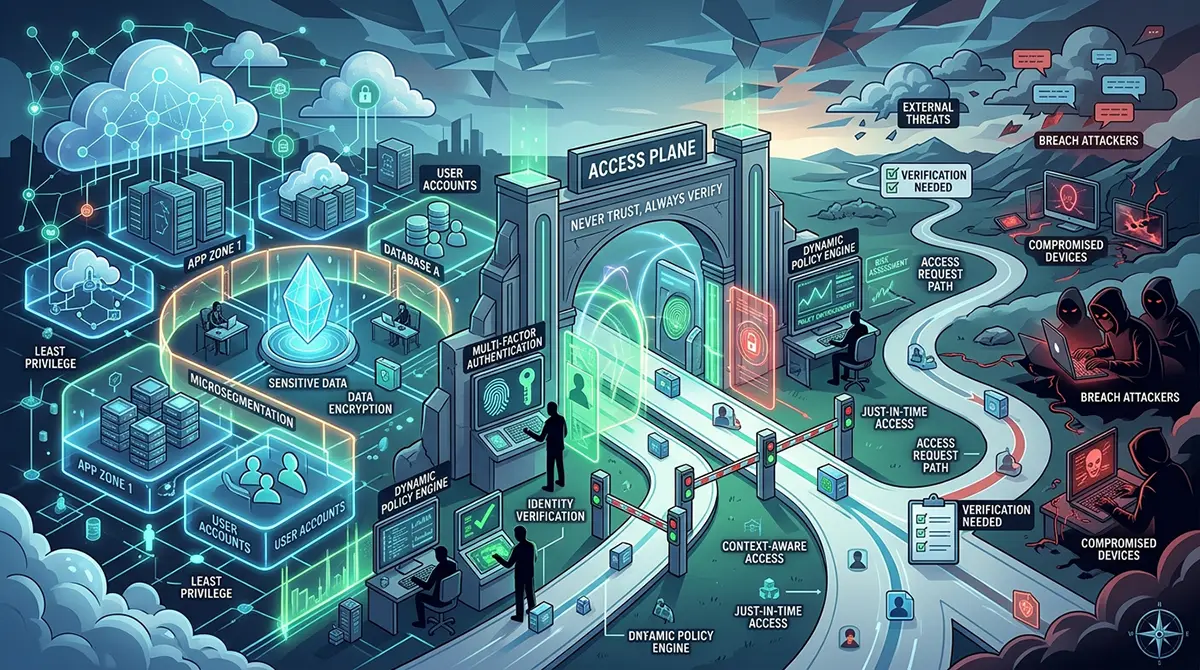
Explicit Verification: Always authenticate and authorize based on all available data points. Every single request must be explicitly verified using user identity, physical location, device health, service or workload status, data classification, and real-time anomaly detection. Trust is never granted permanently; it is evaluated continuously for every discrete transaction.
-
Least Privilege Access: Limit user and machine access using Just-In-Time (JIT) and Just-Enough-Access (JEA) policies. Entities are granted only the minimum level of access necessary to complete their specific task, and only for the exact duration required. By restricting access rights strictly to what is necessary, organizations drastically reduce the attack surface and contain potential damage.
-
Assume Breach: Design and operate systems under the persistent assumption that threat actors have already compromised the perimeter and are actively executing code inside the environment. This mindset forces organizations to minimize blast radiuses by segmenting networks, encrypting all communications end-to-end, utilizing continuous analytics, and actively hunting for threats within internal systems.
By forcing every user, device, and application to continuously prove its identity and security posture, Zero Trust turns the traditional security model on its head. Instead of granting wide access upon entry and monitoring for bad behavior later, Zero Trust denies all access by default and grants micro-permissions only when explicit, verified proof of legitimacy is provided.
Deconstructing the Pillars of a Zero Trust Architecture
To translate the philosophy of worst-case defense into daily IT operations, organizations construct Zero Trust architectures around several interconnected operational pillars. Each pillar addresses a specific component of the digital ecosystem, ensuring comprehensive coverage across all potential vector paths.
1. Identity Verification and Access Control
Identity serves as the primary control plane in a Zero Trust framework. Because physical perimeters have dissolved, digital identity is the new perimeter. Every user, device, and service account attempting to access a resource must establish a strong, verified identity. This pillar relies heavily on modern identity and access management solutions that enforce robust authentication mechanisms.
Multi-Factor Authentication (MFA) is mandatory across all applications and endpoints, with a strong preference for phishing-resistant MFA methods such as FIDO2 hardware keys or biometrics. Furthermore, Zero Trust requires identity providers to evaluate risk factors in real time. If a user logs in from New York and three minutes later attempts to access a database from London, the system flags the impossible travel anomaly and revokes session privileges immediately.
2. Device Posture and Endpoint Security
Verifying user credentials is only half the battle; the security state of the device being used to access data is equally critical. A legitimate user logging in from a compromised, malware-infected laptop presents an extreme risk to the network.
Under Zero Trust, devices must be registered, managed, and continually evaluated before being granted access. Security management agents assess whether the device has its operating system fully patched, firewall enabled, disk encryption active, and Endpoint Detection and Response (EDR) software running. If an endpoint fails to meet predefined compliance standards, access is denied or restricted to a isolated remediation environment, regardless of how valid the user’s login credentials may be.
3. Network Microsegmentation
In traditional networks, once a device connects to a Local Area Network (LAN) or Virtual Private Network (VPN), it can communicate freely with almost any other device on that subnet. This flat network structure is what enables malicious lateral movement during a security breach.
Zero Trust eliminates flat networks through microsegmentation. Microsegmentation divides the network into isolated, granular zones down to individual workloads, applications, or database instances. Software-defined perimeters construct dynamic micro-perimeters around sensitive assets. Traffic between these micro-segments is blocked by default and permitted only through explicit, policy-driven rules. If an attacker compromises a web server in a microsegmented network, they are completely isolated within that single container and cannot hop to internal database clusters or administrative controls.
4. Application and Workload Security
Applications and microservices themselves must be secured under the assumption that the underlying network environment is hostile. Modern enterprise applications often communicate through Application Programming Interfaces (APIs), container instances, and serverless functions.
Zero Trust application security ensures that internal API calls between microservices require mutual authentication and encryption (using technologies like Mutual TLS). Software components do not automatically trust incoming data from other internal components. Additionally, runtime application self-protection tools continuously monitor application execution paths to block unauthorized memory access, code injection, or abnormal data queries in real time.
5. Data Protection and Continuous Encryption
Data is the ultimate asset that cybercriminals target. Zero Trust prioritizes data-centric security by categorizing, classifying, and encrypting data wherever it exists or travels.
All data must be encrypted in transit using strong, modern cryptographic protocols like TLS 1.3, and encrypted at rest across cloud storage, local disks, and database backups. Furthermore, Rights Management Services (RMS) and Data Loss Prevention (DLP) tools attach persistent security policies directly to sensitive files. These policies control whether a file can be opened, copied, printed, or forwarded, maintaining data protection even if the document leaves the organizational ecosystem.
6. Visibility, Automation, and Analytics
A Zero Trust model cannot function without continuous real-time monitoring and automated orchestration. Because access decisions are made dynamically and continuously, security systems generate vast streams of telemetry data from identities, endpoints, networks, and applications.
Centralized Security Information and Event Management (SIEM) and Security Orchestration, Automation, and Response (SOAR) platforms aggregate this telemetry using artificial intelligence and machine learning algorithms. By analyzing behavior patterns across the entire digital footprint, automated analytics systems can detect subtle indicators of compromise—such as abnormal data download rates or unusual access timing—and instantly execute automated responses, such as revoking user credentials or isolating affected endpoints, without waiting for human intervention.
Accelerate Your Digital Transformation
Looking to optimize your IT infrastructure, streamline business operations, and stay ahead of the competition? Discover how tailored technology advisory services uae can transform your organization. From strategic cloud adoption to cutting-edge cybersecurity, get expert guidance to drive measurable business growth in today’s fast-evolving market.
The Mechanics of Continuous Trust Assessment
One of the most profound differences between traditional security and Zero Trust is the concept of continuous assessment. In legacy security models, trust was binary and persistent: once authenticated at the start of a workday, a user retained access rights until they logged off or their VPN session timed out hours later.
Zero Trust treats trust not as a static state, but as a temporary, fragile metric that degrades over time and must be revalidated constantly. This dynamic process is powered by continuous evaluation engines that analyze risk signals in real time throughout an active user session.
When a user initiates an action—such as opening a file or requesting database access—the Zero Trust policy engine calculates a dynamic risk score based on contextual telemetry:
-
User Context: Is the user accessing resources during their typical working hours? Is their behavior aligned with their normal role and historical activity?
-
Device Context: Is the endpoint managed by the company? Is the device’s antivirus software up to date? Has any suspicious malware activity been flagged recently on this hardware?
-
Network Context: Is the request coming from a known corporate IP, a recognized home network, or an anonymized VPN proxy? Is the connection encrypted using modern cryptographic suites?
-
Resource Sensitivity: How critical is the requested data? Does accessing this resource require elevated privileges or compliance clearance?
If the dynamic risk score remains low, access is granted seamlessly in the background without interrupting the user. However, if the contextual signals change during the session—for instance, if the user switches to an unsecured public Wi-Fi network, attempts to download an unusually large volume of confidential files, or triggers an endpoint protection alert—the Zero Trust policy engine intervenes immediately.
The system can automatically step up authentication requirements, demanding a biometric scan or hardware token tap. If the risk threshold is violated significantly, the engine can instantly downgrade session privileges, restrict access to read-only mode, or terminate the session entirely and quarantine the device. This real-time agility prevents attackers from using hijacked sessions to achieve their objectives.
Overcoming the Friction: Zero Trust Implementation Challenges
While the theoretical framework of Zero Trust is compelling, transitioning an enterprise from a traditional perimeter model to a full Zero Trust architecture is a complex, multi-year endeavor filled with technical, operational, and organizational hurdles.
The primary technical challenge lies in legacy infrastructure. Many older enterprise applications, legacy databases, and proprietary operational technology systems were designed decades ago with implicit trust hardcoded into their architecture. These legacy systems often lack support for modern authentication protocols like SAML or OpenID Connect, cannot handle encrypted API traffic, and do not integrate with modern identity providers. Wrapping these brittle systems in Zero Trust controls without breaking business-critical operations requires delicate engineering, reverse proxies, or costly application modernization.
Another major challenge is maintaining organizational productivity and user experience. If Zero Trust policies are implemented heavy-handedly, employees may face endless authentication prompts, complex access workflows, and constant performance bottlenecks. Security controls that create excessive friction inevitably drive employees to seek workarounds, giving rise to “Shadow IT” systems that bypass corporate security controls altogether. Designing Zero Trust controls that operate frictionlessly in the background requires sophisticated policy optimization and seamless identity integration.
Furthermore, Zero Trust requires breaking down deeply entrenched operational silos within IT and security teams. Traditionally, network engineering, identity management, endpoint security, and cloud operations operated as independent departments with separate budgets and tooling. Zero Trust demands total alignment and seamless telemetry sharing across all of these domain boundaries. Achieving this level of operational convergence requires strong executive leadership, cultural alignment, and a unified strategic vision.
The Strategic Value: Business Benefits Beyond Cyber Defense
Although Zero Trust is fundamentally a risk mitigation framework designed for worst-case scenarios, its benefits extend far beyond cybersecurity defense. Organizations that successfully implement Zero Trust architectures gain significant operational and strategic advantages that drive business agility and competitive performance.
-
Enabling Secure Remote and Hybrid Work: Zero Trust provides a seamless, secure framework for modern workforces. Employees can connect securely to enterprise tools from anywhere in the world, on corporate or personal devices, without relying on slow, bottlenecked legacy VPN infrastructure.
-
Accelerated Cloud Migration: By decoupling security controls from physical network perimeters, Zero Trust simplifies multi-cloud and hybrid-cloud adoption. Workloads can be moved fluidly between on-premises data centers and public cloud providers while maintaining identical, policy-driven security controls.
-
Reduced Breach Impact and Recovery Costs: When security incidents occur, network microsegmentation and least-privilege policies strictly contain the blast radius. Attackers are prevented from moving laterally, turning what could have been a catastrophic enterprise-wide breach into a minor, isolated incident that can be remediated quickly.
-
Simplified Regulatory Compliance: Zero Trust aligns closely with global data protection regulations, such as GDPR, HIPAA, and PCI-DSS. Continuous monitoring, explicit access logging, robust encryption, and strict identity controls provide clear, auditable proof of compliance across distributed computing environments.
-
Enhanced Operational Visibility: Implementing Zero Trust requires comprehensive mapping of all identities, endpoints, applications, and data flows across the organization. This deep infrastructural visibility eliminates blind spots, uncovers redundant software licenses, and optimizes IT resource utilization.
The Road Ahead: Artificial Intelligence and the Next Generation of Zero Trust
As cyber threats become faster, more sophisticated, and increasingly automated through artificial intelligence, Zero Trust architectures must evolve to keep pace. The future of Zero Trust lies in hyper-automation, predictive risk scoring, and AI-driven security orchestration.
Generative AI and automated attack frameworks enable threat actors to generate polymorphic malware, execute targeted deepfake social engineering, and discover zero-day vulnerabilities at speeds human operators cannot match. In response, Zero Trust policy engines are incorporating advanced machine learning models capable of evaluating millions of telemetry signals per second to establish dynamic behavioral baselines for every user and machine component.
Future Zero Trust architectures will move beyond reactive policy enforcement to predictive defense. By analyzing subtle, sub-second anomalies in application traffic, memory usage, and user interactions, AI-driven Zero Trust engines will predict and intercept malicious intent before an attack can fully materialize.
Ultimately, Zero Trust is not a static endpoint or a project with a final completion date; it is a continuous journey of operational refinement. By embracing the absolute worst-case scenario as a permanent operational reality, Zero Trust empowers modern organizations to build resilient digital environments capable of thriving amid an endlessly evolving global threat landscape.
Summary of Key Takeaways
-
Core Model: Zero Trust Architecture assumes that networks are always compromised and operates on the governing mandate: “Never Trust, Always Verify.”
-
Paradigm Shift: Replaces obsolete perimeter-based “castle-and-moat” security with explicit, continuous verification of every user, device, and request.
-
Fundamental Principles: Explicit verification, least privilege access, and an “assume breach” operational mindset.
-
Core Architectural Pillars: Encompasses identity management, endpoint health evaluation, microsegmentation, application security, continuous data encryption, and centralized automated analytics.
-
Strategic Outcome: Reduces attack blast radiuses, prevents lateral movement during breaches, enables secure hybrid work environments, and streamlines regulatory compliance.