
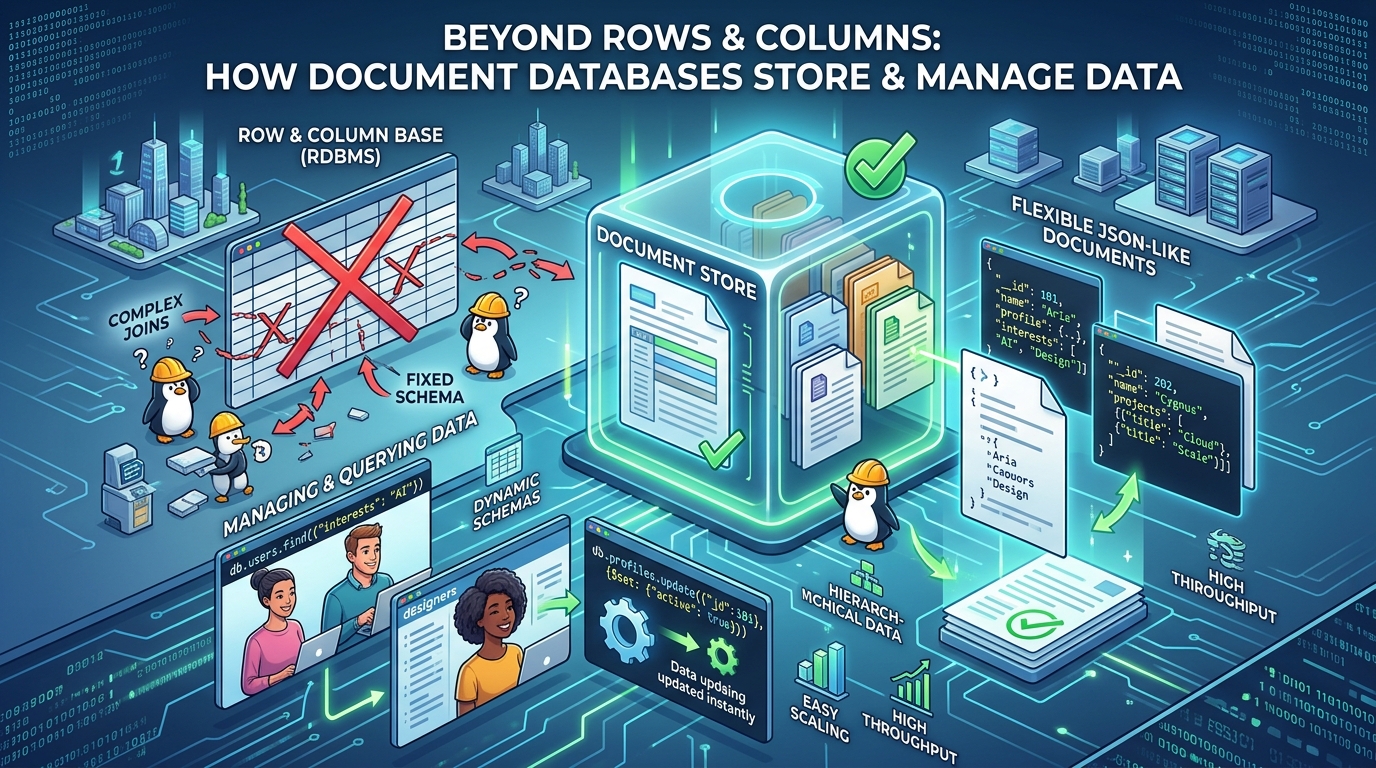



For decades, the relational database reigned supreme. Data was neatly chopped into rows and packed into rigid, normalized tables connected by foreign keys. But as the internet expanded, applications grew more complex, user bases exploded, and data became inherently unstructured and fast-evolving. The rigid boundaries of relational tables began to strain under the weight of modern software demands.
Enter the document database. Belonging to the NoSQL family, document databases reimagined data storage from the ground up. Instead of forcing real-world entities into predefined tables, document databases store data in flexible, self-describing structures known as documents. This fundamental architectural shift changes how developers build applications and redefines how database engines write, index, query, and retrieve information from disk and memory.
To understand how a document database works under the hood, one must look past the simple JSON snippets shown in tutorials and explore the underlying storage engines, serialization formats, indexing strategies, and data access paradigms that make these systems fast, flexible, and resilient.
The Core Abstraction: What Is a Document?
At the application level, a document is a self-contained, semi-structured data record. It groups related data together rather than spreading it across multiple tables. If you are building an e-commerce platform in a relational database, an order might require rows across an Orders table, an Order_Items table, a Customers table, and a Products table. In a document database, that same order is stored as a single, cohesive document.
Documents are typically represented using formats like JSON (JavaScript Object Notation). A document consists of field-value pairs, where fields are strings and values can range from primitive data types to complex structures:
-
Primitive types: Strings, numbers, booleans, dates, and null values.
-
Arrays: Ordered lists of values, allowing a single field to hold multiple items.
-
Nested documents: Embedded sub-documents that allow hierarchical relationships within a single record.
This structure provides schema flexibility, often referred to as schema-on-read or dynamic schema. Unlike relational databases, where every row in a table must conform to the exact same column definitions, documents in the same collection or namespace can have different fields, missing properties, or nested structures.
This flexibility eliminates the need for complex schema migrations when application requirements evolve. If a user profile needs a new field for social media handles, the application can simply start writing documents with that field without altering existing records or locking database tables.
Need a Reliable DevOps Partner in Dubai?
Managing servers, monitoring performance, and automating workflows can be overwhelming when you’re trying to scale your business. If you’re looking for hands-on expertise in cloud migration, server hardening, and pipeline automation, We are here to bridge the gap. Reach out to us and let’s build a resilient infrastructure tailored to your needs.
From Text to Bits: Binary Serialization Formats
While developers interact with document databases using human-readable JSON, storing raw JSON text on disk would be inefficient. Text files require parsing on every read operation, waste space with repetitive whitespace and structural symbols, and lack native support for advanced data types like high-precision decimals, binary data, or explicit date objects.
To solve this, modern document databases convert JSON into optimized binary serialization formats before persisting data to disk or holding it in memory.
BSON (Binary JSON)
Popularized by MongoDB, BSON extends the JSON model by providing explicit data types and encoding length prefixes for fields and documents. BSON introduces types like 64-bit integers, floating-point numbers, UTC datetime, ObjectId, and raw binary data (BinData). The length prefixes allow the database engine to jump directly to specific fields within a document without parsing the entire payload, significantly speeding up query execution.
Protocol Buffers and Custom Binary Encodings
Other document databases use proprietary or open-standard binary encodings. For instance, Amazon DocumentDB, Couchbase, and CouchDB employ binary wrappers that optimize payload size and memory layout. These encodings often compress key names, align memory boundaries for faster CPU cache reads, and store structural metadata at the header of the document so the database can inspect contents without decoding the whole blob.
By serializing documents into binary representations, document databases achieve a balance between dynamic flexibility and high-performance hardware utilization.
The Architecture of On-Disk Storage Engines
Storing a binary document is only the first step. The database must also write that document to persistent storage in a way that ensures data integrity, fast lookup speed, and efficient disk utilization. Document databases rely on specialized storage engines, which generally follow one of two core architectural paradigms: B-Trees or Log-Structured Merge-trees (LSM-trees).
B-Tree Variants and Page-Based Storage
Traditional databases and several document engines (such as MongoDB’s WiredTiger engine) utilize B-Tree or B+Tree variations. In these systems, disk space is divided into fixed-size chunks called pages, typically ranging from 4 KB to 64 KB.
Documents are packed into these pages alongside metadata tracking free space. When a document is inserted or updated:
-
The database traverses the tree structure to locate the appropriate leaf page.
-
The binary document is written into that page.
-
If the page becomes full, a page split occurs, dividing the data into two pages and updating the parent nodes in the tree.
B-Trees offer fast point-read performance because the database can locate any document key in a predictable number of disk seeks. However, frequent updates or random writes can lead to disk fragmentation and costly page splits.
Log-Structured Merge-Trees (LSM-Trees)
For write-heavy workloads, some document databases adopt LSM-tree architectures. Instead of modifying pages in-place, an LSM-tree buffers incoming writes in memory within a data structure called a MemTable. When the MemTable reaches capacity, it is written to disk as a sequential, immutable file called an SSTable (Sorted String Table).
Because writes are strictly append-only, LSM-trees deliver impressive write throughput. Background processes continuously perform compaction, merging older SSTables to remove duplicate entries, apply deletions, and reclaim space. The trade-off comes during read operations, where the database may need to check multiple SSTables and the in-memory buffer to find the latest version of a document.
Append-Only Storage and Copy-on-Write
Databases like Apache CouchDB use an append-only, copy-on-write B-tree model. Every update or deletion creates a new version of the modified document and appends it to the end of the file, updating the tree roots accordingly. This approach guarantees that old data is never overwritten in-place, making the database inherently crash-resilient and eliminating the need for complex locking mechanisms during concurrent reads and writes.
Navigating the Maze: Indexing Strategies in Document Databases
Without indexes, searching a document database would require a full collection scan, reading every document from disk to check if it matches a query filter. Because documents contain nested structures and arrays, indexing in a document database is considerably more sophisticated than indexing flat table columns.
Field-Level Indexes
At its simplest, a field-level index creates a mapping from a specific field value to the physical location of the documents containing that value. If you index the field
user_id, the database builds an internal B-Tree where keys are user IDs and values are pointers (such as Record IDs or page offsets) to the matching documents.Compound Indexes
Compound indexes combine multiple fields within a single index structure. The order of fields in a compound index matters significantly. An index on
{ status: 1, created_at: -1 } allows the database to quickly isolate documents matching a specific status and retrieve them pre-sorted by their creation date.Multikey Indexes for Arrays
One of the distinguishing features of document databases is the ability to index array fields. When an index is created on a field that contains an array, the database generates a separate index entry for every single element within that array. This is known as a multikey index.
For example, if a document contains
tags: ["tech", "database", "nosql"], the database creates three distinct index entries pointing back to the same document. This enables efficient querying of array membership, though it increases index storage overhead and update latency.Wildcard and Schema-Agnostic Indexing
Given that documents can have dynamic schemas, some document databases support wildcard indexing. Instead of explicitly listing fields to index, a wildcard index scans all fields or sub-documents and indexes every key-value pair it encounters. This allows applications to execute arbitrary queries across unpredictable JSON payloads, albeit at the cost of higher storage requirements and heavier write overhead during ingestion.
Geospatial and Text Indexes
Document databases frequently incorporate specialized index structures:
-
Geospatial Indexes: Use 2D spatial structures or S2 geometry cells to index latitude and longitude pairs embedded within documents, enabling proximity searches and bounding-box queries.
-
Full-Text Indexes: Tokenize, stem, and remove stop-words from string fields, building inverted indexes that allow fast keyword searches across document bodies.
Data Modeling Paradigms: Embedding vs. Referencing
How data is stored on disk depends heavily on how the application developer designs the document structure. Document databases offer two primary strategies for modeling relationships: embedding and referencing.
+-------------------------------------------------------------------+
|                        DOCUMENT STORAGE                           |
|                                                                   |
|   EMBEDDED MODEL                                                  |
|   +-----------------------------------------------------------+   |
|   | Document: Customer                                        |   |
|   | {                                                         |   |
|   |   _id: "c123",                                            |   |
|   |   name: "Jane Doe",                                       |   |
|   |   orders: [ { id: "o1", total: 45.00 }, { id: "o2" } ]    |   |
|   | }                                                         |   |
|   +-----------------------------------------------------------+   |
|   (Single contiguous read on disk)                                |
|                                                                   |
|   REFERENCED MODEL                                                |
|   +--------------------------+     +--------------------------+   |
|   | Document: Customer       |     | Document: Order          |   |
|   | { _id: "c123",           | ==> | { _id: "o1",             |   |
|   |   name: "Jane Doe" }     |     |   customer_id: "c123" }  |   |
|   +--------------------------+     +--------------------------+   |
|   (Requires lookup or join across multiple storage locations)     |
+-------------------------------------------------------------------+
The Embedded Data Model (Denormalization)
In an embedded model, related data is nested directly inside a single document as sub-documents or arrays. For example, a blog post document might embed an array of comments inside itself.
Advantages:
-
Locality of Reference: Because the post and its comments live in the exact same physical byte sequence on disk, reading a post along with its comments requires a single I/O operation.
-
Atomic Updates: Updating a post and adding a comment happens atomically within a single document operation without needing complex multi-document transactions.
Trade-offs:
-
Document Growth: Continually appending to an embedded array causes the document to grow. If the document exceeds its allocated memory page on disk, the database must move the entire document to a new location, creating storage fragmentation and write overhead.
-
Size Limits: Most document databases enforce maximum document size limits (such as 16 MB in MongoDB) to prevent runaway memory allocation.
The Referenced Data Model (Normalization)
In a referenced model, data is separated into distinct documents, often stored in different collections. One document stores a reference (such as an ID field) pointing to another document.
Advantages:
-
Elimination of Duplication: Prevents data redundancy when entities are shared across multiple parents (such as shared product categories).
-
Smaller Document Sizes: Keeps individual records lean, improving cache utilization and preventing document growth issues.
Trade-offs:
-
Query Latency: Fetching related data requires multiple queries or application-side joins, increasing network round-trips and disk seeks. While modern document databases support server-side lookup stages (such as MongoDB’s
$lookup), these operations are computationally heavier than single-document reads.
Memory Management and Caching Architectures
To deliver low latency, document databases rely heavily on memory management layers that sit between the raw disk storage and the query processing engine.
The Working Set and In-Memory Caching
A database performs best when its active working set (frequently accessed documents and indexes) fits entirely inside System RAM. Document databases use dedicated cache managers, often built on Least Recently Used (LRU) or adaptive page eviction algorithms.
When a query requests a document:
-
The engine checks the memory cache.
-
If present (a cache hit), the document is deserialized and returned directly.
-
If absent (a cache miss), the engine reads the corresponding storage page from disk into the cache, evicting older pages if memory is full.
Operating System Page Cache
In addition to internal application caches, many document databases leverage the operating system page cache. When reading from or writing to disk, the operating system caches file blocks in unallocated RAM. Databases that use memory-mapped files (like early versions of MongoDB using the MMAPv1 engine) offload cache management entirely to the OS virtual memory subsystem, mapping database files directly into the process’s address space.
Ensuring Durability: Write-Ahead Logs and Journaling
Flexible storage models do not relieve a database of its responsibility to guarantee data safety. Document databases employ journaling, also known as Write-Ahead Logging (WAL), to ensure ACID properties and recoverability from sudden crashes or power failures.
Client Write Request
       │
       ▼
┌──────────────┐      Concurrent Writes
│ Memory Cache │ ──────────────────────────┐
└──────────────┘                           ▼
       │                        ┌────────────────────┐
       │ (Periodic Flush)       │ Write-Ahead Log    │
       ▼                        │ (Sequential Disk)  │
┌──────────────┐                        └────────────────────┘
│ Main Storage │                                   │
│ (Data Pages) │ <────── Crash Recovery ───────────┘
└──────────────┘
When an application issues a write, update, or delete operation:
-
Memory Update: The database applies the modification to its in-memory data structures and marks the affected pages as dirty.
-
Journal Write: Simultaneously, a sequential log entry describing the exact byte-level changes is written to an on-disk journal file (WAL).
-
Group Commit: To maximize throughput, the database batches multiple write operations together and flushes them to the journal in a single disk sync operation.
Because writing sequentially to a log file is substantially faster than modifying random pages across the main database storage files, journaling adds minimal latency while guaranteeing durability.
If the database crashes before dirty memory pages are flushed to main storage files, the storage engine reads the journal upon startup, replaying the logged operations to restore the database to a consistent state.
Concurrency Control: Handling Simultaneous Access
Modern applications process thousands of concurrent requests. Document databases must manage simultaneous reads and writes without corrupting data or causing bottlenecks.
Document-Level Locking
Early document databases used coarse-grained lock mechanisms, locking entire database instances or collections during write operations. Modern document engines implement document-level concurrency control.
With document-level locking, two concurrent operations can modify different documents in the same collection at the exact same time without blocking each other. Locks are acquired briefly at the individual document level only while memory representations are updated.
Multi-Version Concurrency Control (MVCC)
To provide high read performance alongside heavy write traffic, many document engines utilize Multi-Version Concurrency Control (MVCC).
Under MVCC:
-
When a write operation modifies a document, the engine creates a new version of that record rather than overwriting the existing data in-place immediately.
-
Read operations access a point-in-time snapshot of the data, seeing a consistent view of the document without acquiring read locks.
-
Readers do not block writers, and writers do not block readers.
Old document versions are cleaned up asynchronously by background garbage collection threads once active read transactions complete.
Distributed Storage: Sharding and Partitioning Across Nodes
As data grows beyond the storage or compute capacity of a single physical server, document databases scale out horizontally by partitioning data across a cluster of nodes. This process is known as sharding.
                             [ Router / Proxy ]
                                     │
           ┌─────────────────────────┴─────────────────────────┐
           ▼                                                   ▼
┌─────────────────────┐                             ┌─────────────────────┐
│   Shard A (Node 1)  │                             │   Shard B (Node 2)  │
│  Range: A - M       │                             │  Range: N - Z       │
│ ┌─────────────────┐ │                             │ ┌─────────────────┐ │
│ │ Doc: "Customer" │ │                             │ │ Doc: "Order"    │ │
│ └─────────────────┘ │                             │ └─────────────────┘ │
└─────────────────────┘                             └─────────────────────┘
Partition Keys and Routing
To distribute documents evenly, the database requires a partition key (or shard key). The shard key is a field present in every document that determines which node in the cluster will store that record.
Databases use two primary partitioning strategies:
-
Range-Based Partitioning: Documents are clustered based on contiguous value ranges of the shard key. This supports efficient range queries but can cause write hot-spots if keys grow monotonically (e.g., auto-incrementing timestamps).
-
Hash-Based Partitioning: The database computes a cryptographic or deterministic hash of the shard key value and uses the resulting hash to assign the document to a partition. This guarantees an even distribution of data across nodes, though it turns range queries into cluster-wide broadcast operations.
Replicas and Consensus Protocols
To prevent data loss if a physical server fails, every shard is typically configured as a replica set consisting of a primary node and multiple secondary nodes.
-
Writes are sent to the primary node, which persists the document and logs the operation to an oplog (operations log).
-
Secondary nodes continuously tail the primary node’s oplog, replicating the operations to their local storage engines.
-
Distributed consensus algorithms, such as Raft or Paxos, manage leader elections. If the primary node goes offline, the remaining secondaries vote to elect a new primary automatically.
Query Execution and Storage Optimization Engine
When an application submits a query, the document database does not simply pass it straight to disk. It processes the query through a pipeline designed to minimize resource consumption and maximize throughput.
Query Parsing and Optimization
The query engine parses the request, validates field references, and passes the query to an optimizer. The optimizer evaluates potential execution plans:
-
Can the query be satisfied using an existing index?
-
Is a compound index match available?
-
Should the database perform an index scan, or is the result set large enough that a collection scan is faster?
Modern document databases collect runtime statistics on query execution times. The optimizer tests different plans concurrently, caching the fastest route for subsequent identical queries.
Covered Queries
An ideal query scenario is a covered query, where every field requested in the projection exists directly inside the index itself. In this case, the database engine returns the result straight from the in-memory index structure without fetching the full binary document from disk storage at all, reducing I/O overhead to near zero.
Aggregation Pipelines and In-Memory Transformations
Document databases support complex data transformations through aggregation frameworks. These pipelines process documents through sequential stages, such as filtering, grouping, reshaping, and sorting.
To handle large datasets efficiently without exhausting memory, the database streams documents through pipeline stages. If a sorting stage exceeds memory limits, the engine can spill intermediate data to temporary disk files, balancing execution speed with memory constraints.
Storage Compression Techniques
Because documents contain repetitive structural information (such as JSON field names), storage engines employ compression techniques to reduce the physical disk footprint and decrease disk I/O requirements.
Block Compression
Storage engines compress data pages before writing them to disk using algorithms such as Snappy, zlib, or Zstandard. Snappy provides rapid compression and decompression with low CPU utilization, making it an ideal choice for high-throughput operational workloads. zlib or Zstandard offer higher compression ratios at the cost of additional CPU cycles, making them well-suited for analytical or archival storage.
Dictionary and Prefix Encoding
Within individual indexes and document collections, databases use dictionary encoding. If millions of documents contain the field name
customer_shipping_address_zipcode, the storage engine assigns a short integer symbol to that string key in a shared dictionary, storing only the symbol within the binary document representation on disk.Index pages also utilize prefix compression, storing only the differences between consecutive index keys. This drastically reduces index sizes in RAM, allowing larger datasets to stay cached in memory.
Evolution of Document Databases: Multi-Model and Cloud-Native Storage
The boundaries between database categories continue to blur. Modern document databases have evolved beyond simple NoSQL stores into sophisticated multi-model and cloud-native systems.
Multi-Model Convergence
Many relational databases now offer native JSON document storage capabilities alongside traditional tables, complete with binary JSON data types (such as PostgreSQL’s
jsonb) and specialized functional indexes. Conversely, primary document databases have added full multi-document ACID transaction support, bringing the reliability guarantees of relational systems to flexible document architectures.Cloud-Native Storage Decoupling
Cloud-native document databases (such as Amazon DynamoDB, Google Cloud Firestore, and Azure Cosmos DB) decouple compute nodes from storage nodes.
In these architectures:
-
Stateless compute nodes handle query parsing, index matching, and transaction routing.
-
A specialized, distributed storage layer manages replication, journaling, page storage, and background compaction across elastic storage clusters.
This separation allows storage to scale indefinitely independent of compute power, enabling databases to ingest massive document writes while maintaining fast point reads.
Conclusion
At first glance, a document database appears to be a straightforward tool designed to store JSON files. However, beneath that intuitive developer interface lies a complex assembly of computer science innovations.
From converting flexible fields into serialized binary layouts like BSON, to navigating disk pages via B-Trees or LSM-trees, document databases are carefully engineered for modern hardware. Their reliance on multikey array indexing, document-level concurrency, write-ahead logging, and automated sharding allows them to store unpredictable, rapidly changing data at scale.
By replacing rigid rows with flexible, self-describing documents, these storage engines bridge the gap between application code objects and persistent disk storage, powering the real-time, high-throughput applications that drive the modern web.