


Companies that deliver critical digital services face an unforgiving reality: every minute of downtime carries measurable financial, reputational, and operational costs. For global platforms handling payments, streaming, e-commerce, or real-time communications, even brief interruptions can translate into lost revenue measured in hundreds of thousands of dollars per minute and lasting damage to customer trust. Achieving near-zero downtime is therefore not a luxury but a strategic necessity. The most successful organizations treat availability as a first-class design goal rather than an afterthought. They engineer systems that continue operating through component failures, regional disruptions, software bugs, and even planned maintenance.
This article examines the concrete practices that enable companies to approach continuous availability. It covers architectural foundations, operational disciplines, deployment techniques, testing strategies, and cultural practices that together make near-zero downtime attainable.
Understanding the Meaning of Near-Zero Downtime
Near-zero downtime refers to systems that remain available to users with only negligible interruption, typically measured in seconds rather than minutes or hours. Industry benchmarks express this through the “nines” of availability. Four nines (99.99 percent) allow roughly 52 minutes of downtime per year. Five nines (99.999 percent) reduce that allowance to about five minutes annually. True continuous availability, sometimes called six nines or higher, pushes interruptions into the realm of a few seconds per year.
These targets are not absolute. They depend on the business context. A social media feed may tolerate brief degradation, while a payment processor or air-traffic system cannot. Companies therefore define recovery time objectives (RTO) and recovery point objectives (RPO) for each critical service. RTO specifies how quickly service must resume after failure. RPO defines the maximum acceptable data loss. Near-zero downtime usually implies an RTO measured in seconds and an RPO approaching zero.
Achieving these numbers requires more than buying redundant hardware. It demands deliberate architectural choices, automated recovery mechanisms, rigorous testing, and continuous improvement.
Eliminating Single Points of Failure as the Foundation
Every system that reaches high availability begins with a systematic hunt for single points of failure. A single point of failure is any component whose individual loss renders the entire service unavailable. Servers, databases, network links, power supplies, DNS resolvers, and even human operators can all become single points of failure if left unprotected.
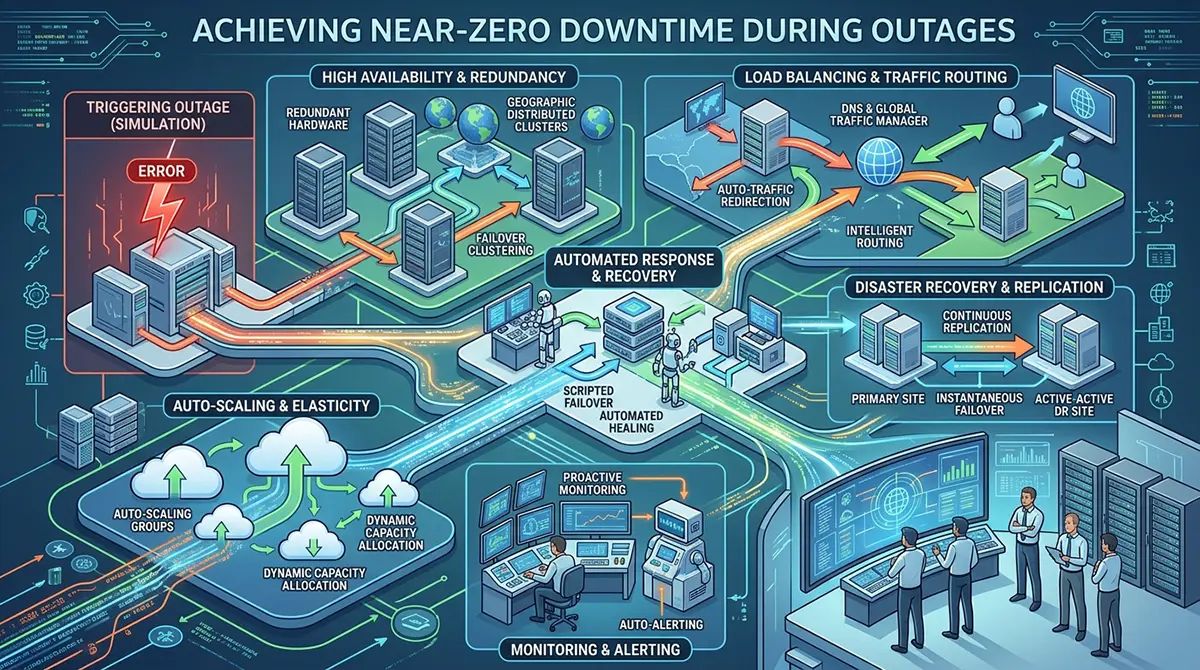
Leading companies inventory every dependency and introduce redundancy at each layer. At the compute layer they run multiple instances of every application service. At the data layer they replicate databases and caches across independent failure domains. At the network layer they employ multiple load balancers, diverse transit providers, and anycast routing. Power and cooling systems receive the same treatment through dual utility feeds, uninterruptible power supplies, and backup generators configured in N+1 or 2N arrangements.
Cloud platforms accelerate this process by exposing availability zones: physically separate data centers within a region that share low-latency networking yet maintain independent power, cooling, and networking. Deploying workloads across at least two, and preferably three, availability zones removes the risk that a single facility outage will take the service offline. For services that cannot tolerate regional failure, companies extend the same principle across multiple geographic regions.
The discipline is relentless. Teams continuously ask whether the failure of any one component can still cascade into a full outage. When the answer is yes, they redesign until the answer becomes no.
Accelerate Your Digital Transformation
Looking to optimize your IT infrastructure, streamline business operations, and stay ahead of the competition? Discover how tailored technology advisory services uae can transform your organization. From strategic cloud adoption to cutting-edge cybersecurity, get expert guidance to drive measurable business growth in today’s fast-evolving market.
Multi-Availability-Zone and Multi-Region Architectures
Once single points of failure are addressed within a data center, the next layer of protection is geographic distribution. Modern cloud providers organize infrastructure into regions and availability zones. A region is a geographic area containing multiple availability zones. Each zone is isolated enough that a fire, flood, or power event in one zone is unlikely to affect another.
Companies achieve four-nines availability by placing identical application stacks in multiple zones inside a single region and configuring load balancers and databases for automatic failover between them. Synchronous or near-synchronous replication keeps data consistent. Health checks continuously monitor every instance. When an instance or an entire zone becomes unhealthy, traffic is redirected within seconds.
For workloads that must survive the loss of an entire region, multi-region architectures are required. Two primary patterns dominate. In the active-passive model one region serves all traffic while a second region maintains warm or hot standby capacity. Data is continuously replicated to the standby. Upon regional failure the standby is promoted and DNS or global load balancing redirects users. Failover times range from tens of seconds to a few minutes depending on the degree of readiness.
In the active-active model multiple regions simultaneously serve production traffic. Global traffic management systems route users to the nearest healthy region based on latency, health, and capacity. Data consistency becomes more complex because writes may occur in more than one place. Solutions include conflict-free replicated data types, last-writer-wins policies, or carefully partitioned workloads that keep related data within a single region. Active-active designs can deliver near-zero recovery times because capacity already exists and is already handling traffic.
Amazon, Google, and Microsoft publish reference architectures that illustrate both patterns. Netflix operates a sophisticated multi-region active-active system that has repeatedly absorbed large-scale cloud disruptions with minimal user impact. Amazon Prime Video has publicly described how redundant media processing pipelines across regions combine to achieve five-nines availability even when the underlying managed services themselves offer only three-nines SLAs.
Automated Failover and Health-Driven Traffic Management
Redundancy alone is insufficient if humans must manually detect failure and switch traffic. Near-zero downtime requires automated detection and recovery measured in seconds.
Health checks form the nervous system of these architectures. Application load balancers probe every instance at short intervals. Instances that fail consecutive checks are removed from the pool. Route health checks at the DNS or global accelerator layer can shift traffic away from an entire zone or region. Database services such as Amazon RDS Multi-AZ or Aurora Global Database promote a standby replica automatically when the primary becomes unreachable.
Modern systems go further by embedding circuit breakers and bulkheads. When a downstream dependency slows or fails, the circuit breaker opens and returns a fast fallback response rather than letting requests pile up and exhaust resources. Bulkheads isolate critical functions so that overload in one part of the system cannot starve another.
Global traffic directors such as AWS Global Accelerator, Azure Front Door, Cloudflare, or Google Cloud Load Balancing continuously evaluate latency and health from hundreds of edge locations. They can shift traffic within seconds when a region degrades. Combined with short DNS TTLs or anycast addressing, these systems make regional failover largely invisible to end users.
Data Resilience Through Replication and Consistency Trade-offs
Availability is meaningless without data integrity. Companies therefore invest heavily in replication strategies that balance durability, consistency, and latency.
For zero RPO requirements, synchronous replication ensures that a transaction is acknowledged only after it has been written to multiple independent locations. This approach is common within a region across availability zones. Across regions the latency cost of synchronous replication often becomes prohibitive, so asynchronous or semi-synchronous replication is used. In those cases RPO is measured in seconds or minutes rather than zero.
Distributed databases such as Google Spanner, Amazon DynamoDB Global Tables, Cassandra, and CockroachDB provide multi-region consistency models that applications can select according to business needs. Some workloads accept eventual consistency for higher availability; others require strong consistency and therefore constrain write locality.
Stateless application design further simplifies recovery. When session state and user data live in external stores rather than on individual application servers, any healthy instance can serve any request. This removes the need to drain or migrate sessions during failover and allows rapid horizontal scaling.
Zero-Downtime Deployment Practices
Even the most resilient architecture can be taken offline by a bad software release. Companies that maintain continuous availability therefore treat deployments as carefully orchestrated events rather than risky maintenance windows.
Blue-green deployments maintain two identical production environments. New code is deployed to the idle environment, thoroughly tested, and then traffic is switched atomically. If problems appear, traffic is switched back. Canary releases gradually shift a small percentage of traffic to the new version while monitoring error rates, latency, and business metrics. Automated systems roll back the moment thresholds are breached.
Feature flags and progressive delivery tools allow teams to enable new functionality for specific user cohorts without redeploying. Configuration changes themselves are treated with the same caution: staged rollouts, validation gates, and rapid rollback paths prevent a misconfigured setting from cascading into an outage.
Immutable infrastructure and infrastructure-as-code further reduce risk. Servers are never patched in place; new instances are created from verified images. This eliminates configuration drift and makes rollback as simple as reverting to a previous known-good image.
Chaos Engineering and Proactive Resilience Testing
The most mature organizations do not wait for real outages to discover weaknesses. They deliberately inject failures under controlled conditions to verify that recovery mechanisms work as designed.
Netflix pioneered this practice with Chaos Monkey, a tool that randomly terminates instances in production. The company later expanded the approach into a full chaos engineering discipline that simulates network partitions, latency spikes, region failures, and dependency outages. The goal is not to cause chaos for its own sake but to surface assumptions that only hold under ideal conditions.
Game days and disaster recovery exercises take the same idea further. Cross-functional teams practice responding to simulated large-scale incidents, refining runbooks and automation until recovery becomes routine. Metrics such as mean time to detect and mean time to recover are tracked and improved over successive exercises.
These practices create a feedback loop. Every discovered weakness is fixed, every successful recovery is automated further, and the organization gradually raises its confidence that real failures will be absorbed gracefully.
Observability, Monitoring, and Rapid Detection
Near-zero downtime is impossible without near-instant detection. Modern observability platforms collect metrics, logs, and traces at massive scale and surface anomalies within seconds. Synthetic monitoring continuously exercises critical user journeys from multiple geographic locations. Real-user monitoring captures actual client-side performance.
Alerting systems are tuned to minimize noise while ensuring that genuine problems reach on-call engineers quickly. Many companies now employ AI-assisted anomaly detection that learns normal behavior and flags deviations before traditional threshold alerts would fire.
Site reliability engineering (SRE) teams define service level objectives and error budgets. When error budgets are exhausted, feature work pauses and reliability work takes priority. This creates a concrete, data-driven mechanism for balancing innovation and stability.
Organizational Culture and Operational Discipline
Technology alone cannot deliver continuous availability. The organizations that succeed treat reliability as a shared responsibility across development, operations, and product teams. Blameless postmortems after every incident focus on systemic improvements rather than individual fault. Automation is preferred over manual intervention. Toil is systematically eliminated so that engineers spend time improving systems rather than fighting fires.
Capacity planning and auto-scaling ensure that sudden traffic spikes do not create artificial scarcity. Load testing and capacity exercises verify that the system can absorb expected peaks with headroom to spare. Vendor management includes rigorous evaluation of third-party services’ own resilience postures, because a critical SaaS dependency can become a single point of failure.
Graceful Degradation and User Experience During Partial Failures
Even the best systems occasionally experience partial degradation. Companies that protect user trust design for graceful degradation. When a recommendation engine fails, the site continues to display static content. When a secondary service slows, requests timeout quickly and return cached or simplified responses. Progressive enhancement ensures that core functionality remains available even when advanced features are unavailable.
Clear, honest communication during incidents further preserves trust. Status pages, in-product banners, and proactive customer outreach turn potential frustration into understanding.
The Economic Reality of Near-Zero Downtime
Building and operating these systems is expensive. Multi-region active-active architectures roughly double infrastructure costs. Continuous testing and SRE staffing add further investment. Companies therefore apply these techniques selectively. Mission-critical paths receive the full suite of protections. Lower-priority services may accept higher RTO and RPO in exchange for lower cost.
The return on investment is calculated against the cost of downtime. For large digital businesses the break-even point is reached quickly. A single avoided major outage can justify years of redundancy investment.
Looking Ahead: Continuous Evolution of Resilience
The landscape continues to evolve. Edge computing pushes compute closer to users and creates new opportunities for localized resilience. Serverless and managed services abstract away more of the underlying infrastructure, allowing teams to focus higher in the stack. Advances in distributed consensus and conflict-free data structures make multi-region active-active designs more practical for a wider range of applications. AI-driven operations promise faster detection and automated remediation.
Yet the fundamental principles remain constant. Eliminate single points of failure. Automate recovery. Test the recovery mechanisms relentlessly. Measure everything. Improve continuously.
Companies that internalize these principles do not merely survive outages; they absorb them so effectively that most users never notice. That is the practical meaning of near-zero downtime, and it is achievable today by organizations willing to treat availability as a core product capability rather than an operational afterthought.