


The United Arab Emirates stands at the absolute forefront of global digital transformation. From the gleaming corporate towers of Downtown Dubai and the bustling logistics hubs of Jebel Ali to the burgeoning financial and technological free zones in Abu Dhabi and Sharjah, businesses across the Emirates are accelerating their journey toward cloud computing, artificial intelligence, and decentralized remote workforces. As companies expand, establishing secure, reliable, and high performance connections between headquarters, regional branch offices, and cloud environments becomes a foundational pillar of operational success.
For decades, traditional Virtual Private Networks served as the gold standard for enterprise networking. They provided encrypted tunnels over public infrastructure, allowing remote sites to securely communicate with the central data center. However, the modern business landscape looks vastly different from the era when traditional VPN architectures were conceived. Today, corporate applications no longer reside exclusively in an on premises server room at headquarters. Instead, they live across multiple cloud providers, software as a service platforms, and distributed data centers.
Multi-branch companies operating within the UAE face unique networking challenges. They must contend with stringent data residency regulations, high bandwidth demands, and the imperative to deliver seamless user experiences across diverse geographic locations. In this dynamic environment, IT leaders are increasingly forced to reevaluate their wide area network strategies. The central question facing decision makers today is whether to stick with trusted traditional VPN configurations or make the strategic leap to Software Defined Wide Area Networking.
This comprehensive analysis explores the nuances of both technologies, examining their architectures, performance metrics, security implications, and financial realities. By evaluating how SD-WAN and traditional VPN stack up against the backdrop of the UAE telecommunications ecosystem, organizations can determine the optimal path forward to support their growth, resilience, and digital ambitions.
The Evolution of Enterprise Networking: From Legacy Circuits to Cloud-First Realities
To truly appreciate the debate between SD-WAN and traditional VPN, one must understand how enterprise networking has evolved over the past thirty years. Historically, multi-branch companies relied heavily on Multiprotocol Label Switching circuits to connect their remote offices to corporate headquarters. MPLS offered exceptional reliability, predictable latency, and dedicated quality of service, making it ideal for mission critical applications and voice communications.
However, MPLS networks came with a massive drawback: exorbitant costs. Leasing dedicated private circuits across cities, let alone across international borders or remote industrial zones, required significant capital expenditure and long term contractual commitments. As bandwidth demands exploded with the advent of high definition video conferencing, massive data backups, and cloud migration, relying entirely on expensive MPLS links became financially unsustainable for many growing enterprises.
Enterprises began supplementing or replacing expensive private circuits with traditional VPN tunnels established over public internet connections. By leveraging internet broadband, companies could achieve secure connectivity at a fraction of the cost of MPLS. Traditional VPN architectures typically relied on routers at each branch office to establish encrypted IPsec tunnels back to a central firewall or gateway at the primary data center.
Empower your enterprise with seamless connectivity explore our tailored Internal Communication Network Solutions for Businesses in Dubai.
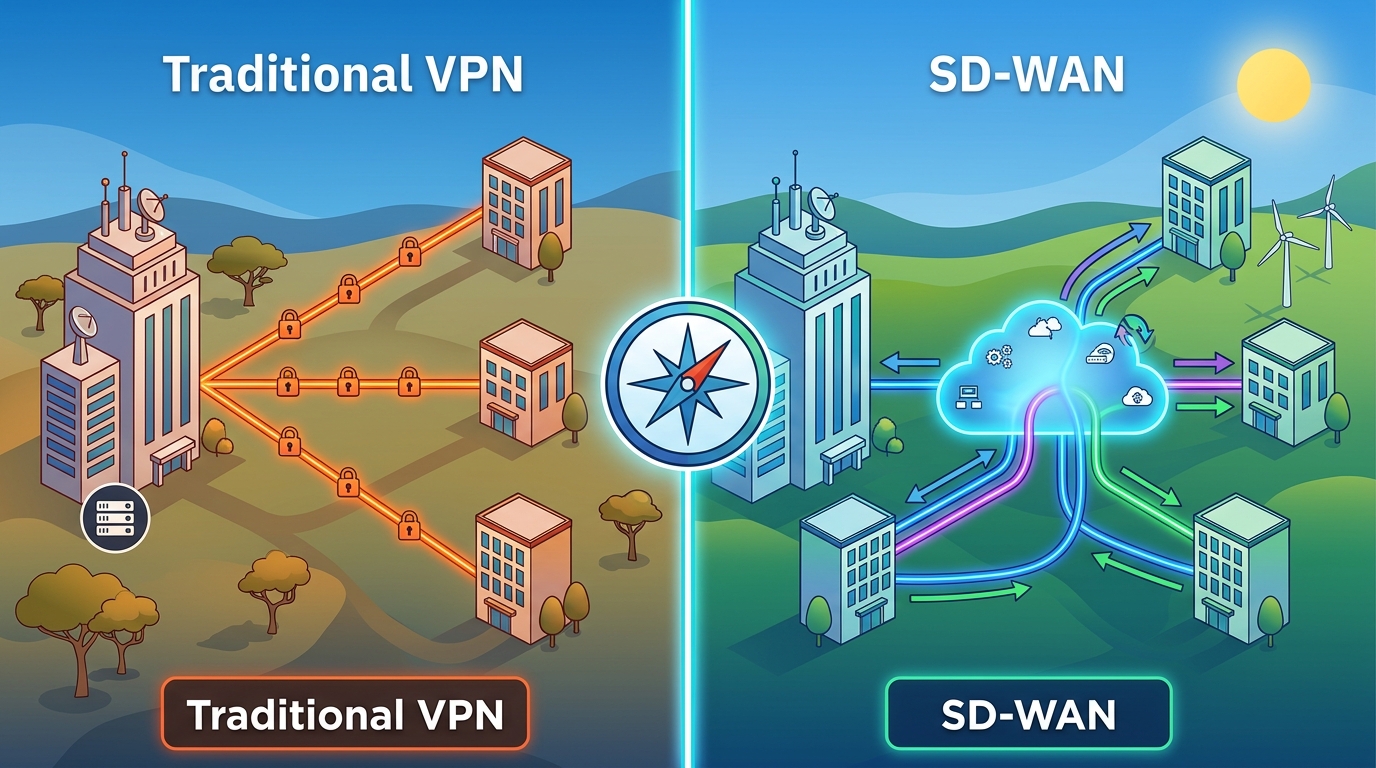
While this approach democratized enterprise connectivity and reduced hardware costs, it introduced a severe architectural bottleneck known as backhauling. In a traditional VPN setup, all branch office traffic, whether destined for an internal file server at headquarters or a Microsoft 365 instance hosted in a public cloud, was forced to travel through the secure tunnel back to the central data center before being routed to its final destination. This meant that a branch office in Ras Al Khaimah communicating with a cloud application hosted in a Dubai data center would experience unnecessary latency and consume precious headquarters bandwidth.
As businesses shifted toward cloud first strategies, the limitations of traditional hub and spoke VPN topologies became glaringly apparent. Applications moved out of the data center, but network traffic patterns remained tethered to legacy infrastructure. This mismatch paved the way for software defined networking principles to migrate from the local area network out to the wide area network, giving rise to SD-WAN.
Decoding Traditional VPN: Architecture, Strengths, and Inherent Limitations
Traditional VPN technology remains deeply embedded in the enterprise landscape. Understanding how it operates, why it has endured, and where it falls short is crucial for any organization weighing its networking options in the UAE.
At its core, a traditional VPN creates a secure, encrypted communication channel over an unsecured public network, such as the public internet. This is typically achieved using Internet Protocol Security or Secure Sockets Layer protocols. In a multi branch deployment, each branch is equipped with a compatible router or security appliance. These devices negotiate cryptographic keys and encapsulate data packets within encrypted wrappers, shielding sensitive corporate information from prying eyes as it traverses public telecom infrastructure.
The primary advantage of traditional VPN is its familiarity and proven security posture. IT departments around the world have decades of experience configuring, managing, and troubleshooting IPsec and SSL tunnels. The underlying cryptographic standards are robust and well understood, making it easier for compliance officers to audit and approve. Furthermore, traditional VPN hardware is relatively inexpensive upfront compared to specialized multi path appliances, and setup can often be accomplished quickly using standard internet connections provided by local telecom operators.
Despite these benefits, traditional VPN architectures suffer from severe scalability and performance bottlenecks when deployed across modern multi-branch environments.
The first major limitation is the lack of dynamic path selection. Traditional VPN tunnels typically rely on a single primary internet connection. If that connection experiences packet loss, jitter, or complete outage, the tunnel drops. While some advanced routers allow for backup links, failing over from a primary broadband connection to a backup 4G or secondary broadband link often requires manual intervention or causes noticeable session drops, disrupting critical business applications and frustrating end users.
The second limitation is bandwidth inefficiency. Because traditional VPNs aggregate all branch traffic and route it through a central gateway, organizations must purchase massive amounts of bandwidth at their headquarters to handle the concentrated load. This creates a single point of failure and a massive bottleneck. If the central firewall experiences high CPU utilization or a hardware failure, connectivity for every single branch office across the country is compromised simultaneously.
Finally, traditional VPNs offer very limited visibility into application performance. IT administrators can see whether a tunnel is up or down, but they lack granular, real time insights into how specific applications are performing across the network. Troubleshooting intermittent latency spikes or voice jitter across an encrypted IPsec tunnel often feels like searching for a needle in a haystack, requiring tedious packet captures and multi vendor finger pointing.
Unpacking SD-WAN: The Software-Defined Revolution in Wide Area Networking
Software Defined Wide Area Networking represents a paradigm shift in how multi-branch enterprises design, deploy, and manage their network infrastructure. By decoupling the network control plane from the underlying hardware data plane, SD-WAN introduces intelligence, automation, and flexibility that legacy routing architectures simply cannot match.
In an SD-WAN architecture, network traffic management is governed by a centralized software controller. Branch locations are equipped with intelligent edge devices that abstract and virtualize multiple underlying transport mediums, including fiber broadband, standard internet, 4G LTE, and 5G wireless connections. Instead of treating these links in isolation, SD-WAN pools them together into a unified, high performance virtual WAN fabric.
One of the defining capabilities of SD-WAN is application aware dynamic path selection. The SD-WAN fabric continuously monitors the real time performance metrics of every available link, measuring latency, jitter, packet loss, and available bandwidth. When an employee at a branch office initiates a video conference, accesses an enterprise resource planning system, or browses the web, the SD-WAN edge device instantly identifies the application and routes its traffic over the optimal path available at that exact millisecond.
If a primary broadband link experiences sudden degradation due to local network congestion, the SD-WAN appliance seamlessly steers active sessions onto a secondary backup link without dropping the connection or requiring user re authentication. This sub second failover capability ensures absolute business continuity for latency sensitive applications like voice over IP and real time financial transactions.
Another transformative feature of SD-WAN is secure local breakout. Unlike traditional VPNs that force all traffic through a centralized data center, SD-WAN enables branch offices to securely connect directly to cloud services and software as a service applications over local internet breakouts. Traffic destined for Microsoft 365, Salesforce, or cloud storage platforms bypasses the headquarters data center entirely, freeing up critical bandwidth at the core and significantly reducing latency for branch users. Security is maintained through integrated cloud security features, such as secure web gateways and cloud access security brokers, ensuring that direct internet access does not compromise corporate defenses.
Furthermore, SD-WAN introduces zero touch provisioning. Deploying a new branch office no longer requires sending a specialized network engineer on site to spend hours configuring command line interfaces. Instead, an unconfigured SD-WAN appliance can be shipped directly to the remote location, plugged into power and internet by local non technical staff, and automatically download its configuration policies, security profiles, and routing tables from the central cloud controller within minutes.
The UAE Telecommunications Landscape: Infrastructure, Regulators, and Connectivity Realities
Evaluating networking technologies requires a deep understanding of the local telecommunications ecosystem. In the United Arab Emirates, the business environment is shaped by world class digital infrastructure, progressive regulatory frameworks, and a duopolistic telecom market dominated by major operators such as e& and du.
The UAE consistently ranks among the global leaders in fixed broadband speeds and mobile connectivity penetration. The nationwide rollout of fiber optic networks and advanced 5G infrastructure provides enterprises with exceptional foundational bandwidth. However, this high performance environment also comes with specific regulatory and operational considerations that heavily influence network design.
First, regulatory compliance is paramount. The UAE Telecommunications and Digital Government Regulatory Authority enforces strict guidelines regarding data privacy, telecommunications services, and data residency. Organizations operating in regulated sectors such as banking, finance, healthcare, and government must ensure that their network architectures comply with local data protection laws. While traditional VPNs allow organizations to maintain tight control over encrypted tunnels terminating within their own data centers, modern SD-WAN solutions also offer robust enterprise grade encryption and compliance features that meet these rigorous regulatory standards.
Second, the geographic dispersion of UAE businesses creates distinct operational challenges. Many enterprises maintain their primary headquarters in commercial hubs like Dubai or Abu Dhabi while operating branch offices, retail outlets, warehouses, or customer service centers in the Northern Emirates, industrial zones like Mussafah or Dubai Industrial City, and remote energy extraction sites in the desert or offshore.
In these diverse locations, internet service availability can vary. While downtown commercial districts enjoy ultra fast fiber connections, remote sites may rely on wireless broadband or 4G and 5G cellular links as primary or secondary connections. Traditional VPNs struggle to maintain stable performance over fluctuating wireless links because they lack intelligent multi path mitigation. SD-WAN excels in this exact scenario, leveraging cellular links alongside fiber, dynamically aggregating bandwidth, and applying error correction algorithms to ensure reliable communication even over unstable wireless connections.
Finally, cost optimization remains a driving factor for UAE businesses. As commercial real estate and operational overhead costs rise, IT budgets face constant scrutiny. Traditional VPNs often require heavy investments in powerful central firewall gateways to handle aggregated backhauled traffic. SD-WAN shifts the economic model by allowing enterprises to harness cost effective broadband and wireless connections, reducing reliance on expensive private circuits without sacrificing performance or security.
Performance and Reliability Showdown: Latency, Uptime, and Application Experience
When comparing SD-WAN and traditional VPN for multi-branch companies, performance and reliability are the ultimate benchmarks. The success of digital operations depends entirely on how well the network handles mission critical workloads under real world conditions.
Latency is a critical metric, particularly for businesses operating in real time domains such as financial trading, customer contact centers, and collaborative engineering. In a traditional VPN setup, backhauling traffic through a central data center introduces artificial latency. For instance, if two employees in neighboring branch offices in Sharjah need to collaborate on a file, their data must travel from Sharjah to the central headquarters in Dubai and back to Sharjah. SD-WAN eliminates this inefficiency through direct branch to branch communication capabilities, allowing remote sites to establish secure tunnels directly with one another when needed, drastically reducing latency and conserving core network resources.
Uptime and resilience differentiate the two technologies starkly. Traditional VPN architectures rely heavily on the stability of a single primary connection per branch. When that link fails, business grinds to a halt until the backup link is engaged. SD-WAN treats connection resilience as an active, ongoing process. By continuously monitoring packet loss, jitter, and latency across all available paths, SD-WAN can dynamically steer traffic away from a degrading link before a complete outage occurs. This proactive approach to path remediation ensures uninterrupted uptime for critical applications like enterprise resource planning systems and unified communications platforms.
Application prioritization is another area where SD-WAN outshines traditional VPN. In a traditional network, all IPsec traffic is treated equally, competing for the same bandwidth pool. If a user downloads a large software update over the same VPN tunnel that is carrying live voice calls, the voice quality inevitably suffers from jitter and packet drops. SD-WAN incorporates deep packet inspection to identify hundreds of distinct applications. Administrators can assign granular quality of service policies, ensuring that voice and video traffic receive absolute priority over bulk data transfers, regardless of which underlying network link they traverse.
Security Posture Analysis: Encryption, Threat Mitigation, and Compliance
Security is often the primary concern for Chief Information Security Officers when evaluating modern networking architectures. There is a common misconception that abandoning traditional VPN topologies in favor of SD-WAN introduces unacceptable security risks. In reality, modern enterprise SD-WAN solutions are engineered with security embedded directly into the fabric.
Both traditional VPN and SD-WAN utilize robust cryptographic protocols, such as IPsec with advanced encryption standards like AES 256, to protect data in transit. Whether data is moving through a traditional VPN tunnel or an SD-WAN virtual overlay, it remains fully encrypted and protected from interception.
However, the security philosophy of SD-WAN extends far beyond simple tunnel encryption. Traditional VPNs focus heavily on securing the perimeter, establishing a trusted zone inside the tunnel and an untrusted zone outside. Once a device successfully authenticates and establishes a traditional VPN tunnel, it often gains broad access to the entire corporate internal network, creating a dangerous lateral movement corridor if that branch router or remote endpoint is compromised.
SD-WAN embraces a zero trust security model. Modern SD-WAN platforms integrate advanced security functions directly into the edge appliance or combine with cloud delivered security services. This is commonly referred to as Secure Access Service Edge or SASE. With an integrated SASE approach, every session originating from a branch office is inspected, authenticated, and authorized based on user identity, device posture, and application context, regardless of whether the traffic is heading to the data center, a public cloud, or the open internet.
Furthermore, centralized management consoles in SD-WAN solutions provide security teams with unprecedented visibility and automated policy enforcement. Instead of manually updating access control lists on dozens of individual branch routers, security administrators can push global security policies across the entire multi branch network instantly. If a vulnerability or threat is detected at one branch, the central controller can isolate the affected segment within seconds, mitigating potential blast radiuses that would take hours to contain in a traditional VPN environment.
Financial Implications: Total Cost of Ownership and Return on Investment
Evaluating network infrastructure requires looking beyond initial purchase prices to calculate the total cost of ownership over a three to five year lifecycle. While both technologies involve capital and operational expenditures, their long term financial profiles diverge significantly.
Traditional VPN hardware upfront costs can appear deceptively low. Standard routers capable of running IPsec tunnels are widely available and relatively inexpensive. However, the hidden costs of traditional VPN accumulate rapidly in other areas.
First, the bandwidth costs associated with traditional VPN architectures are exceptionally high. Because all branch traffic must be backhauled through the central data center, organizations must continuously upgrade their central firewall capacity and lease expensive, high bandwidth circuits at headquarters to prevent bottlenecks.
Second, operational expenditure related to management and troubleshooting is substantial. Traditional VPNs require manual, device by device configuration and maintenance. When changes occur, such as updating routing policies or adding new subnets, IT teams must log into each branch router individually. Troubleshooting connection drops or latency issues across disparate hardware appliances demands significant time from skilled network engineers, leading to high operational labor costs and extended downtime resolution times.
SD-WAN requires a higher initial investment in specialized edge hardware and software subscription licenses. However, this upfront investment yields dramatic long term financial returns.
By enabling organizations to leverage low cost commercial broadband and wireless connections in place of expensive private circuits, SD-WAN slashes ongoing monthly connectivity costs. Companies can offload non critical internet bound traffic away from expensive private links, optimizing their bandwidth expenditure.
Operational savings with SD-WAN are equally impressive. Zero touch provisioning eliminates the need for on site engineering visits when opening new branches. Centralized management dashboards allow a lean IT team to manage hundreds of remote locations effortlessly, pushing updates, monitoring performance, and diagnosing issues from a single pane of glass. These efficiency gains drastically reduce operational overhead, shorten deployment timelines, and accelerate return on investment for multi branch UAE enterprises.
Strategic Decision Framework: Which Architecture Suits Your UAE Enterprise?
Choosing between SD-WAN and traditional VPN is not a one size fits all decision. The right choice depends heavily on an organization’s size, geographic footprint, application ecosystem, security posture, and strategic growth plans within the UAE market.
A traditional VPN approach may still suffice for smaller organizations with very specific operational characteristics. If a company operates only two or three branch offices, relies almost entirely on legacy applications hosted within a single on premises data center, has minimal cloud utilization, and possesses a stable, low bandwidth requirement, a traditional VPN may provide adequate functionality at a low initial cost.
However, for mid sized to large enterprises, multi-branch retailers, financial institutions, hospitality groups, and logistics companies operating across the UAE, SD-WAN emerges as the definitive strategic choice.
Organizations that exhibit any of the following characteristics should strongly prioritize migrating to SD-WAN:
- Heavy reliance on cloud based applications such as Microsoft 365, enterprise resource planning suites, and customer relationship management platforms.
- A geographically dispersed footprint spanning multiple Emirates or remote industrial and desert operational sites.
- High volume, latency sensitive traffic such as voice over IP, video conferencing, or real time customer transactions.
- Lean IT teams requiring centralized automation, rapid deployment capabilities, and comprehensive network visibility.
- A strategic mandate to optimize bandwidth expenditure and reduce reliance on expensive private circuits.
Transitioning from legacy infrastructure to SD-WAN requires careful planning. Enterprises should begin by conducting a comprehensive audit of their existing network traffic patterns, application dependencies, and bandwidth utilization. Partnering with a reputable local telecommunications provider or managed service provider in the UAE can streamline the migration process, ensuring seamless integration with existing security frameworks and local regulatory compliance standards.
Conclusion: Empowering UAE Businesses for the Next Decade of Digital Growth
As the United Arab Emirates continues to cement its status as a global hub for innovation, enterprise connectivity has transcended its traditional role as a simple utility and evolved into a core strategic driver of business competitiveness.
Traditional VPN technology served enterprises well for decades, offering a reliable and secure method for connecting remote sites to central headquarters. However, the relentless shift toward cloud computing, distributed workforces, and bandwidth intensive applications has exposed the structural limitations of legacy hub and spoke architectures. Backhauling traffic, high latency, rigid single path routing, and high operational overhead no longer align with the agility required in the modern business environment.
SD-WAN shatters these limitations, delivering an intelligent, application aware, and highly resilient networking framework. By dynamically steering traffic across multiple transport links, securing direct cloud access, automating branch deployments, and centralizing management control, SD-WAN empowers multi-branch companies in the UAE to achieve unprecedented levels of performance, security, and cost efficiency.
For UAE enterprises looking to future proof their operations, enhance customer experiences, and scale fearlessly across the Emirates and beyond, transitioning from traditional VPN to SD-WAN is not merely an IT upgrade. It is a fundamental strategic imperative that paves the way for sustained digital success in the decades to come.