


Dubai stands as a global beacon of commerce, innovation, and futuristic architecture. From the soaring towers of Downtown Dubai and the sleek financial hubs of the Dubai International Financial Centre (DIFC) to the vibrant creative spaces in Dubai Design District (d3) and the high-tech expanses of Dubai Silicon Oasis, the city is a permanent construction site of ambition. In this hyper-connected landscape, businesses compete fiercely not only for market share but for top-tier talent, operational efficiency, and seamless digital experiences. Yet, behind the gleaming glass facades and panoramic views of the Burj Khalifa or the Arabian Gulf, a silent infrastructure battle takes place every single day. That battle is fought over wireless network performance.
As modern enterprises embrace hybrid work models, cloud computing, high-definition video conferencing, artificial intelligence tools, and Internet of Things (IoT) ecosystems, the demands placed on office networks have skyrocketed. Traditional Wi-Fi standards, once state-of-the-art, are increasingly buckling under the weight of concurrent data streams, high device density, and bandwidth-hungry applications. A lagging connection in a high-stakes board meeting or a buffering video call with international stakeholders is more than a minor annoyance. It is a direct drain on productivity, employee morale, and ultimately, corporate profitability.
Empower your enterprise with seamless connectivity explore our tailored Internal Communication Network Solutions for Businesses in Dubai.
Enter Wi-Fi 6 and Wi-Fi 6E, the revolutionary wireless standards designed to transform how office networks operate. These technologies are not merely incremental upgrades; they represent a fundamental reimagining of wireless communication architecture. By addressing the core limitations of congestion, latency, and spectrum scarcity, Wi-Fi 6 and 6E provide the robust foundation that modern Dubai offices need to thrive. This article explores why upgrading to these advanced wireless standards is essential for boosting workplace productivity, how the technology works, and what strategic steps Dubai businesses must take to future-proof their digital environments.
The Unique Architectural and Cultural Context of Dubai Workplaces
To understand why Wi-Fi 6 and 6E are exceptionally critical for Dubai offices, one must first examine the unique characteristics of the region’s corporate ecosystem. Dubai is a multicultural metropolis that attracts multinational corporations, fast-growing tech startups, financial institutions, and creative agencies from across the globe. These organizations operate in dynamic, fast-paced environments where speed and agility are paramount.
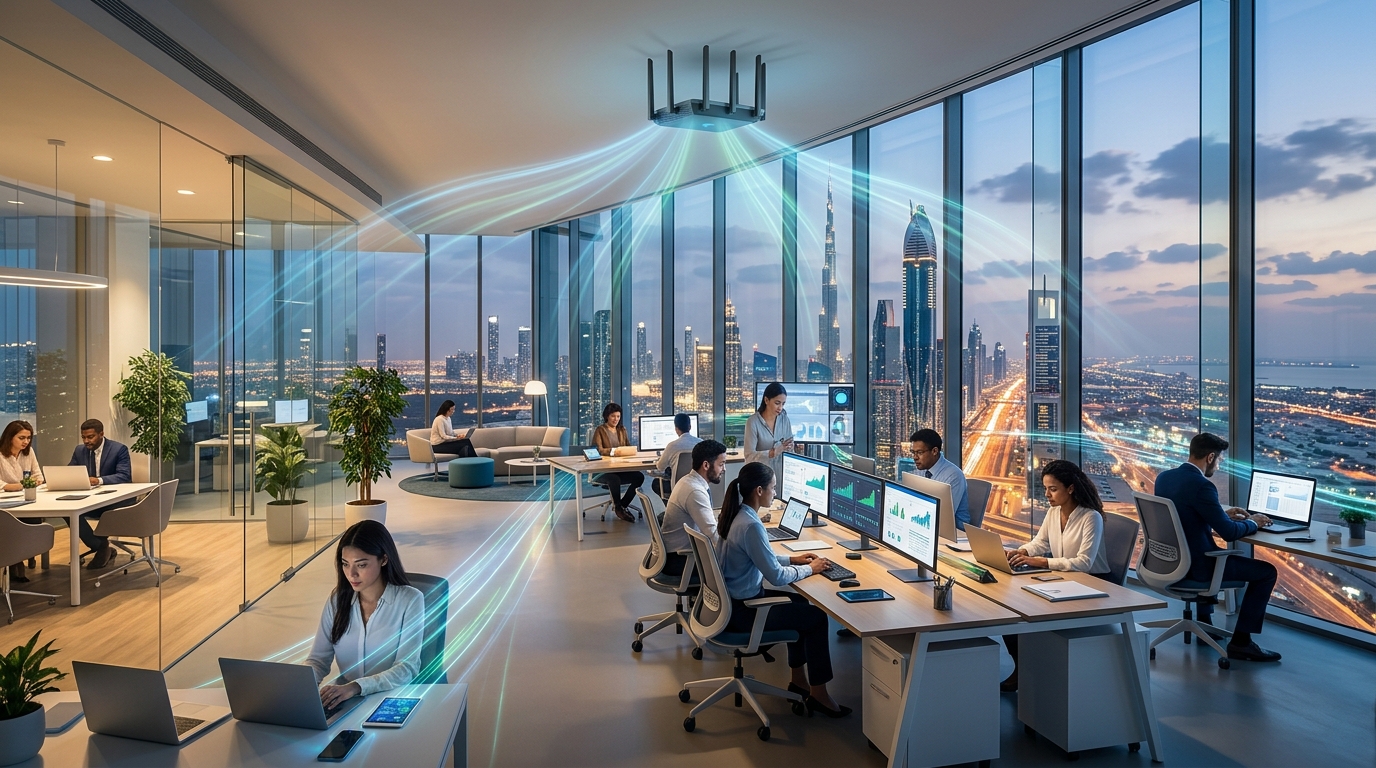
Dubai office spaces are often designed with openness and collaboration in mind. Hot-desking, agile workstations, sprawling breakout areas, and glass-walled conference rooms are standard architectural features. While these designs foster communication and teamwork, they create complex propagation challenges for traditional wireless networks. Signals must travel through thick glass partitions, open collaborative lounges packed with human traffic, and dense clusters of smart devices. Furthermore, many Dubai offices house dozens or even hundreds of employees in a single open-plan floor, each carrying multiple connected devices including laptops, smartphones, tablets, and smart wearables.
Compounding this high device density is the city’s relentless drive toward digital transformation. Government initiatives such as Smart Dubai and the Dubai Paperless Strategy have accelerated the adoption of cloud-first workflows. Employees constantly upload and download massive files, collaborate on real-time design documents, stream high-resolution presentations, and participate in simultaneous video conferences. In such a high-demand ecosystem, legacy Wi-Fi networks quickly become congested highways during rush hour, leading to dropped packets, slow load times, and frustrated professionals. Upgrading to Wi-Fi 6 and 6E provides the multi-lane digital superhighway required to keep these modern workplaces moving at peak velocity.
Decoding Wi-Fi 6 and Wi-Fi 6E: What Sets Them Apart?
Before examining the productivity benefits, it is helpful to understand the technological leaps that define Wi-Fi 6 (officially known as 802.11ax) and Wi-Fi 6E. At its core, Wi-Fi 6 was engineered not just to make individual device connections faster, but to fundamentally improve network efficiency when thousands of devices are connected simultaneously.
One of the standout features of Wi-Fi 6 is Orthogonal Frequency Division Multiple Access, commonly referred to as OFDMA. In older Wi-Fi generations, a router could only communicate with one device at a time, forcing other devices to wait their turn in a queue, which introduced latency and lag. OFDMA allows a single channel to be subdivided into smaller sub-channels. This enables the router to transmit data to multiple devices simultaneously in a single transmission burst. Imagine a delivery truck that previously delivered a single package to one house at a time versus a modern delivery van equipped to drop off packages to multiple houses on the same street in one efficient trip.
Another powerful innovation in Wi-Fi 6 is Multi-User Multiple Input Multiple Output, or MU-MIMO. While OFDMA divides channels for smaller data packets, MU-MIMO allows routers to handle multiple data streams simultaneously for heavier bandwidth tasks. Combined with 1024-QAM (Quadrature Amplitude Modulation), which packs more data into the same amount of spectrum space, Wi-Fi 6 delivers up to a fourfold increase in throughput capacity compared to Wi-Fi 5.
Wi-Fi 6E takes these remarkable capabilities and introduces an entirely new playground: the 6 GHz frequency band. Traditional Wi-Fi operates in the crowded 2.4 GHz and 5 GHz bands, which are shared with Bluetooth devices, microwaves, baby monitors, and neighbouring office networks, leading to severe interference. By opening up the vast, uncongested 6 GHz spectrum, Wi-Fi 6E provides up to 1200 MHz of contiguous spectrum space. This is equivalent to adding multi-lane expressways to a gridlocked city. There is zero overlap with legacy devices, meaning devices built for 6E enjoy lightning-fast speeds, near-zero latency, and pristine signal integrity.
Direct Drivers of Workplace Productivity
Upgrading to Wi-Fi 6 and 6E directly translates into tangible productivity gains across every department in a modern Dubai office. Productivity is no longer measured solely by hours spent at a desk, but by the efficiency and fluidity with which tasks are executed. Here is how advanced wireless infrastructure drives workplace output.
Eradicating Latency and Lag in Collaboration Tools
Modern business runs on communication platforms like Microsoft Teams, Zoom, Slack, and Google Workspace. In a city like Dubai, where regional headquarters coordinate daily with teams in London, Singapore, New York, and Riyadh, crystal-clear video conferencing is non-negotiable. Laggy video feeds, frozen screens, and audio dropouts disrupt the flow of conversation, miscommunicate nuances, and waste valuable meeting time.
Wi-Fi 6 and 6E dramatically reduce latency through technologies like Target Wake Time (TWT) and scheduled OFDMA transmissions. TWT allows access points to negotiate when and how often clients will wake up to send or receive data, reducing contention and keeping the channel clear for active voice and video streams. The result is seamless, high-definition video conferencing where participants can converse naturally, share heavy media files in real time, and collaborate without technical interruptions.
Empowering Seamless Cloud and Big Data Operations
Dubai enterprises increasingly rely on cloud-based Enterprise Resource Planning (ERP) systems, Customer Relationship Management (CRM) platforms, and heavy data analytics tools. When employees are tethered to slow networks, downloading massive client databases, uploading high-resolution marketing assets, or running real-time financial models becomes a tedious exercise in waiting.
With the multi-gigabit speeds enabled by Wi-Fi 6 and 6E, local network bottlenecks are effectively eliminated. Data moves between employee devices and cloud servers at speeds that rival wired Ethernet connections. This instantaneous data transfer means marketing teams can upload 4K video campaigns in seconds, financial analysts can pull massive datasets without crashing local connections, and software developers can push code repositories instantly. Removing these micro-delays preserves employee focus and prevents workflow fatigue.
Supporting High-Density Hybrid Work Environments
The shift toward hybrid work means office occupancy fluctuates throughout the week, often peaking on Tuesdays, Wednesdays, and Thursdays. On these busy days, traditional office networks struggle as hundreds of employees bring multiple devices into the office simultaneously.
Wi-Fi 6 is specifically designed for high-density environments. Its advanced scheduling and channel-splitting capabilities ensure that even when an office is packed to capacity, every single connected device receives consistent bandwidth. Whether an employee is sitting at their assigned desk, collaborating in an agile huddle room, or attending a town hall in an auditorium, the network adapts dynamically to maintain high performance. This reliability gives office managers the confidence to transition fully to flexible, unassigned seating arrangements without worrying about network dropouts.
Enhancing Employee Well-being and Job Satisfaction
Beyond raw output and operational speed, workplace infrastructure plays a profound psychological role in employee satisfaction and retention. In a competitive labor market like Dubai, where top global talent expects cutting-edge digital amenities, technology friction is a major source of workplace stress.
Constant technical glitches, slow loading screens, and dropped connections create daily micro-frustrations that wear down employee morale over time. When technology works effortlessly in the background, employees feel empowered, trusted, and equipped to do their best work. They can move freely around the office workspace with their laptops or tablets, transitioning from a formal meeting room to a quiet breakout pod without losing connectivity or having to manually reconnect to different access points.
Furthermore, seamless wireless connectivity supports modern wellness initiatives. Employees are no longer chained to static desktop computers with restrictive Ethernet cords. They can collaborate outdoors on landscaped office terraces, conduct walking one-on-one meetings in communal zones, or work from collaborative cafeteria spaces. This physical mobility boosts creativity, reduces sedentary fatigue, and fosters a more vibrant, dynamic corporate culture.
Securing the Enterprise: Advanced Protection for Modern Networks
Productivity cannot exist without security. In an era of sophisticated cyber threats, corporate networks must be protected against unauthorized access, data interception, and malware incursions. Upgrading to Wi-Fi 6 and 6E brings significant security enhancements that safeguard corporate assets while maintaining high performance.
Wi-Fi 6 mandates the adoption of WPA3 (Wi-Fi Protected Access 3), the latest and most secure wireless encryption standard. WPA3 introduces several critical security upgrades over its predecessor, WPA2:
- Robust Password Protection:** WPA3 utilizes Simultaneous Authentication of Equals (SAE) to protect user passwords against offline dictionary attacks, even if the password is weak or easy to remember.
- Individualized Data Encryption:** In open or enterprise Wi-Fi environments, WPA3 uses opportunistic wireless encryption to encrypt traffic between individual devices and the access point, protecting user data from eavesdropping on public or guest networks.
- Enhanced Enterprise Security:** For corporate environments requiring high security, WPA3 offers a 192-bit security suite that aligns with commercial national security algorithms, ensuring rigorous protection for sensitive financial, legal, and governmental communications.
Additionally, the clean 6 GHz spectrum available in Wi-Fi 6E provides an extra layer of physical security. Because legacy devices cannot operate in the 6 GHz band, malicious actors cannot use older hardware tools to scan or tamper with traffic on these high-speed channels. This creates an isolated, highly secure digital enclave for mission-critical enterprise operations.
Future-Proofing for IoT, AI, and Immersive Technologies
Technology never stands still, and modern offices must anticipate the innovations of tomorrow. Dubai is at the forefront of adopting artificial intelligence, spatial computing, augmented reality (AR), virtual reality (VR), and advanced Internet of Things (IoT) ecosystems.
Consider the modern smart office in Dubai. Automated climate control systems adjust temperatures based on real-time occupancy heatmaps. Smart lighting systems optimize energy consumption. Automated security cameras, biometric access control points, and digital reception desks operate continuously in the background. Furthermore, forward-thinking enterprises are beginning to explore AR and VR applications for architectural visualization, immersive remote collaboration, and employee training simulations.
These emerging technologies demand immense bandwidth, ultra-low latency, and absolute network reliability. Legacy Wi-Fi standards would quickly buckle under the combined load of corporate data traffic and dense IoT ecosystems. Wi-Fi 6 and 6E provide the massive capacity and intelligent scheduling needed to seamlessly integrate these future technologies. By investing in Wi-Fi 6 and 6E today, Dubai organizations are building a scalable digital foundation that will easily absorb the innovations of the next decade.
Strategic Implementation Roadmap for Dubai Businesses
Migrating from an older wireless network to a cutting-edge Wi-Fi 6 and 6E infrastructure requires careful planning and execution. To ensure a smooth transition with minimal disruption to daily business operations, IT leaders in Dubai offices should follow a structured implementation roadmap.
Conducting a Comprehensive Site Survey
Every office space is unique. Factors such as square footage, wall materials, glass partitions, ceiling heights, and sources of electromagnetic interference must be carefully evaluated. A professional site survey maps out radio frequency propagation across the office floor plan. This ensures that access points are placed in optimal locations to eliminate dead zones and deliver uniform, high-speed coverage to every corner of the workspace.
Assessing Client Device Compatibility
While Wi-Fi 6 and 6E routers are backward compatible with older devices, to reap the full productivity benefits, employee laptops, tablets, and smartphones must also support the new standards. IT departments should audit existing hardware fleets and prioritize upgrading employee devices during regular hardware refreshment cycles, ensuring that high-performance machines are paired with high-performance networks.
Designing for High-Density and Traffic Prioritization
Modern office networks must handle diverse traffic types, ranging from routine web browsing to mission-critical voice and video calls. Network architects should configure Quality of Service (QoS) policies to prioritize real-time communication traffic over less urgent background tasks, such as large software updates or cloud backups. This ensures that critical business operations remain smooth even during peak usage hours.
Partnering with Certified Local Experts
The telecommunications and IT landscape in Dubai is governed by specific regulatory frameworks and high standards. Partnering with certified local network integrators and IT service providers ensures that hardware selection, installation, configuration, and compliance adhere to regional best practices and telecommunications regulations. Local experts also provide ongoing monitoring and maintenance support to keep the network running at peak efficiency.
Conclusion: The Competitive Edge of Next-Generation Connectivity
In the dynamic and competitive business environment of modern Dubai, standing still is equivalent to moving backward. Every minute lost to network lag, every frustrating video call dropped during a crucial negotiation, and every bottleneck in cloud data transfer chips away at corporate productivity and employee morale.
Upgrading to Wi-Fi 6 and 6E is far more than a routine IT infrastructure upgrade. It is a strategic investment in human potential, operational agility, and future growth. By eliminating latency, empowering seamless collaboration across hybrid teams, securing corporate data with advanced encryption, and providing the robust foundation required for artificial intelligence and IoT ecosystems, these advanced wireless standards unlock a new tier of workplace efficiency.
Dubai offices are designed to inspire innovation, foster collaboration, and showcase architectural brilliance. By extending that brilliance into the digital realm with a world-class Wi-Fi 6 and 6E network, forward-thinking enterprises ensure their teams are equipped to succeed, lead, and thrive in the digital age.