
The Gatekeepers of Virtual Infrastructure
Modern enterprise data centers rely heavily on VMware vSphere as the bedrock of their virtualized environments. At the heart of this virtualization ecosystem sits VMware vCenter Server, a centralized management platform that orchestrates virtual machines, ESXi hosts, storage clusters, and network configurations. To support automation, infrastructure as code, and seamless integrations with third-party tools, vCenter exposes a rich suite of Application Programming Interfaces (APIs). These REST APIs, SOAP endpoints, and SDKs enable administrators and automated systems to programmatically provision, modify, and monitor virtual assets across the entire enterprise.
However, the very capability that makes vCenter APIs so powerful also transforms them into a prime target for malicious actors. If an attacker gains unauthorized access to a vCenter API, they bypass standard edge defenses and obtain direct control over the core computing environment. An unauthenticated or improperly authorized API invocation can result in catastrophic operational disruption, data exfiltration, ransomware deployment across virtual machine disks, or complete infrastructure takeover. Therefore, hardening vCenter APIs is not merely a recommended best practice, but an indispensable security imperative for every modern enterprise.
To effectively protect these critical endpoints, security teams must understand the complex landscape of vCenter API access, the threat vectors that target them, and the layered defense mechanisms required to enforce robust authorization. Securing vCenter APIs demands a comprehensive strategy that spans network segmenting, strict identity management, fine-grained role-based access control, encryption in transit, proactive logging, and continuous threat monitoring.
Mapping the Surface: Understanding the vCenter API Landscape
To protect vCenter APIs, one must first comprehend how they are constructed and exposed. VMware vCenter Server provides multiple API interfaces designed for different generations of tools and automation workflows. The classic VMware vSphere Web Services API relies on SOAP protocols to expose deep administrative functionality. Alongside it, the modern vSphere Automation API provides RESTful endpoints for simplified management of virtual machines, appliances, content libraries, and networking components. Additionally, specialized APIs such as the vSphere Storage APIs and ESXi Host Management APIs run in parallel to facilitate dedicated operational workflows.
These endpoints typically communicate over standard web ports, primarily TCP port 443 for encrypted HTTPS traffic. Behind this port, the vCenter Reverse Proxy routes incoming HTTP requests to various underlying microservices and management daemons. Because these APIs handle everything from session creation to snapshot deletion, any weakness in authentication handling or access controls can be exploited to gain high-level permissions.
A major challenge in securing vCenter APIs stems from their dual usage by both human operators and automated system accounts. Human administrators interact with APIs indirectly through command-line utilities like PowerCLI, scripting toolkits, or custom web portals. Simultaneously, automated pipelines, backup agents, monitoring platforms, and cloud management tools maintain persistent API connections. Securing this diverse ecosystem requires distinct policies for human users and machine identities, ensuring that every request is strictly authenticated, authorized, and audited regardless of its origin.
The Threat Landscape: How Attackers Exploit vCenter API Endpoints
Threat actors are fully aware of the power granted by vCenter access. In recent years, nation-state adversaries and cybercrime syndicates have increasingly targeted hypervisors and central management servers. Attackers prefer targeting vCenter APIs because compromising the management layer grants broad control over all hosted workloads without needing to compromise individual guest operating systems one by one.
One common vector involves the exploitation of unauthenticated API vulnerabilities. Software flaws such as remote code execution, server-side request forgery, or arbitrary file upload vulnerabilities in vCenter API endpoints allow attackers to bypass authentication entirely. Once an unauthenticated attacker achieves code execution within the vCenter appliance, they can dump credentials, generate forged administrative tokens, or manipulate virtual machine states.
Another prevalent threat vector is credential theft and API token hijacking. Attackers frequently harvest credentials from developer workstations, automation scripts stored in public or private code repositories, or unencrypted configuration files. If an attacker acquires a valid vCenter API session token or administrative credentials, they can execute legitimate API commands without triggering traditional signature-based detection mechanisms.
Furthermore, attackers exploit weak role-based access controls to move laterally across virtual networks. When service accounts are granted blanket administrator privileges rather than strictly required permissions, an attacker who compromises a low-priority monitoring tool can leverage its vCenter API token to reconfigure production firewalls, extract virtual machine memory dumps, or delete critical backups.
Foundation of Isolation: Network Segmentation and Perimeter Defense
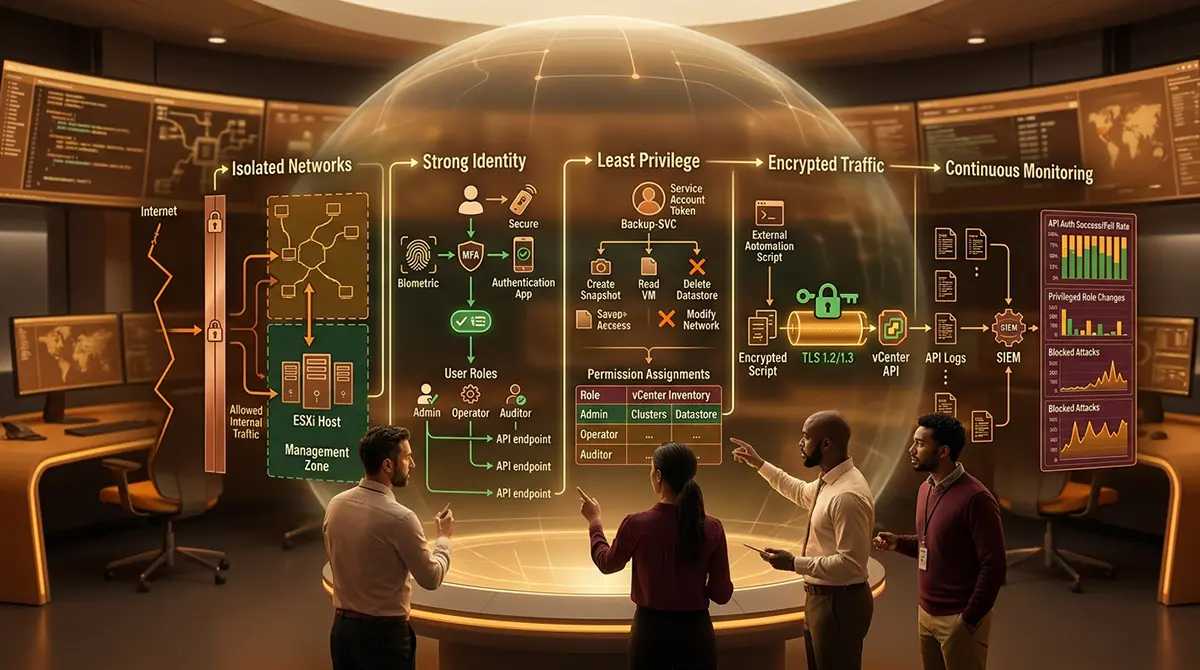
The primary line of defense for vCenter APIs involves restricting network reachability. Under no circumstances should vCenter API endpoints be accessible from the public internet. Access to port 443 on the vCenter Server Appliance must be strictly isolated to trusted administrative networks and authorized management systems.
Network segmentation should be implemented using dedicated Virtual Local Area Networks (VLANs) and micro-segmentation policies. The vCenter management network must reside on an isolated segment separated from general user networks, guest virtual machine traffic, and external connectivity. Access to this management VLAN should be mediated by stateful firewalls that enforce strict IP address filtering.
For remote management and external automation pipelines, organizations should mandate access through secure Bastion hosts or dedicated virtual private networks with multi-factor authentication. Implementing hardware jump boxes or privileged access workstations ensures that API calls originate only from known, hardened endpoints. Furthermore, network access control lists should restrict outbound internet connections from the vCenter server itself, preventing compromised management nodes from contacting external command and control servers.
Where applicable, organizations that manage complex hybrid deployments across international offices or distributed cloud environments, such as those leveraging specialized DevOps Services in Dubai or other global technology hubs, must maintain strict zero trust network policies regardless of geography. Ensuring that API endpoints remain invisible to unauthorized scanners across all network zones dramatically reduces the exposure surface.
Ironclad Identity: Strengthening Authentication Protocols
Securing API endpoints begins with robust, identity-based authentication. VMware vCenter Server integrates with VMware Single Sign-On (SSO) to manage identity federation, session tokens, and authentication workflows. To defend against unauthorized API access, organizations must replace legacy, password-only authentication mechanisms with modern, multi-factor security frameworks.
-
Integration with Enterprise Identity Providers: vCenter SSO should be integrated with centralized Active Directory, Azure Active Directory, or Security Assertion Markup Language (SAML) 2.0 identity providers. Centralizing identity management allows security teams to enforce unified password policies, immediate account revocation, and conditional access controls.
-
Enforcement of Multi-Factor Authentication: Multi-factor authentication must be mandatory for all human accounts capable of initiating vCenter API sessions. By requiring a second authentication factor, such as a hardware token or push notification, organizations neutralize the risk of compromised passwords.
-
Deprecation of Legacy Authentication Methods: Legacy authentication mechanisms, such as basic HTTP authentication transmitting credentials in plain text or poorly secured local domain accounts, must be explicitly disabled. All API clients should utilize secure authentication flows that issue short-lived SAML tokens or OAuth 2.0 bearer tokens.
-
API Session Timeout Rules: API session tokens must be configured with aggressive expiration limits. Leaving API sessions open indefinitely exposes the environment to token theft and replay attacks. Administrators should enforce automatic session termination after brief periods of inactivity.
Granular Control: Implementing Least Privilege Role-Based Access
Authenticating a user or service account is only half the battle; the system must also restrict what that authenticated identity is permitted to do. VMware vSphere provides a sophisticated Role-Based Access Control (RBAC) framework that allows administrators to grant precise permissions across folder structures, clusters, datastores, and individual virtual machines.
Unfortunately, many enterprise deployments suffer from permission sprawl. To simplify setup, administrators frequently assign service accounts and automation scripts to the default Administrator role. This practice creates severe security vulnerabilities, as a compromise of any single service account results in full control over the entire vSphere infrastructure.
To enforce the principle of least privilege across vCenter APIs, security teams should adhere to structured permission modeling practices:
-
Creation of Custom Roles for Automated Services: Default administrator roles should never be assigned to service accounts, scripts, or third-party applications. Instead, security teams must define granular custom roles that grant only the specific privileges required for the task. For example, a backup service account requires permissions to read virtual machine configurations and create snapshots, but has no need for permissions to delete datastores or reconfigure virtual networks.
-
Context-Aware Permission Scoping: Permissions should be applied at the lowest possible level in the vCenter inventory hierarchy. Rather than granting permissions at the root vCenter object, access should be restricted to specific folders, resource pools, or ESXi host clusters.
-
Segregation of Administrative Duties: Operational responsibilities should be divided among distinct administrative groups. Network management, storage provisioning, virtual machine lifecycle management, and security auditing should each require separate roles with mutually exclusive privileges.
-
Continuous Privilege Auditing: Permissions granted across vCenter objects must be reviewed periodically. Unused service accounts, orphaned custom roles, and excessive administrative assignments should be identified and removed systematically.
Protecting Data in Motion: Mandatory Encryption and Certificate Management
Because vCenter APIs handle sensitive data including administrative credentials, session tokens, host configurations, and virtual disk contents, all network traffic between API clients and vCenter endpoints must be encrypted using strong cryptographic protocols.
By default, vCenter uses Transport Layer Security (TLS) to encrypt communications over TCP port 443. However, improper TLS configuration can leave API communications vulnerable to man-in-the-middle attacks, credential sniffing, and token interception.
To maintain robust cryptographic protections for vCenter APIs, administrators must execute several essential practices:
-
Enforce Modern TLS Protocols: Legacy encryption protocols, specifically SSL v3, TLS 1.0, and TLS 1.1, must be entirely disabled within the vCenter Server configuration. API endpoints should strictly mandate TLS 1.2 or TLS 1.3, utilizing strong cipher suites that provide Perfect Forward Secrecy.
-
Replace Default Self-Signed Certificates: Upon installation, vCenter Server generates self-signed certificates issued by the internal VMware Certificate Authority. Leaving default self-signed certificates in production leads administrators and automation scripts to disable certificate validation, leaving them open to interception. Organizations must replace these default certificates with trusted certificates issued by an enterprise Root Certificate Authority or a recognized public authority.
-
Enforce Strict Certificate Validation in API Scripts: Developer scripts, SDK applications, and command-line automation toolkits must be configured to validate TLS certificates rigorously. Code snippets that bypass SSL verification, such as explicitly ignoring certificate warnings, must be strictly forbidden in production automation pipelines.
-
Implement Mutual TLS for Service Connections: For high-security environments, mutual TLS (mTLS) can be implemented for API automation endpoints. By requiring API clients to present a valid client-side X.509 certificate in addition to valid credentials, organizations ensure that only pre-approved devices can initiate API sessions.
Shielding the Core: Hardening the vCenter Server Appliance
Securing the API layer is directly dependent on the security posture of the underlying operating system and application services running on the vCenter Server Appliance (VCSA). If the appliance itself is compromised, an attacker can bypass API security controls entirely by manipulating local configuration files, intercepting memory, or disabling security services.
Appliance hardening involves a comprehensive set of baseline security configurations designed to minimize the operating system attack surface:
-
Rapid Vulnerability Patching: VMware frequently releases security advisories and patches addressing critical vulnerabilities in vCenter management components and API services. Security teams must establish a rigorous patch management schedule, applying security patches immediately upon release for high-severity vulnerabilities.
-
Disabling Unnecessary Services and Interfaces: Any service or interface not required for core vCenter operations should be disabled. For instance, the Appliance Shell and SSH access should remain disabled during normal operation and enabled only temporarily by authorized staff for troubleshooting purposes.
-
Utilizing Built-in Firewall Rules: The VCSA includes a native iptables firewall that can be configured directly through the Appliance Management Interface. System administrators should configure local firewall rules on the appliance to allow incoming API requests only from trusted management IP ranges, adding an additional layer of protection beneath network perimeter firewalls.
-
Hardening Operating System Parameters: The underlying Photon OS distribution must be configured according to benchmark guidelines, such as those provided by the Center for Internet Security (CIS) or Defense Information Systems Agency (DISA) Security Technical Implementation Guides (STIGs). This includes enforcing password complexity for appliance root accounts, setting strict file permissions, and enforcing kernel-level security parameters.
Eyes on the Environment: Logging, Auditing, and Real-Time Monitoring
Comprehensive visibility is essential for detecting unauthorized API activity, investigating suspicious behavioral anomalies, and proving compliance with regulatory standards. Every API call made to vCenter generates event logs and task records that describe who initiated the request, when it occurred, the source IP address, and the specific operation performed.
To convert raw log data into actionable security intelligence, organizations must implement a centralized logging and event monitoring framework:
-
Centralized Log Forwarding: Local logs stored on the vCenter Appliance can be altered or erased by an attacker who achieves root access. Therefore, vCenter event logs, audit logs, and syslog outputs must be continuously streamed to an external, write-once Log Management system or Security Information and Event Management (SIEM) platform.
-
Monitoring Critical API Events: Security operations teams should configure automated alerts for high-risk API events. Operations that should trigger real-time alerts include multiple failed API authentication attempts, creation or modification of administrative roles, deletion of virtual machine snapshots, changes to network virtual distributed switches, and unexpected batch exports of virtual disks.
-
Tracking Anomaly Patterns in Service Accounts: Automated service accounts typically execute predictable tasks at defined schedules from fixed IP addresses. Security monitoring platforms should establish baseline behavioral profiles for service accounts. Any API request from a service account originating from an unusual IP address or requesting unexpected privileges should be flagged immediately for investigation.
-
Retaining Audit Logs for Forensic Analysis: Log retention policies must preserve API audit logs for a sufficient duration, typically 90 days to one year depending on regulatory requirements. Detailed audit logs allow forensic investigators to trace the exact scope and timeline of an incident if a credential compromise occurs.
Building Resilient Automation: Secure Software Development Practices
In modern cloud environments, vCenter APIs are frequently consumed by custom infrastructure tools, continuous integration pipelines, and orchestration frameworks. The security of vCenter APIs is therefore directly tied to the security of the code that interacts with them. Poor coding practices can easily expose API credentials or introduce vulnerabilities into management workflows.
Development teams building integrations for vCenter APIs must adopt secure coding principles throughout the software development lifecycle:
-
Elimination of Hardcoded Credentials: API passwords, private keys, and session tokens must never be embedded directly into source code, scripts, or configuration files. Hardcoded secrets are easily leaked through code repositories or log files. Instead, code should retrieve credentials dynamically at runtime from secure secrets management solutions, such as hardware security modules or dedicated vault platforms.
-
Input Validation and Sanitization: Software that accepts user inputs and constructs vCenter API calls must perform rigorous input validation. Failing to sanitize inputs can expose the management platform to injection attacks or unintended operational failures.
-
Safe Token Handling and Memory Management: API authentication tokens should be stored securely in memory, transmitted only over encrypted channels, and explicitly invalidated via log-out API calls as soon as the automation task is completed.
-
Automated Dependency Scanning: Third-party SDKs, libraries, and modules used to interact with vCenter APIs must be regularly updated and scanned for known security vulnerabilities. Vulnerable software dependencies can serve as an entry point for attackers targeting administrative APIs.
Proactive Validation: Continuous Vulnerability Scanning and Penetration Testing
Configuring security controls is an ongoing process that requires constant validation. Systems drift over time as updates are applied, new integrations are added, and operational requirements change. To ensure that vCenter API defenses remain effective, organizations must conduct continuous vulnerability management and periodic security testing.
Automated vulnerability scanners should be configured to scan the vCenter infrastructure regularly for known software flaws, misconfigurations, and outdated SSL certificates. However, automated scanning alone is insufficient to identify complex logic flaws or multi-stage attack paths.
Organizations should complement automated scanning with professional penetration testing and red teaming exercises. Security assessors should simulate real-world attacks against vCenter API endpoints, attempting to exploit weak access controls, hijack active sessions, or execute unauthorized operations. The insights gained from these security assessments provide invaluable feedback for hardening network controls, refining SIEM alerting rules, and elevating the overall security posture of the virtualized environment.
Conclusion: A Holistic Strategy for vCenter API Defense
As virtualized infrastructure continues to serve as the backbone of modern enterprise operations, securing the APIs that control these environments is paramount. VMware vCenter APIs provide incredible agility and automation potential, but unmanaged access exposes the core of the enterprise to severe cyber threats.
Achieving robust protection against unauthorized API access requires a defense-in-depth architecture. Organizations must restrict network reachability through strict segmentation, enforce strong multi-factor authentication, apply the principle of least privilege through tailored role-based access controls, and mandate modern encryption protocols. Furthermore, securing the underlying vCenter Appliance, centralizing log analysis, adopting secure development practices, and conducting continuous security validation ensure that API endpoints remain resilient against evolving attack vectors.
By treating vCenter APIs as critical security boundaries and implementing comprehensive operational controls, enterprise IT organizations can safely harness the full power of virtualization and automation while keeping unauthorized actors firmly at bay.