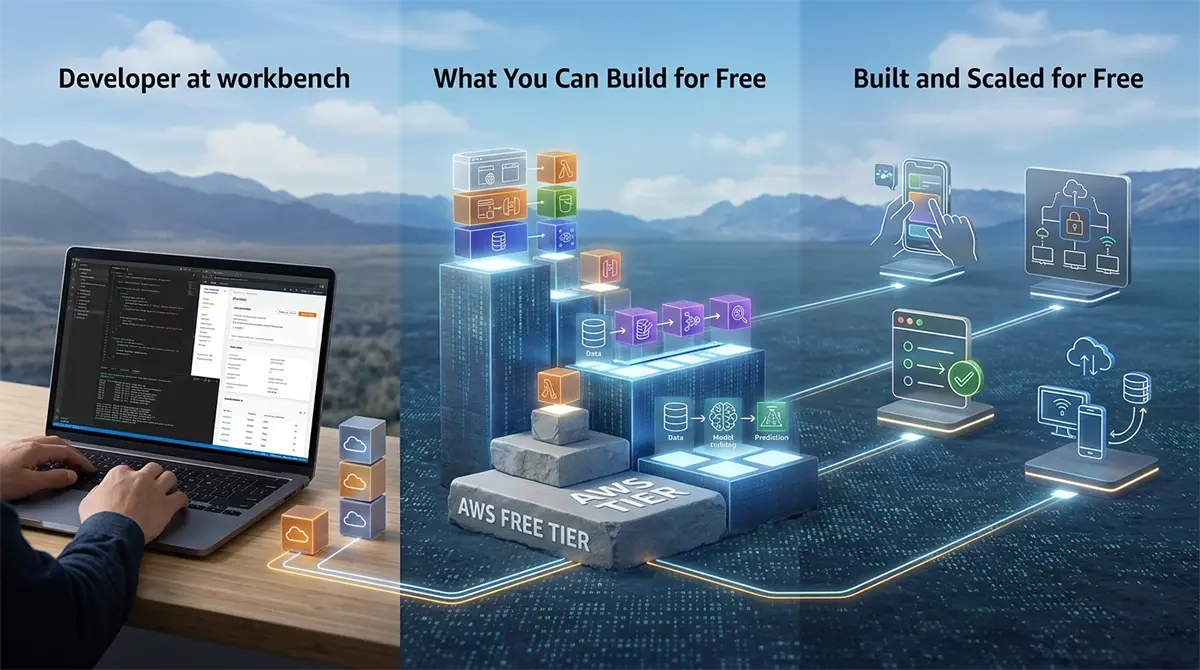

Imagine having access to the exact same cloud infrastructure that powers global enterprise giants, streaming services, and revolutionary technology companies, all without spending a single dollar. That is not a marketing exaggeration or a temporary promotional gimmick. The Amazon Web Services (AWS) Free Tier offers developers, entrepreneurs, students, and system architects an unprecedented opportunity to experiment, build, deploy, and scale application prototypes entirely free of charge. Whether you are aiming to launch a full-stack web application, construct a serverless data processing pipeline, deploy an artificial intelligence microservice, or build an enterprise-grade automated backup solution, the AWS platform gives you the foundational tools to make it happen.
Navigating the cloud landscape can sometimes feel overwhelming due to the sheer variety of service offerings, billing metrics, and tier specifications. However, once you understand how the free offerings are structured, you unlock a sandbox of near-infinite possibilities. In this comprehensive guide, we will unpack how the AWS Free Tier functions, explore the three distinct types of free offers available, detail what you can realistically construct across various technical domains, and share crucial strategies to ensure your cloud architecture stays strictly within zero-cost boundaries.
Deconstructing the AWS Free Tier Engine
To make full use of free cloud resources, it helps to understand that Amazon does not treat all free services identically. Amazon Web Services structures its non-paying allocations into three primary models: Always Free, 12 Months Free, and Short-Term Trials. Grasping the distinction between these three tiers is the key to designing architectures that remain active and operational without triggering unexpected charges on your billing statement.
The Always Free tier represents a perpetual grant of resources. These offers do not expire after your first year of account creation. As long as your account remains active and in good standing, Amazon refreshes these resource quotas at the beginning of every calendar month. This category includes powerhouse services such as AWS Lambda, which gives you one million free requests every month, and Amazon DynamoDB, which provides twenty-five gigabytes of cloud storage alongside sufficient read and write capacity units to support small to medium operational workloads.
The 12 Months Free allocation begins the exact day you activate your new AWS account. For three hundred and sixty-five consecutive days, you receive monthly quotas for core cloud infrastructure components. This includes seven hundred and fifty hours per month of Amazon Elastic Compute Cloud (EC2) micro instances, seven hundred and fifty hours of Amazon Relational Database Service (RDS), five gigabytes of Amazon Simple Storage Service (S3) standard object storage, and generous allowances for network load balancers, API gateways, and notification hubs. Because a standard calendar month contains seven hundred and forty-four hours max, seven hundred and fifty hours means you can run a single compute instance and database instance continuously twenty-four hours a day, seven days a week for an entire year.
The third tier consists of Short-Term Trials. These are specialized free access periods triggered when you activate specific advanced services for the first time, regardless of how old your overall AWS account is. For example, machine learning tools like Amazon SageMaker or security platforms like Amazon GuardDuty offer free trials lasting anywhere from fourteen days to two months, or up to a specific dollar credit equivalent. Understanding these three buckets allows you to chain services together seamlessly, building sophisticated distributed systems while keeping your ledger balanced at zero.
Architectural Masterpiece One: High-Availability Web Applications
Building a production-ready, fault-tolerant web application used to require purchasing dedicated server hardware, leasing datacenter rack space, and configuring physical networking switches. Today, you can assemble a modern full-stack web application completely within the AWS Free Tier.
Consider a classic full-stack three-tier architecture consisting of a web front end, a business logic backend, and a persistence database layer. You can host the frontend static files, such as HTML, CSS, JavaScript, and compiled single-page application assets, directly within Amazon S3. S3 standard tier includes five gigabytes of storage, which is more than enough room for thousands of optimized frontend builds. To make your web application load at lightning speed for global users, you can place Amazon CloudFront in front of your S3 bucket. CloudFront is AWS’s global Content Delivery Network (CDN), and its Always Free tier provides a staggering one terabyte of outbound data transfer per month along with ten million HTTP or HTTPS requests.
For the application logic layer, you can run a lightweight Linux or Windows virtual machine using Amazon EC2. The twelve-month free tier grants seven hundred and fifty hours of t2.micro or t3.micro compute instances every month. Alternatively, if you prefer a modern serverless design pattern, you can eliminate the virtual machine entirely and write your backend logic using AWS Lambda. By pairing Lambda with Amazon API Gateway, which provides one million free API calls per month for twelve months, your application automatically scales up during traffic surges and down to zero when idle, consuming zero compute credits when no requests are active.
Finally, for persistent database storage, you can choose between transactional SQL databases and flexible NoSQL data stores. Under the twelve-month free tier, Amazon RDS provides seven hundred and fifty hours of single-AZ database compute paired with twenty gigabytes of General Purpose SSD storage, supporting popular engines such as PostgreSQL, MySQL, and MariaDB. If your architecture aligns better with document or key-value storage, Amazon DynamoDB gives you twenty-five gigabytes of Always Free storage capacity. When combined, these server components allow you to host high-performance web portals, content management platforms, personal blogs, or e-commerce prototypes completely free of charge.
Architectural Masterpiece Two: Event-Driven Serverless Data Pipelines
Data engineering and automated stream processing represent some of the most dynamic areas of modern software development. Traditional data pipelines require dedicated clusters that idle during off-peak hours, wasting compute budget. Serverless data pipelines built on AWS eliminate idle capacity costs by executing code purely on demand.
Imagine building an automated media processing pipeline that ingests user uploads, extracts metadata, resizes high-resolution imagery, and indexes content for real-time search. When an end user uploads an image or document file to an Amazon S3 bucket, S3 can instantly trigger an asynchronous event notification. This event invokes an AWS Lambda function without requiring any active polling servers.
Inside the Lambda function, your application code can parse the image using open source libraries, generate modern WebP thumbnails, and save the converted files back into an output storage bucket. Simultaneously, you can pass document metadata into Amazon Simple Notification Service (SNS) or Amazon Simple Queue Service (SQS). SQS provides one million free request operations per month under the Always Free model, enabling reliable asynchronous message decoupling between decoupled services.
If your processing pipeline requires orchestration across multiple branching workflows, such as checking file integrity, handling execution errors, and updating external notification channels, you can leverage AWS Step Functions. Step Functions provides four thousand free state transitions every month on the Always Free tier. This allows you to visualize and execute complex distributed workflows, retry failed tasks automatically, and establish human-in-the-loop approval processes without managing background worker nodes.
Architectural Masterpiece Three: Intelligent AI and Machine Learning Workloads
Artificial intelligence and automated visual recognition were once restricted to research labs with million-dollar GPU clusters. The AWS platform democratizes intelligent cloud compute by exposing sophisticated pre-trained machine learning models through simple RESTful API endpoints, many of which offer generous free usage allocations.
You can construct an intelligent document analysis microservice without writing a single line of machine learning code from scratch. By sending scanned document images or PDF uploads to Amazon Textract, which offers one thousand free page extractions per month during your first year, you can convert unstructured paper forms into structured JSON data automatically.
If your workflow requires analyzing text sentiment, extracting key entities, or categorizing customer feedback messages, Amazon Comprehend provides fifty thousand units of text processing per month for the first twelve months. You can combine this with Amazon Transcribe, which offers sixty minutes of free speech-to-text conversion per month, to automatically parse incoming call transcripts or voice memos.
For voice synthesis, Amazon Polly provides five million free characters of text-to-speech conversion every month during your initial twelve months. This enables you to build custom interactive voice applications, automated language learning tutors, accessible content readers, and real-time audio announcement systems without investing in proprietary speech models or expensive dedicated hardware accelerators.
When companies scale these intelligent proof-of-concept projects into enterprise-wide production deployments, they often collaborate with specialized aws consulting services to optimize model inference latency, structure hybrid cloud security policies, and maintain lean architectural governance across multi-account environments.
Architectural Masterpiece Four: Internet of Things and Edge Telemetry Hubs
The proliferation of smart home devices, industrial telemetry sensors, and remote environmental monitors has made real-time Internet of Things (IoT) ingestion a crucial technical domain. AWS provides an end-to-end framework designed specifically to capture, process, and store streaming metric data from hardware peripherals.
With AWS IoT Core, you can connect physical microcontrollers, Raspberry Pi boards, or simulated device software to the cloud using lightweight security protocols like MQTT or HTTP. The AWS IoT Core Always Free tier includes five hundred thousand free message transfers per month. Devices can securely authenticate using X.509 digital certificates, ensuring encrypted communication across public network boundaries.
Once your telemetry data arrives at AWS IoT Core, the built-in rules engine can evaluate incoming telemetry payloads instantly. You can route temperature anomalies, vibration threshold breaches, or geospatial updates directly to Amazon DynamoDB for long-term storage, or trigger immediate emergency notifications to mobile devices through Amazon SNS.
To visualize this sensor data, you can host lightweight analytical dashboards on an EC2 instance running open source visualization tools like Grafana, or generate static HTML charts and push them directly to S3. This setup lets you build smart agricultural tracking setups, home automation telemetry controllers, or remote fleet management loggers without incurring ongoing service expenses.
Architectural Masterpiece Five: Automated DevOps, CI/CD, and Infrastructure Governance
Modern software engineering relies on continuous integration and continuous delivery (CI/CD) pipelines to maintain rapid release cycles and high software quality. AWS supplies native developer tools that enable you to build fully automated code deployment systems within the free allocation limits.
You can host your private source code repositories on AWS CodeCommit, which offers five active user licenses per month for free, complete with fifty gigabytes of cloud storage and ten thousand git requests. When developers push code commits to your repository, AWS CodePipeline can automatically detect changes and trigger automated build stages. CodePipeline grants one free active pipeline per month under the Always Free tier.
To compile source code, execute unit test suites, and package application container images, you can invoke AWS CodeBuild. CodeBuild provides one hundred build minutes per month of standard compute instances. Once the build completes successfully, CodeBuild can automatically push container images into Amazon Elastic Container Registry (ECR), which includes five hundred megabytes per month of free storage in the private registry tier.
For monitoring, observability, and system health logging, Amazon CloudWatch provides an essential foundation. The Always Free cloud monitoring allocation includes ten custom metrics, ten alarm monitors, one million API requests, five gigabytes of ingested log data, and three dashboards with up to fifty metrics each. This allows you to configure automated operational alerts that notify your team via email or SMS whenever system metrics spike beyond defined thresholds, ensuring complete visibility into your cloud stack’s operational stability.
Vital Strategies to Avoid Unintended Cloud Charges
While the AWS Free Tier offers immense technical capability, failing to monitor your underlying infrastructure can lead to unexpected surprise charges. AWS bills based on resource consumption, and exceeding free allocations by even a small margin will result in automated credit card charges. Adopting disciplined cloud management habits from day one ensures your experimental projects remain truly free.
-
Set Up AWS Budgets Immediately: Create a zero-spend budget or custom threshold alert within the AWS Billing Dashboard during account setup. This ensures you receive instant email notifications the moment actual or forecasted usage approaches eighty percent of your free tier boundaries.
-
Capitalize on CloudFront Outbound Limits: Instead of exposing EC2 or S3 directly to the public internet, route your traffic through Amazon CloudFront. This increases your monthly free outbound data transfer threshold from standard S3 limits to a massive one terabyte per month.
-
Practice Rigorous Resource Hygiene: Unattached Elastic IP addresses, orphan EBS storage volumes left behind after deleting virtual instances, outdated database snapshots, and unused NAT Gateways accrue background charges. Systematically clean up stopped resources when testing concludes.
-
Enforce Least Privilege Security Controls: Protect root account credentials with multi-factor authentication (MFA) and construct dedicated Identity and Access Management (IAM) user roles. Keeping API keys secure prevents unauthorized third parties from hijacking your compute resources for malicious operations.
Transform Your Ideas Into Reality Today
The AWS Free Tier removes financial barriers, allowing developers, innovators, and organizations to transform creative concepts into operational software systems. By strategically combining micro-compute instances, serverless function routines, scalable object storage, managed database clusters, intelligent AI APIs, and real-time messaging hubs, you can build production-ready applications that serve real users across the globe without financial investment.
The modern cloud landscape rewards hands-on experimentation and continuous learning. With zero financial risk on the table, there has never been a better time to register an account, launch your first cloud architecture, and discover firsthand what you can build for free on AWS.