

In the rapidly evolving landscape of online retail, selecting the right platform is one of the most critical structural decisions an e-commerce entrepreneur or institutional investor will ever make. For years, WooCommerce and Shopify have stood as the two dominant titans of the digital storefront ecosystem. While both enable merchants to catalog products, process payments, and connect with customers globally, they represent fundamentally contrasting philosophies of technology management, financial ownership, and operational scaling. As the market for buying, selling, and flipping digital assets matures, the platform underpinning an e-commerce business has shifted from a mere technical detail to a primary driver of valuation, transaction friction, and post-acquisition ROI. Investors looking at Shopify stores for sale often find themselves comparing these turn-key hosted businesses with self-hosted WooCommerce operations, or contemplating acquiring a WooCommerce store with the explicit strategy of migrating it to Shopify post-purchase. This article provides an exhaustive, institutional-grade evaluation of WooCommerce versus Shopify, specifically tailored through the lens of purchasing, operating, and transitioning existing e-commerce assets.
Understanding the Core Philosophies: Open Source Sovereignty vs. Hosted Convenience
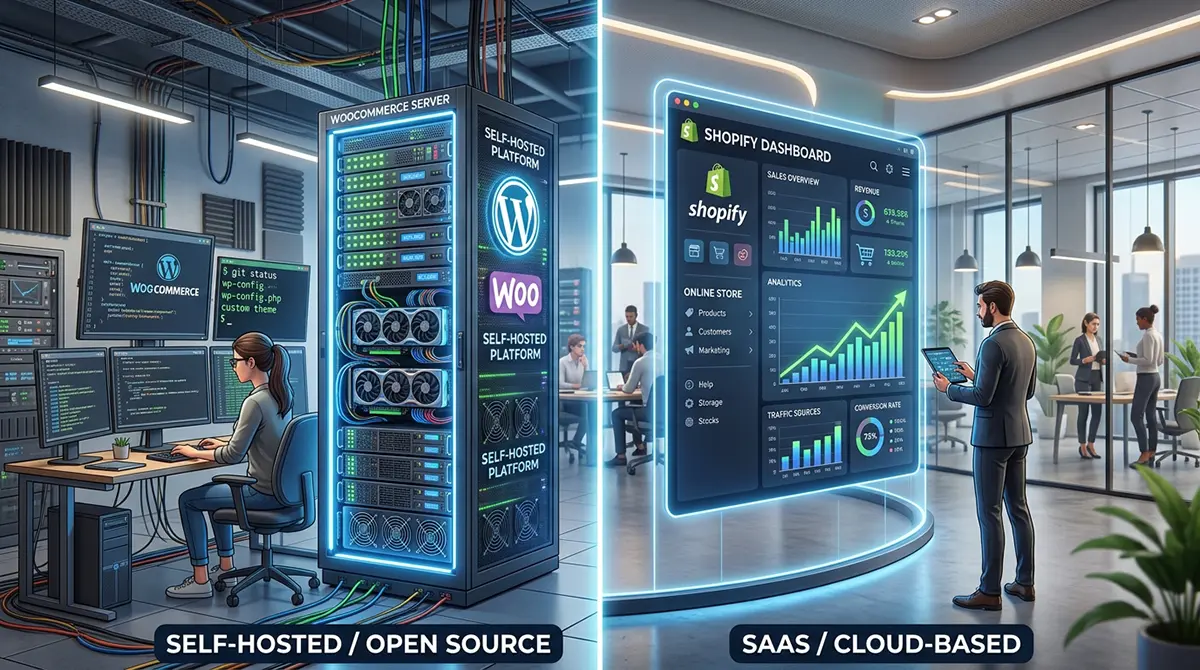
To evaluate any existing storefront for sale, one must first grasp the core architectural differences that separate WooCommerce and Shopify. WooCommerce is an open-source, self-hosted plugin built specifically for WordPress, the content management system that powers a vast portion of the global web. Because it is open source, WooCommerce grants merchants absolute ownership over their code, database, server environment, and customer relationships. There are no platform-level transaction fees, no arbitrary service bans, and virtually zero restrictions on customized business logic or design architecture. However, this total digital sovereignty comes with significant operational overhead. Merchants are responsible for managing hosting infrastructure, securing payment processing gateways, enforcing PCI compliance, optimizing database queries, and maintaining custom code stability across plugin updates.
Conversely, Shopify is a fully managed, Software-as-a-Service (SaaS) ecosystem. It abstracts away server management, security updates, database administration, and basic payment integration in exchange for a monthly subscription fee and transaction-based charges. Shopify operates as a walled garden: highly optimized, exceptionally stable, and remarkably user-friendly, but bounded by the terms of service and technical constraints set by its parent corporation. When evaluating Shopify stores for sale on public brokerages or private deal networks, buyers are looking at businesses built on predictable, standardized infrastructure. The tradeoffs between open-source autonomy and SaaS convenience influence every stage of the M&A lifecycle, from initial due diligence and audit capabilities to post-close operational effort and long-term brand enterprise value.
Evaluating Existing E-Commerce Assets: Diligence in WooCommerce vs. Shopify Acquisitions
When auditing an established e-commerce asset for acquisition, the underlying software architecture directly dictates the complexity and risk profile of the due diligence process. Acquiring a business means taking on its technical debt, supply chain dependencies, and financial trail. The ease with which an investor can verify financial performance and assess operational health varies dramatically between WooCommerce and Shopify.
Due diligence for Shopify stores for sale is notoriously straightforward, which explains why Shopify businesses command a high volume of transactions among micro-private equity firms and individual buyers. Because Shopify centralizes transaction history, traffic logs, and customer records on a unified cloud backend, proof of revenue is simple to verify. Buyers can request read-only access to the store’s dashboard or utilize automated verification tools provided by platforms like Empire Flippers, Flippa, or Quiet Light. Furthermore, technical debt on Shopify is usually capped by the guardrails of the platform. Unless the store relies heavily on custom liquid code or complex headless architectures, a Shopify site consists of off-the-shelf themes and third-party apps from the official store. This high level of standardization means that a buyer rarely needs a software engineer on retainer just to audit the codebase before placing an offer.
In stark contrast, conducting due diligence on a WooCommerce store requires a much deeper, highly technical audit. Because database records reside on self-hosted servers, historical revenue numbers can technically be manipulated in the backend unless corroborated by third-party payment processor logs from Stripe, PayPal, or bank statements. Beyond financial auditing, technical due diligence for WooCommerce demands an exhaustive review of hosting arrangements, server configuration files, custom PHP functions, database bloat, and plugin compatibility. A WooCommerce asset might show strong profit margins on paper, but if its database is overburdened by years of unindexed transient data, or if its custom core functionality relies on abandoned plugins, the true cost of acquisition rises significantly once post-sale maintenance costs are factored in.
Key areas to inspect during technical due diligence include:
-
Database Health: Verifying index optimization, cleaning unused transients, and ensuring order tables are isolated cleanly from post storage.
-
Plugin Architecture: Audit for legacy, unmaintained, or redundant plugins that increase vulnerability surfaces.
-
Hosting Infrastructure: Evaluating whether current server allocations can handle existing traffic levels without immediate server upgrades.
-
Custom Codebase: Reviewing functions.php file modifications and custom child themes for hardcoded errors or security oversights.
Ready to take your digital platform to the next level? Visit our website support Dubai page for reliable maintenance, or connect with our Dubai design agency to start your next web design project today.
Financial Trajectories: Cost Structures and Profit Margin Mechanics
A critical area of evaluation when comparing these two platforms for purchase is the structure of operating expenses. The underlying cost engine directly influences the net profit margins of an e-commerce store, which in turn determines its earnings multiple and valuation on the open market.
WooCommerce operates on an unbundled cost structure. The core plugin is free, but operating a high-volume storefront requires substantial investment in premium hosting, private server infrastructure, enterprise security firewalls, automated backup systems, and specialized third-party plugins for subscriptions, advanced marketing, or CRM integrations. For small stores, WooCommerce can look remarkably lean, costing only a few dollars per month for shared hosting. However, as order volumes scale into seven or eight figures, WooCommerce scaling expenses shift heavily toward developer retainers, specialized WooCommerce-optimized managed hosting, and custom database administration. The primary financial advantage of WooCommerce at scale is the absence of forced platform transaction fees. A merchant only pays their direct payment processor rates, allowing high-margin, high-volume operations to retain more gross profit per order.
Shopify utilizes a bundled, subscription-driven financial model. Store owners pay a recurring monthly fee that scales based on tier requirements, alongside additional costs for essential third-party apps from the Shopify App Store. The most significant financial variable on Shopify is transaction fees. If a merchant uses Shopify Payments, transaction costs are aligned with standard credit card processing rates. However, if a business uses an external gateway or operates in a jurisdiction or niche where Shopify Payments is unavailable, Shopify levies an additional platform fee on top of standard processing charges. As a store scales, app subscription costs can compound rapidly, creating a layered operating expense structure. When acquiring Shopify stores for sale, investors must carefully scrutinize the target app stack to identify recurring software costs that could be streamlined or consolidated post-purchase to expand operating margins.
Scaling Mechanics: Infrastructure, Performance, and Peak Traffic Management
The capacity of an e-commerce store to handle sudden spikes in web traffic and order volume is a fundamental driver of business enterprise value. High-volume marketing campaigns, viral social media trends, or seasonal flash sales can easily crush an unprepared infrastructure, leading to crashed checkout pages and lost revenue.
Shopify excels at handling extreme scaling events out of the box. Its cloud infrastructure is built on distributed server clusters engineered to handle Black Friday and Cyber Monday traffic spikes without merchant intervention. When buying a Shopify store, an investor inherits a system where bandwidth, server response times, edge caching, and server updates are fully offloaded to Shopify engineering team. This predictability removes infrastructure management from the buyer operational burden, allowing leadership to focus on product development, performance marketing, and customer acquisition.
WooCommerce scaling requires deliberate engineering and proactive server orchestration. Because WordPress was originally designed as a content publishing engine rather than a transaction processing system, high-concurrency scenarios can create severe server bottlenecks if database queries are inefficiently structured. When WooCommerce experiences heavy traffic, uncached dynamic requests such as adding items to cart or processing user checkouts strain server CPU resources and memory limits. Scaling a WooCommerce storefront to handle high concurrency demands enterprise-grade managed WooCommerce hosting, object caching via Redis or Memcached, Content Delivery Network integration for dynamic assets, and clean database maintenance. For buyers with internal technical capabilities or engineering teams, a WooCommerce asset provides unlimited headroom for performance optimization, allowing custom server caching layers that can outperform generic hosted environments.
Customization and Sovereignty: Vendor Lock-in vs. Unlimited Adaptability
The operational freedom afforded by a platform often dictates the long-term strategic direction an investor can pursue after acquiring an e-commerce business. Customization choices determine how effectively a brand can differentiate its customer experience, launch unique subscription models, or expand globally.
WooCommerce is the clear leader in total customization and digital sovereignty. Because developers have direct access to the source code, database tables, and application programming interfaces, there are zero structural limits on what can be built. A WooCommerce storefront can be configured into a complex B2B portal, an advanced personalized subscription ecosystem, or a hybrid content commerce destination without asking permission from a platform provider. Furthermore, WooCommerce offers true platform independence. If a web host increases prices, performance degrades, or policies change, the entire site can be packaged into a migration archive and moved to a new hosting provider within hours. There is no central authority capable of freezing a WooCommerce store account, shutting down a payment gateway due to policy shifts, or forcing sudden design updates.
Shopify offers immense convenience at the expense of absolute platform control. While Shopify liquid framework and modern hydrogen/headless tools allow for significant design flexibility, merchants operate within the operational boundaries of Shopify ecosystem. Customizations must conform to Shopify API rate limits, database fields, and checkout customization rules. Additionally, vendor lock-in on Shopify is substantial. Moving a multi-million-dollar store off Shopify to another framework requires an extensive, custom rebuild from scratch, as database schemas, app integrations, and theme architecture cannot be exported directly to non-Shopify environments. Buyers of Shopify stores for sale must accept this structural dependency in exchange for operational stability and simplified maintenance.
Operational Efficiency and Asset Management Post-Acquisition
For non-technical investors, portfolio aggregators, or lean operators buying digital assets, day-to-day administrative complexity is a central evaluation metric. The post-acquisition management workflow determines the staffing overhead and technical resources required to keep the business operating smoothly.
Shopify is built for operational simplicity. The administrative portal is intuitive, clean, and unified across mobile and desktop environments. Non-technical staff can easily manage order fulfillment, catalog updates, customer service issues, discount codes, and basic inventory tracking without technical training. Furthermore, security management is handled entirely behind the scenes. Shopify maintains Level 1 PCI DSS compliance, handles SSL certificates automatically, and routinely patches system vulnerabilities. For buyers acquiring multiple digital storefronts to manage under a central holding company, Shopify predictable workflows allow a single operations manager to oversee multiple storefronts simultaneously without constant engineering support.
Managing a WooCommerce asset post-acquisition requires a disciplined technical routine. The store manager must regularly review and execute core WordPress updates, plugin updates, and PHP version upgrades. Because third-party plugins are developed by independent creators across the global WordPress ecosystem, software updates can occasionally introduce compatibility conflicts, breaking checkout flows or layout integrity. To operate safely, a WooCommerce business must maintain staging environments where updates are thoroughly tested before being deployed to live production servers. Additionally, security compliance, including firewall configuration, malware monitoring, and PCI DSS compliance testing, falls directly on the owner responsibility. For businesses with dedicated technical teams, this overhead is manageable, but for sole operators, it represents a meaningful recurring labor investment.
Standard operational responsibilities compare as follows:
-
Security and Compliance: Handled automatically by Shopify vs. Managed manually via firewalls, SSL configuration, and PCI audits on WooCommerce.
-
Software Updates: Deployed silently by Shopify engineers vs. Tested on staging servers and executed manually on WooCommerce.
-
Ecosystem Integrations: Single-click installs from Shopify App Store vs. Plugin sourcing, API key setup, and custom PHP integration on WooCommerce.
-
Staff Training: Minimal learning curve for Shopify administrative portal vs. Moderate training required for WordPress dashboard navigation.
Acquisition Playbook: Buying WooCommerce Assets and Migrating to Shopify
One of the most popular value-add strategies among e-commerce aggregators and digital asset flippers is acquiring an underperforming or operationally complex WooCommerce store and re-platforming it onto Shopify post-purchase. This arbitrage strategy seeks to unlock hidden enterprise value by reducing technical debt, improving site speed, standardizing the tech stack, and optimizing conversion rates through Shopify frictionless checkout experience.
Executing a successful WooCommerce to Shopify migration requires a meticulous plan to preserve historical search engine ranking, preserve customer account data, and maintain order history integrity. The migration process begins with a comprehensive audit of the source WooCommerce site, identifying all active SKUs, product variations, customer records, historical orders, blog content, and custom metadata fields. Utilizing specialized data migration tools or custom API scripts, data is extracted from the WooCommerce database and mapped into Shopify data schema. Care must be taken to ensure product handles, variants, pricing, and media assets transfer accurately without losing association tags.
The most critical component of any platform migration is the preservation of Search Engine Optimization equity. WooCommerce stores often accumulate strong domain authority and search engine rankings over years of operation. Because WooCommerce and Shopify utilize different URL permalink structures for products, categories, and blog posts, every single historical URL must be mapped to its corresponding Shopify destination using permanent 301 redirects. Failing to establish comprehensive 301 redirect mapping will lead to broken links, degraded user experience, and catastrophic drops in organic search engine traffic following launch.
Furthermore, buyers executing this playbook must account for functional gaps between the two systems. If the target WooCommerce store relies on highly customized plugin logic for complex product options or bespoke loyalty programs, equivalent apps must be sourced from the Shopify ecosystem or built as custom Shopify apps prior to launch. Once data is transferred, design themes are implemented, and redirects are set, rigorous end-to-end checkout testing must be conducted across all payment gateways before switching domain DNS records to point to the new Shopify storefront.
The core phases of a migration playbook include:
-
Data Extraction and Schema Mapping: Exporting customer records, order histories, and SKU catalogs into structured CSVs or API migration buffers.
-
Store Design and App Alignment: Rebuilding visual identity within a responsive Shopify theme and replicating WooCommerce custom features using vetted Shopify apps.
-
SEO Protection Protocol: Crawling the original WooCommerce site to generate a complete URL map, followed by implementing 301 redirects within Shopify control panel.
-
User Acceptance and Payment Gateway Testing: Performing test purchases across all payment modes to verify tax calculations, shipping logic, and automated email flows.
-
Cutover and DNS Propagation: Lowering DNS TTL settings, pointing domain names to Shopify servers, and monitoring real-time user sessions for post-launch errors.
Valuation Multiples, Exit Opportunities, and Market Liquidity
The decision to choose, maintain, or migrate a platform ultimately impacts the financial valuation of the business when it comes time to exit. In the digital asset M&A market, buyers evaluate risk profiles, growth stability, and operational efficiency when assigning earnings multiples to an e-commerce business.
Historically, Shopify stores for sale enjoy higher market liquidity and slightly higher valuation multiples among micro-cap and middle-market buyers. The high demand for Shopify businesses is driven by the large pool of non-technical buyers, portfolio managers, and first-time investors looking for manageable assets with predictable operations. A well-managed Shopify store with clean financial accounting, diversified marketing channels, and automated fulfillment can readily trade at attractive multiples of Seller Discretionary Earnings (SDE) or EBITDA. The standardized nature of Shopify reassures buyers that they can step in and run the business without fearing immediate technical breakdowns.
WooCommerce assets, on the other hand, often attract a more technical, institutional buyer base. While some individual buyers avoid WooCommerce due to technical management requirements, sophisticated buyers appreciate WooCommerce lower platform costs and complete data sovereignty. A WooCommerce store that generates significant revenue with high profit margins can trade at premium valuations, particularly if it features proprietary software customizations, unique subscription workflows, or strong content-driven organic traffic profiles. However, if a WooCommerce store displays heavy technical debt, slow loading speeds, or fragmented plugin architectures, buyers will discount the valuation multiple to account for the cost and risk of post-sale remediation or migration.
Key valuation factors influencing both platforms include:
-
Margin Integrity: Net profit margins after accounting for platform SaaS fees, payment processing, app overhead, and hosting.
-
Transferability: How easily ownership of domain, code, databases, or SaaS accounts can be transferred without operational disruption.
-
Brand Autonomy: The strength of direct customer relationships and organic content channels independent of third-party advertising algorithms.
-
Technical Debt Burden: The cost required by an incoming owner to stabilize infrastructure, update software, or fix existing code bugs.
Making the Strategic Decision: Aligning Platform Choice with Business Goals
Ultimately, neither WooCommerce nor Shopify is universally superior in every business scenario. The optimal choice depends entirely on the strategic objectives, technical capability, and financial capital of the investor or merchant.
For operators and investors whose primary strength lies in product development, brand strategy, performance marketing, and rapid operational execution, Shopify is the superior vehicle. It eliminates technical distractions, delivers enterprise-grade infrastructure out of the box, and offers high resale liquidity in the digital M&A marketplace. Acquiring a Shopify store allows investors to focus immediately on growth levers, conversion optimization, and channel expansion without being dragged down by server maintenance or custom code bugs.
For entrepreneurs, engineers, and strategic buyers who demand complete ownership of their digital infrastructure, custom business logic, and maximum gross profit margins at high volume, WooCommerce offers unmatched freedom. It provides an unconstrained sandbox where complex customized business models can flourish without platform transaction fees or ecosystem boundaries. Furthermore, acquiring WooCommerce stores with operational or technical flaws offers a clear path to value creation, whether through optimizing the existing open-source setup or executing a strategic migration to Shopify. By carefully weighing hosting requirements, financial models, operational capabilities, and exit strategies, e-commerce investors can confidently navigate the market for digital storefronts and build long-term, highly profitable digital assets.