


In the traditional software development lifecycle, security was almost universally treated as an afterthought or a final compliance checkpoint. Engineering teams would spend months planning, designing, and building complex application architectures, driving hard toward aggressive feature deadlines. Once the code was declared complete, it would be bundled up and handed over to an isolated security team right before the scheduled production release. Security engineers and third-party auditors would then rush against time to perform manual penetration testing, vulnerability scanning, and code audits.
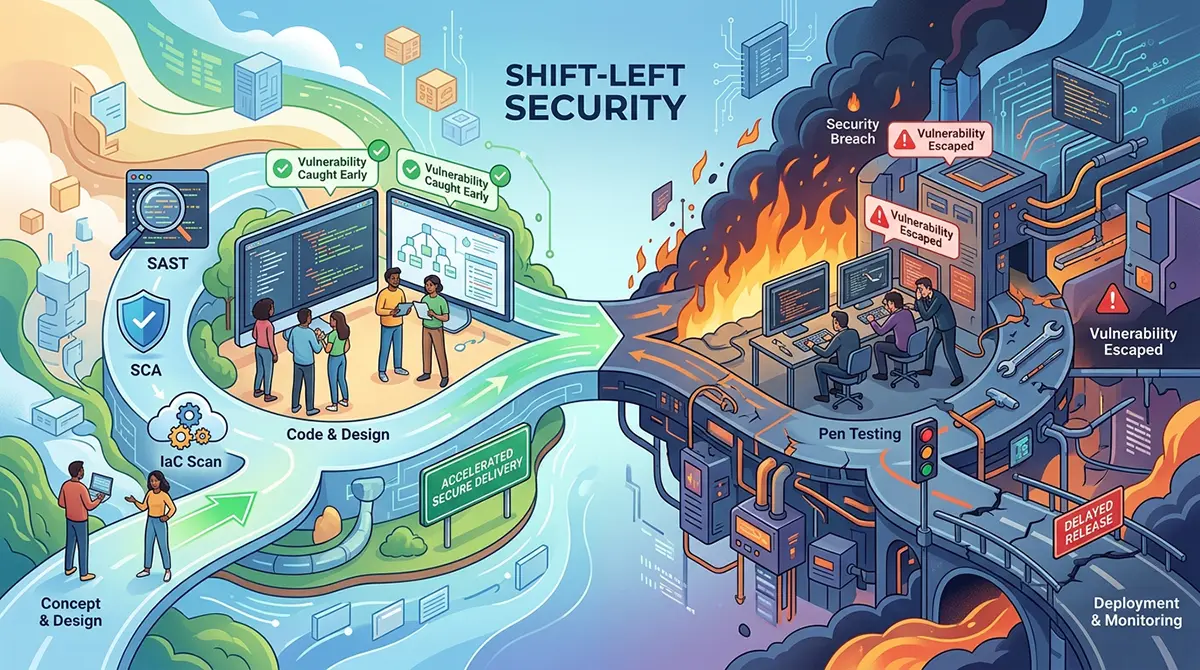
When security teams inevitably uncovered serious vulnerabilities during these late-stage reviews, it triggered immediate operational friction. Deployments were abruptly halted, product launches were delayed, and developers were forced to stop their current projects to context-switch back to code they had written months prior. This reactive security model, often referred to as a “Shift-Right” or gatekeeping approach, built deeply entrenched silos between software developers and security personnel, inflated operational overhead, and frequently resulted in unaddressed security flaws leaking directly into live production environments.
Shift-Left Security represents a fundamental paradigm shift in how modern digital products are designed, built, and delivered. Rather than treating security as a perimeter guard at the end of an assembly line, Shift-Left embeds security thinking, practices, automated testing, and validation into the earliest phases of the development lifecycle. Security transforms from a reactive downstream activity into a proactive, continuous, and collaborative discipline starting at the architectural planning stage, progressing through daily coding and local build checks, and extending seamlessly across automated continuous integration pipelines. By discovering and remediating security defects when they are fresh in a developer’s mind, organizations can build far more resilient applications, maintain rapid delivery velocity, and drastically reduce the exponential costs associated with fixing vulnerabilities.
The True Cost of Late Security Discovery
The strategic, operational, and economic arguments for Shift-Left Security are rooted in a well-established law of software engineering: the cost to identify and fix a defect increases exponentially the further that defect travels through the development pipeline. A flaw caught while an engineer is designing a feature or actively typing code costs a fraction of what it costs to fix once that code is deployed to a live production environment.
The Remediation Cost Curve
When a vulnerability is identified during the initial design or local development phase, remediation requires minimal effort and cost. The developer holds full cognitive context regarding the logic, the code change is contained entirely on a local development branch, and no shared infrastructure or end users are impacted. Resolving an issue at this stage takes minutes or hours, requiring simple edits and instantaneous verification.
As the code moves downstream through pull requests, integration testing, staging environments, and finally production, the complexity and cost of remediation skyrocket. Once a vulnerability is deployed to production, fixing it requires opening high-severity incident tickets, convening emergency cross-functional response teams, conducting exhaustive root-cause investigations, drafting emergency hotfixes, running extensive regression tests, and executing out-of-band production deployments.
Beyond Direct Engineering Expense
The hidden costs of late-stage security discovery extend far beyond wasted developer hours and delayed features. When security flaws escape into live environments and are exploited by malicious actors, the financial impact can devastate an organization. Modern cyber attacks result in severe monetary losses, including:
-
Regulatory Fines and Non-Compliance Penalties: Global privacy regulations such as GDPR, CCPA, and HIPAA impose massive financial penalties for data breaches resulting from inadequate security controls or known unpatched vulnerabilities.
-
Operational Disruption and Downtime: Remediating active exploits frequently requires taking critical systems offline, disrupting business operations, and causing direct revenue loss for every hour systems remain unavailable.
-
Litigation and Class-Action Lawsuits: Data breaches almost inevitably attract legal actions from impacted customers, enterprise partners, and regulatory bodies, leading to astronomical legal defense fees and cash settlements.
-
Irreparable Brand and Reputational Damage: Loss of customer trust, negative media coverage, and reduced market capitalization can permanently damage an enterprise’s standing, driving users straight to competitors.
Shift-Left Security serves as an organizational insurance policy. By transforming potential production breaches into routine, low-cost code edits during the early stages of development, enterprises protect both their bottom line and their market reputation.
Accelerate Your Digital Transformation
Looking to optimize your IT infrastructure, streamline business operations, and stay ahead of the competition? Discover how tailored technology advisory services uae can transform your organization. From strategic cloud adoption to cutting-edge cybersecurity, get expert guidance to drive measurable business growth in today’s fast-evolving market.
Key Pillars of a Modern Shift-Left Strategy
Implementing a successful Shift-Left Security framework requires far more than purchasing a few security scanning tools and mandating their use. It requires building a comprehensive, multi-layered strategy that spans architecture, continuous integration, dependency management, and cloud infrastructure.
1. Threat Modeling during Planning and Architecture
Long before developers write a single line of application code, security considerations must begin with structured threat modeling. Threat modeling is a methodical engineering practice used to identify potential security risks, system weaknesses, entry points, and attack vectors in an application’s design.
During initial product planning and architecture reviews, software engineers, system architects, and security specialists collaborate to map out data flows, trust boundaries, authentication mechanisms, and third-party integrations. By systematically asking questions about what could go wrong and evaluating how an adversary might attempt to compromise the application, teams can embed security controls directly into the system’s structural blueprint. Resolving an architectural vulnerability on a whiteboard or design document takes minimal effort, whereas restructuring a live microservices architecture post-deployment can take months of complex refactoring.
2. Static Application Security Testing (SAST)
Static Application Security Testing involves inspecting source code, byte code, or binary files for security vulnerabilities without actually executing the program. SAST engines analyze code bases against comprehensive rule sets to identify insecure coding patterns, such as SQL injection, cross-site scripting (XSS), buffer overflows, path traversal, hardcoded secrets, and unsafe cryptographic usage.
In a mature Shift-Left implementation, SAST tools operate directly inside the developer’s Integrated Development Environment (IDE) or run automatically via Git pre-commit hooks and pull request checks. This delivers near-instantaneous feedback. As an engineer writes code, the SAST engine flags potential flaws inline, explaining the risk and suggesting safe alternatives before the code is ever merged into the main development branch.
3. Software Composition Analysis (SCA)
Modern custom software applications are rarely written entirely from scratch. Up to eighty percent or more of a modern enterprise application’s codebase consists of open-source frameworks, third-party libraries, and software dependencies. While leveraging open-source components significantly accelerates development speed, it introduces severe software supply chain risks. A single vulnerable sub-dependency anywhere in an application’s dependency tree can expose the entire enterprise to remote code execution or data exfiltration.
Software Composition Analysis tools continuously audit project manifest files, lockfiles, and software bill of materials (SBOMs) against updated global vulnerability databases such as the National Vulnerability Database (NVD). SCA automatically scans for known Common Vulnerabilities and Exposures (CVEs), flags outdated packages, recommends safe upgrade paths, and alerts organizations to restrictive or non-compliant open-source licenses.
4. Interactive and Dynamic Security Testing (IAST and DAST)
While SAST inspects static source code, Dynamic Application Security Testing (DAST) evaluates running applications from an external perspective, simulating real-world attacks against live runtime instances. DAST tools probe for runtime issues such as broken authentication, session fixation, security misconfigurations, and server-side request forgery (SSRF).
To bring DAST into a Shift-Left workflow, organizations utilize ephemeral preview environments. Whenever a developer opens a pull request, automated Continuous Integration (CI) systems spin up an isolated, short-lived application container environment. Lightweight automated DAST scans execute immediately against this ephemeral build, identifying runtime issues before the feature is merged into staging or main branches.
Interactive Application Security Testing (IAST) further enhances this by combining static and dynamic approaches. IAST agents run within the application runtime during automated integration testing, monitoring code execution from the inside out to detect security defects in real time with high accuracy.
5. Infrastructure as Code (IaC) Security
In cloud-native environments, infrastructure configuration is defined using code through frameworks such as Terraform, AWS CloudFormation, Kubernetes YAML manifests, and Ansible playbooks. Modern security breaches are just as likely to stem from cloud configuration errors as they are from source code flaws. Unprotected Amazon S3 buckets, overly permissive Identity and Access Management (IAM) roles, open security groups, and unencrypted storage volumes present immense risks.
Shift-Left Security extends directly into cloud provisioning by auditing Infrastructure as Code templates prior to deployment. Automated scanners analyze IaC files in source control repositories, catching misconfigurations and compliance violations long before any real-world cloud resources are provisioned.
Overcoming Developer Friction: Making Security Accessible
The ultimate success or failure of any Shift-Left Security initiative hinges entirely on developer adoption. Historically, security tools earned a poor reputation among engineering teams. Legacy security solutions were often slow, disruptive, hard to configure, and notorious for producing high volumes of false positives that overwhelmed developers with noise. To make Shift-Left work effectively, security teams must treat software developers as primary customers and prioritize developer experience.
Integrating Seamlessly into Daily Workflows
Security checks must exist inside the tools developers already use every day. If developers are required to manually log into external web portals or run tedious command-line scripts to view security scan results, compliance will drop dramatically. Security feedback should be delivered natively within:
-
Integrated Development Environments (IDEs): Real-time inline highlighting and linting that flags vulnerabilities as code is being written.
-
Git Code Repositories: Automated comments directly on pull requests and code reviews, providing immediate context alongside code diffs.
-
ChatOps and Developer Dashboards: Contextual notifications in collaboration platforms like Slack or Teams, alerting engineers only to high-priority issues requiring attention.
Eliminating False Positives and Alert Fatigue
High rates of false positives destroy trust between developers and security tools. When developers are repeatedly forced to investigate warnings that turn out to be non-issues, alert fatigue sets in, leading engineers to ignore or bypass security controls entirely.
Security teams must actively tune, curate, and customize security scanning rulesets to fit the specific application context. Scans should focus on high-confidence, actionable findings, while noisy or irrelevant rules are suppressed or demoted to informational backlogs.
Delivering Clear, Actionable Remediation Guidance
A security alert should never simply announce that a defect exists. Telling a developer that their code contains a CWE-79 vulnerability without context is ineffective. High-quality security feedback must provide:
-
A clear explanation of what the vulnerability is and why it poses a threat.
-
The exact line of code or dependency where the issue originates.
-
A concrete code snippet demonstrating how to fix the flaw using secure coding patterns.
-
Automated one-click fix suggestions or automated pull requests for simple dependency updates.
Balancing Pipeline Speed and Security Gates
Continuous Integration pipelines must remain fast. If security scans add thirty minutes to every build, developer productivity plummets, and engineers will seek ways to bypass security gates. Security testing in the pipeline must be optimized by running fast, incremental scans on pull requests and reserving full, deep scans for asynchronous nightly builds.
Building a Security-First Engineering Culture
Technology and automated scanning tools are necessary, but they are insufficient on their own. Successfully shifting security left requires a cultural transformation where security is viewed not as an external enforcement mechanism, but as an essential dimension of software quality, alongside performance, maintainability, and reliability.
Establishing a Security Champions Program
To scale security across expanding engineering organizations, security teams must build bridgehead networks within development squads through a Security Champions program. A Security Champion is a developer or software engineer with a strong interest in security who serves as the embedded security advocate for their squad.
Security Champions receive specialized training from the central security team. They assist their peers with threat modeling, participate in complex code reviews, help triage scanning findings, and promote secure coding best practices directly within daily agile workflows. This peer-to-peer approach democratizes security knowledge and fosters trust across departments.
Continuous, Contextual Security Education
Traditional, once-a-year compliance security training modules are largely ineffective at changing developer behavior or preventing technical vulnerabilities. Effective security education must be continuous, interactive, and highly relevant to an engineer’s daily stack.
Organizations should invest in hands-on secure coding platforms, interactive hackathons, and bug bounty reviews where developers can actively practice exploiting and fixing vulnerabilities in realistic codebases. When developers understand how an attacker thinks and exploits a flaw, writing defensive code becomes second nature.
Cultivating a Blameless Security Culture
How an organization responds to security discoveries deeply influences its security posture. If developers fear public embarrassment, reprimand, or negative performance reviews when vulnerabilities are discovered in their code, they will hide issues, resist security tools, and delay disclosure.
Organizations must establish a blameless culture that views security discoveries as collective learning opportunities. Blameless post-mortems for security incidents focus on systemic improvements, missing automated checks, and process enhancements rather than individual mistakes. Encouraging transparency ensures that risks are disclosed early and addressed collaboratively.
Key Metrics to Track Shift-Left Maturity
To validate investments in early security tooling and evaluate the effectiveness of a Shift-Left program, engineering leadership must track clear, objective metrics over time.
Mean Time to Detect (MTTD)
Mean Time to Detect measures the average time elapsed between when a vulnerability is introduced into a codebase and when it is discovered by a security check. In a traditional Shift-Right model, MTTD is often measured in months or quarters. In a mature Shift-Left organization, MTTD is reduced to seconds or minutes.
Mean Time to Remediate (MTTR)
Mean Time to Remediate tracks how long it takes for a team to fix a security flaw once it has been detected. Catching vulnerabilities during early development phases drastically reduces MTTR because developers can resolve issues while the code context is still fresh in their minds, avoiding the overhead of emergency deployment procedures.
Vulnerability Escape Rate
Vulnerability Escape Rate measures the proportion of security defects discovered in production environments versus those identified and resolved during pre-production development phases. A continuously declining escape rate is a clear indicator that Shift-Left security controls are working effectively.
Vulnerability Density and Flaw Trends
Tracking the total number of security vulnerabilities per thousand lines of code over time provides insight into developer secure coding maturity. A downward trend in flaw density indicates that continuous security training and threat modeling are paying off, as developers naturally write cleaner, safer code from the start.
Developer Tool Adoption and Engagement
Measuring developer interaction with security tools provides crucial insights into developer experience. Metrics such as the percentage of developers using IDE security plugins, the fix rate of automated pull request security suggestions, and pipeline scan pass rates help identify friction points that require further tuning or training.
Strategic Roadmap for Shift-Left Adoption
Transitioning an enterprise from a legacy perimeter security model to a mature Shift-Left posture requires a deliberate, step-by-step rollout strategy rather than an overnight overhaul.
Phase 1: Audit and Baseline Setup (Months 1 to 2)
Begin by assessing current development workflows, deployment pipelines, and security processes. Map out existing build speeds, document historical vulnerability rates, and identify current developer friction points. Select two or three pilot development teams with supportive leadership to trial the initial Shift-Left framework.
Phase 2: Tooling Selection and Pilot Integration (Months 3 to 4)
Introduce lightweight SAST, SCA, and IaC scanning tools directly into the pilot teams’ IDEs and continuous integration pipelines. Focus on enabling a small, highly accurate subset of security rules to prevent false positive overload. Work closely with pilot developers to gather feedback, tune rulesets, and streamline pipeline integration.
Phase 3: Cultural Scaling and Security Champions (Months 5 to 8)
Formalize the Security Champions program by recruiting interested engineers from across the department. Provide specialized secure coding training and begin incorporating light threat modeling into sprint planning sessions. Gradually roll out integrated scanning tools to all development teams while establishing automated security quality gates in CI/CD pipelines.
Phase 4: Full Automation and Continuous Optimization (Months 9 and Beyond)
Expand security coverage to include automated IaC checks, ephemeral environment DAST scans, and container image scanning. Establish executive metrics dashboards to track MTTD, MTTR, and escape rates. Continuously refine security rulesets, automate dependency patch management, and conduct blameless incident reviews to foster constant improvement.
Conclusion
Shift-Left Security is far more than a passing technology trend; it is a fundamental evolutionary requirement for modern software organizations operating in an agile, cloud-centric ecosystem. By moving security testing, risk assessment, and vulnerability remediation to the earliest stages of the development lifecycle, companies can break down long-standing organizational barriers between software engineers and security teams.
The ultimate benefits extend across every facet of the enterprise. Software teams deliver higher quality features faster, security teams shift their focus from manual firefighting to strategic risk management, and the business drastically reduces its exposure to costly data breaches and regulatory fines. When security is integrated naturally into the software engineering process, security ceases to be a bottleneck and becomes an inherent component of software excellence.