


The Computational Crucible of Generative AI
The meteoric rise of generative artificial intelligence has fundamentally transformed the technological landscape, pushing the boundaries of what machines can create, understand, and synthesize. From vast large language models generating human-like prose to diffusion models rendering hyper-realistic imagery and video, the scale of modern generative AI is breathtaking. Yet, beneath the polished user interfaces and conversational agents lies a colossal, highly complex foundation of hardware and software architecture. This is the realm of modern generative AI infrastructure, a domain where traditional computing paradigms have been upended to satisfy an insatiable appetite for computational throughput, massive parallel processing, and ultra-low latency data movement.
To understand how modern generative models are trained and deployed, one must examine the compute platforms that underpin them. Unlike traditional software applications that rely primarily on sequential processing power and general-purpose central processing units, generative AI thrives on massive parallelism. Training a frontier model containing hundreds of billions or trillions of parameters requires processing petabytes of data across thousands of specialized processors working in synchronized harmony for weeks or even months. This article explores the intricate ecosystem of silicon processors, specialized interconnects, memory hierarchies, cloud platforms, and software-hardware co-design principles that collectively form the bedrock of the generative AI revolution.
The Silicon Vanguard: Graphics Processing Units and the Parallel Revolution
For decades, the Central Processing Unit reigned supreme as the undisputed brain of the computer. Designed to handle complex sequential instructions and branch-heavy logic, CPUs are exceptionally well-suited for general-purpose computing and operating systems. However, the foundational mathematics of deep learning—specifically, deep neural networks and transformer architectures—are dominated by matrix multiplications and linear algebra operations. These workloads do not require the intricate control flow of a CPU; instead, they demand the ability to execute millions of simple arithmetic operations simultaneously.
Enter the Graphics Processing Unit. Originally engineered to render complex 3D graphics for video games by manipulating pixels in parallel, GPUs proved to be the accidental saviors of the artificial intelligence boom. By trading a small number of heavy, complex processor cores for thousands of lightweight, concurrent execution cores, GPUs unlocked unprecedented acceleration for deep learning training and inference.
Modern AI-centric GPUs, pioneered heavily by industry leaders like NVIDIA, have evolved far beyond their graphical origins. They now incorporate specialized hardware blocks known as Tensor Cores. These specialized engines are purpose-built to accelerate mixed-precision matrix math, which is the lifeblood of transformer-based models. By utilizing lower precision data formats such as FP16, BF16, and FP8, these GPUs can perform calculations at astonishing speeds without sacrificing the numerical accuracy required for model convergence. The ability to stack these processors together into dense server nodes has made GPUs the primary workhorse of nearly every major AI research laboratory and hyperscale cloud provider across the globe.
Specialized Accelerators: Tensor Processing Units and Custom ASICs
While general-purpose GPUs have captured the lion’s share of the market, the sheer economic and computational scale of generative AI has catalyzed a renaissance in custom silicon development. Tech giants and nimble semiconductor startups alike have recognized that bespoke hardware can often deliver superior performance-per-watt and cost efficiencies compared to off-the-shelf accelerators. This has given rise to a diverse ecosystem of Application-Specific Integrated Circuits designed from the ground up specifically for machine learning workloads.
Google’s Tensor Processing Unit represents one of the pioneering efforts in this space. Designed specifically to accelerate TensorFlow and PyTorch workloads, TPUs omit traditional graphics rendering pipelines entirely, dedicating their entire silicon area to matrix multiplication and vector processing. By optimizing the memory layout, data flow, and systolic array architectures for neural network primitives, Google has scaled its TPU clusters to train some of the world’s most advanced language and multimodal models.
Beyond tech monoliths, a new wave of semiconductor startups is challenging the status quo with innovative architectures. Some companies focus on wafer-scale integration, interconnecting massive arrays of processor cores onto a single continuous piece of silicon the size of an entire semiconductor wafer. Others explore neuromorphic approaches or dataflow architectures that minimize memory access overhead by keeping weights and intermediate activations entirely on-chip. These custom ASICs provide crucial alternatives to the GPU monopoly, injecting vital competition, pricing pressure, and architectural diversity into the modern compute ecosystem.
The Nervous System: High-Speed Interconnects and Cluster Networking
A single advanced accelerator, no matter how powerful, is insufficient to train a frontier generative model containing hundreds of billions of parameters. Because these models exceed the memory capacity of any single chip, their weights and activation states must be partitioned across thousands of accelerators working in unison. This partitioning introduces a monumental engineering challenge: how to synchronize thousands of processors across a massive cluster without letting network latency become the ultimate performance bottleneck.
To solve this, modern generative AI infrastructure relies on ultra-high-speed, low-latency interconnect fabrics. Within a single server chassis, proprietary high-bandwidth interconnect technologies—such as NVIDIA’s NVLink—allow multiple GPUs to communicate with one another at terabits per second, bypassing the traditional peripheral component interconnect bus entirely. This creates a unified memory space where multiple GPUs can interact as if they were a single, monolithic processor.
When scaling out across thousands of servers within a data center, traditional Ethernet protocols often fall short due to packet drops and latency overheads. Instead, AI data centers deploy advanced networking standards such as InfiniBand or RoCE (RDMA over Converged Ethernet). Remote Direct Memory Access enables data to be transferred directly from the memory of one accelerator to the memory of another without involving the host operating system or CPU. This capability is essential for performing distributed training techniques like tensor parallelism, pipeline parallelism, and data parallelism, ensuring that communication overhead does not stall the computational pipeline.
Memory Architecture: Overcoming the Memory Wall with High Bandwidth Memory and CXL
In the architecture of modern AI compute platforms, processing speed is only half the battle. The most powerful processor in the world is virtually useless if it spends its time waiting for data to arrive from storage or main memory. This perennial challenge is known in computer science as the memory wall. For generative AI workloads, which require moving massive parameter weights and context windows through the processor registers constantly, memory bandwidth and capacity are critical determinants of performance.
To overcome this bottleneck, modern AI accelerators abandon traditional system memory in favor of High Bandwidth Memory. HBM integrates multiple layers of DRAM dies vertically onto the same substrate as the processor chip, interconnecting them through microscopic vertical pillars called through-silicon vias. This ultra-dense, 3D-stacked architecture provides staggering memory bandwidths measured in terabytes per second, allowing AI chips to ingest and process data at rates that conventional memory modules could never achieve.
Complementing HBM at the system level are emerging standards like Compute Express Link. CXL is an open industry standard interconnect built on top of the physical PCIe infrastructure that enables high-speed, low-latency communication between the host processor, accelerators, memory expanders, and persistent storage devices. By allowing accelerators to pool and share system memory dynamically, CXL helps alleviate the severe memory capacity constraints that frequently plague large-scale model fine-tuning and massive-context inference workloads.
Hyperscale Clouds and Specialized AI Infrastructure Providers
Building and maintaining the physical infrastructure required to train and run generative AI models is a capital-intensive undertaking. The staggering cost of acquiring thousands of specialized accelerators, securing dedicated high-density power supplies, and engineering advanced liquid-cooling systems has placed traditional on-premises data centers out of reach for many organizations. Consequently, the cloud has become the undisputed epicenter of generative AI development.
Hyperscale cloud providers—such as Amazon Web Services, Microsoft Azure, and Google Cloud Platform—have transformed their massive global data centers into colossal AI factories. These providers offer on-demand access to clusters containing thousands of interconnected accelerators, abstracting away the immense complexity of physical hardware management behind elastic APIs and managed container services. Developers can spin up massive training clusters for a few hours, execute their workloads, and spin them down, paying only for the compute cycles consumed.
In parallel with the traditional hyperscalers, a specialized breed of AI-focused cloud providers has emerged. Companies like CoreWeave, Lambda Labs, and Crusoe have carved out a lucrative niche by building greenfield data centers designed exclusively for high-density GPU computing. By streamlining their supply chains, focusing strictly on AI workloads, and optimizing power procurement, these specialized providers often deliver faster access to cutting-edge silicon and highly competitive pricing models for enterprises scaling their machine learning operations.
Edge Computing and Localized Inference Hardware
While the colossal training runs and massive frontier models capture public headlines, a quiet revolution is taking place at the other end of the spectrum: edge computing and localized inference. As generative AI models become more efficient through techniques like quantization, pruning, and architectural distillation, they are shrinking down to sizes that can run locally on consumer devices, automotive systems, and enterprise Internet of Things hardware.
This shift has driven silicon manufacturers to embed dedicated AI processing units, often called Neural Processing Units, directly into smartphones, laptops, and automotive system-on-chips. Unlike GPUs, which are designed for massive general-purpose parallel workloads, NPUs are hyper-optimized to execute neural network inference with maximum energy efficiency. By running generative AI tasks locally on the device rather than rounding-trip data to a remote cloud data center, users benefit from near-zero latency, enhanced data privacy, and continuous functionality even in offline environments.
In enterprise and industrial settings, edge servers equipped with ruggedized accelerators enable real-time generative AI applications—such as automated quality control, localized video analytics, and smart manufacturing optimization—to operate at the point of data creation. This decentralized computing paradigm ensures that organizations can harness the power of generative AI without being entirely dependent on continuous cloud connectivity.
The Software-Hardware Symbiosis: Compilers, Runtimes, and Ecosystems
Hardware alone is merely dead silicon; it requires a sophisticated and deeply integrated software stack to breathe life into it. The relationship between compute platforms and software frameworks in generative AI is symbiotic, where hardware constraints dictate software optimization, and software demands drive subsequent hardware innovation.
At the foundation of this software stack are low-level driver APIs and hardware-specific libraries—such as NVIDIA’s CUDA ecosystem—which provide developers with direct access to the underlying processor cores and memory hierarchies. Building upon these proprietary or open-source foundations are high-performance machine learning compilers and graph optimization frameworks, such as Apache TVM, Triton, and XLA. These tools analyze the computational graph of a neural network, fusing operations, optimizing memory allocation, and translating abstract model definitions into highly efficient machine code tailored specifically to the target hardware platform.
Higher still in the stack sit the dominant deep learning frameworks, PyTorch and TensorFlow, which abstract away the underlying hardware complexities for everyday researchers and developers. These frameworks rely heavily on vendor-optimized libraries to execute common operations like attention mechanisms, convolutions, and normalization layers at peak hardware efficiency. Ensuring seamless integration across this entire multi-layered software stack is a critical engineering feat, often requiring specialized expertise. For organizations deploying complex AI pipelines across hybrid cloud environments, partnering with experts who provide comprehensive DevOps Services in Dubai or similar global tech hubs ensures that the delicate interplay between software orchestration and underlying compute platforms remains stable, secure, and performant.
Operational Scale, Power, and Deployment Realities
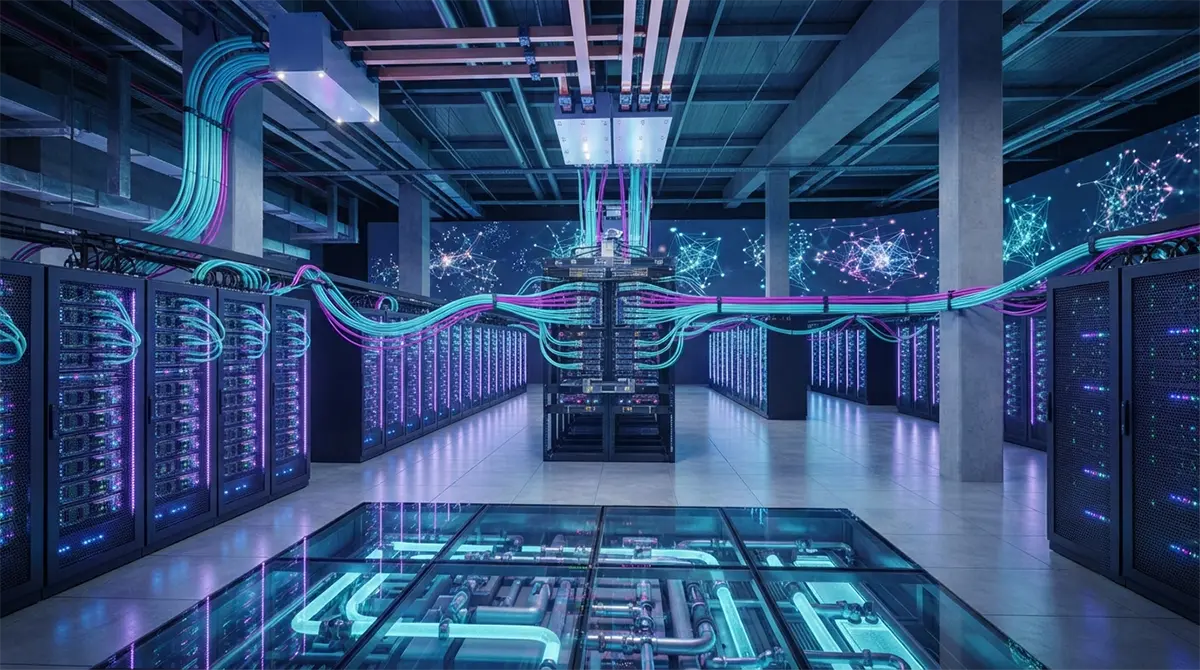
The relentless pursuit of scale in generative AI has created unprecedented operational challenges that extend far beyond raw floating-point performance. Modern AI clusters consume staggering amounts of electrical power, often requiring tens of megawatts for a single facility. This insatiable energy demand has pushed data center operators to the absolute limits of traditional air-cooling technology, forcing a rapid industry-wide transition toward direct-to-chip liquid cooling and advanced thermodynamic management systems.
Furthermore, managing clusters comprising tens of thousands of complex accelerators introduces staggering reliability and fault-tolerance hurdles. At this scale, hardware failures—ranging from faulty interconnect cables and memory ECC errors to sudden node crashes—transition from rare anomalies to statistical certainties. Consequently, modern AI compute platforms must incorporate robust orchestration frameworks, automated health monitoring, and advanced checkpointing mechanisms that can save model states and recover from failures mid-training without losing days or weeks of expensive compute time.
Operationalizing these massive computational environments requires sophisticated infrastructure management, rigorous security protocols, and continuous monitoring to maintain high availability and cost predictability. Balancing power constraints, thermal dynamics, and hardware reliability forms the crucible in which modern AI engineering teams operate day in and day out.
The Horizon of Next-Generation Compute
As we look toward the future, the compute platforms that underpin generative AI infrastructure continue to evolve at a breakneck pace. The limits of traditional silicon scaling, driven by the eventual breakdown of Moore’s Law, are prompting researchers to explore radical new paradigms. Optical computing, which uses light rather than electrons to perform matrix multiplications at the speed of light, promises to shatter current energy and bandwidth barriers. Neuromorphic architectures, modeled after the biological structure of the human brain, offer tantalizing glimpses of ultra-low-power asynchronous processing. Meanwhile, quantum computing research continues to advance, hinting at a distant horizon where entirely new classes of generative algorithms could be unlocked.
Until those paradigm-shifting technologies mature, the immediate future of generative AI will be defined by the relentless optimization of silicon accelerators, high-speed interconnects, advanced memory hierarchies, and intelligent software co-design. The modern data center has transformed from a passive repository of data into an active, breathing AI supercomputer. As models grow larger, multimodal capabilities expand, and enterprise adoption deepens, the underlying compute platforms will remain the indispensable engine driving the next great leap in human technological capability.