


The Architectural Marvel Powering the Digital Economy
Modern cloud computing relies on a massive global physical presence that turns abstract digital ideas into reality. Behind every seamless video stream, instant financial transaction, real-time gaming session, and complex artificial intelligence training run sits a physical infrastructure of unprecedented scale. Amazon Web Services (AWS) pioneered modern cloud architecture by constructing a planetary-scale computing platform engineered to offer high availability, fault isolation, and low latency across every continent.
To truly grasp how AWS maintains its dominant position in enterprise cloud computing, one must look beyond individual software services like EC2 compute instances or S3 storage buckets. The true power of the platform resides in its underlying physical topology. This global physical infrastructure is built upon a carefully designed, multi-tiered architecture consisting of Regions, Availability Zones, Edge Locations, Local Zones, Wavelength Zones, and a massive private fiber-optic network backbone.
Designing a global computing platform requires balancing trade-offs between physical constraints and software requirements. Light travels through fiber-optic cables at approximately 200 kilometers per millisecond. This fundamental speed limit means physical distance directly translates to network latency. Additionally, data privacy laws around the globe require strict geographical boundaries for information storage, while power grids and natural disaster zones present physical threats to continuous uptime.
AWS solved these challenges by designing a modular, highly redundant deployment model. Instead of relying on monolithic mega-data centers, AWS distributes its capacity across isolated geographic hubs interconnected by dedicated high-speed networking. Understanding this global footprint is essential for systems architects, engineering leaders, and technology strategists who wish to build resilient, cost-effective, and globally accessible applications.
AWS Global Infrastructure Hierarchy

┌─────────────────────────────────────────────────────────────┐
│                        AWS Region                           │
│  ┌──────────────────────┐        ┌──────────────────────┐   │
│  │ Availability Zone A  │        │ Availability Zone B  │   │
│  │ ┌────────┐ ┌────────┐│        │ ┌────────┐ ┌────────┐│   │
│  │ │Data Ctr│ │Data Ctr││◄──────►│ │Data Ctr│ │Data Ctr││   │
│  │ └────────┘ └────────┘│ Low-Lat│ └────────┘ └────────┘│   │
│  └──────────────────────┘ Metro  └──────────────────────┘   │
│            ▲              Fiber             ▲               │
└────────────┼────────────────────────────────┼───────────────┘
             │                                │
┌────────────▼────────────┐      ┌────────────▼────────────┐
│    AWS Local Zones      │      │   Edge Points of Pres   │
│ (Sub-ms Metro Compute)  │      │ (CloudFront CDN / Edge) │
└─────────────────────────┘      └─────────────────────────┘
Decoding AWS Regions: The Foundation of Global Presence
At the top of the AWS infrastructure hierarchy sits the AWS Region. An AWS Region is a distinct, self-contained geographical area somewhere in the world. Examples include us-east-1 in Northern Virginia, eu-west-1 in Dublin, and ap-southeast-1 in Singapore. Each Region operates in complete isolation from all other Regions. This deliberate isolation guarantees that a catastrophe, power collapse, or network outage in one geographic area cannot cascade to cause a failure in another.
Selecting the right AWS Region is one of the most consequential decisions an organization makes when migrating to the cloud. The choice of Region directly impacts application performance, end-user experience, overall operating costs, and legal compliance. Engineering teams must evaluate four primary criteria when picking a primary hosting location:
-
User Proximity and Network Latency: Physical distance between server and user remains the primary driver of network round-trip time. Placing workloads in a Region close to the target user base minimizes latency, speeds up page loads, and enhances interactive user experiences.
-
Regulatory Compliance and Data Sovereignty: National and international laws, such as the European Union General Data Protection Regulation (GDPR) or domestic health data protection acts, often mandate that personal data must not cross national borders. Deploying workloads within specific sovereign Regions satisfies these strict legal boundaries.
-
Service Availability and Feature Parity: While core services like Amazon EC2, Amazon S3, and Amazon RDS are ubiquitous across almost all Regions, newly launched services or specialized hardware types may roll out gradually in select primary Regions before expanding globally.
-
Cost Optimization: Operating costs vary significantly between countries and cities due to localized electricity rates, real estate prices, labor costs, and tax frameworks. Consequently, running an identical stack of cloud resources can cost up to 20 percent more in one Region compared to another.
Every AWS Region is designed to operate completely autonomously. Control planes for core management services are scoped to individual Regions to prevent regional disruptions from affecting global infrastructure control. This design philosophy encourages organizations to build multi-Region architectures for mission-critical services that require extreme disaster recovery capabilities.
Availability Zones: The Secret Weapon for Fault Tolerance
While a Region represents a geographic territory, it is not simply a single data center. Instead, every AWS Region comprises multiple, physically separated, and isolated locations known as Availability Zones (AZs). A typical AWS Region contains at least three distinct Availability Zones, with some larger Regions containing as many as six.
An Availability Zone is a fully functional unit of failure domain isolation. It is crucial to understand that an Availability Zone is not always a single building; rather, an individual Availability Zone can consist of multiple physical data centers clustered together. These data centers are housed in distinct facilities located miles apart from one another to protect against localized physical hazards such as fires, floods, utility failures, or localized power grid disruptions.
Key architectural attributes that define AWS Availability Zones include:
-
Physical Isolation: Each Availability Zone is separated by meaningful physical distance, typically up to 100 kilometers (60 miles), while remaining within the same metropolitan area.
-
Independent Power and Utilities: Availability Zones possess independent power infrastructure, utility feeds, back-up generator farms, UPS systems, and dedicated cooling systems.
-
High-Bandwidth, Ultra-Low Latency Interconnects: All Availability Zones within a single Region are interconnected through redundant, high-throughput, private metro fiber networks. This provides sub-millisecond round-trip latency across zones.
-
Synchronous Data Replication Capabilities: Because networking latency between Availability Zones in the same Region is negligible, applications can perform synchronous data replication between zones without degrading user application performance.
To safeguard against hardware concentration risks, AWS uses account-level logical mapping for Availability Zones. For instance, the zone designated as us-east-1a in one AWS account might map to a completely different physical data center cluster than us-east-1a in another account. This randomized mapping ensures that customer deployments are evenly distributed across the underlying physical data center inventory across the entire cloud community.
Building applications across multiple Availability Zones forms the backbone of modern cloud fault tolerance. By deploying server instances and managed database replicas across two or more AZs within a single Region, systems can automatically withstand the total hardware failure of an entire Availability Zone without incurring noticeable end-user downtime.
Edge Networks and CloudFront: Delivering Performance at the Speed of Light
While Regions and Availability Zones form the core computing engine of AWS, serving media, web pages, and API calls to millions of users spread around the globe requires a different strategy. Relying solely on central regional data centers would force requests from faraway end-users to traverse dozens of public internet hops, causing high latency, packet loss, and degraded performance.
To solve this challenge, AWS built an expansive peripheral network layer known as the AWS Edge Network. This edge architecture consists of hundreds of Points of Presence (PoPs) located in major metropolitan areas and population centers around the world. These PoPs are subdivided into Edge Locations and Regional Edge Caches.
-
Edge Locations: These smaller data center facilities sit directly at the entry points of major telecommunication providers worldwide. They run caching proxy services, static asset delivery, DNS routing, and security filtering right next to the end user.
-
Regional Edge Caches: Positioned between primary AWS Regions and localized Edge Locations, these facilities possess larger cache capacity. They hold content that is not popular enough to remain in every individual Edge Location cache, preventing requests from having to travel all the way back to the origin server in the primary Region.
The primary service utilizing this Edge Network is Amazon CloudFront, a global Content Delivery Network (CDN). When a user requests a web page, video file, or static asset, CloudFront routes the request to the closest Edge Location. If the content is cached locally, it is returned instantly. If a cache miss occurs, CloudFront fetches the file from the origin server by traversing the private AWS network backbone rather than the unpredictable public internet.
Beyond static caching, the Edge Network plays a fundamental security role. Services like AWS Shield and AWS WAF (Web Application Firewall) operate directly at the Edge Locations. This allows DDoS attacks, malicious traffic spikes, and unauthorized vulnerability scans to be absorbed and mitigated at the perimeter before they ever reach core application instances running inside a private virtual cloud network.
Furthermore, computing has evolved beyond simple content caching. With Lambda@Edge and CloudFront Functions, developers can execute custom serverless code directly at Edge Locations worldwide. This enables real-time HTTP header manipulation, personalized user authentication, localized dynamic content rendering, and URL rewriting at the edge, removing computational overhead from central backend data centers.
Bridging the Distance: AWS Local Zones and Dedicated Infrastructure
Although AWS Regions and Edge Locations serve the vast majority of global computing requirements, emerging technologies demand even faster response times. Real-time multiplayer gaming, high-frequency financial trading, remote surgical tools, electronic design automation, and augmented reality applications require latency measured in single-digit milliseconds.
To satisfy these aggressive latency targets without requiring a full multi-AZ Region deployment in every city, Amazon introduced AWS Local Zones. An AWS Local Zone is an extension of an existing AWS Region, placing compute, storage, database, and networking services in geographic proximity to major population, industrial, and IT hubs where no primary Region exists.
Local Zones allow organizations to deploy latency-sensitive components of their application stack right in major metro markets, while maintaining seamless, high-bandwidth connectivity back to the parent AWS Region for heavier, non-latency-sensitive backend workloads.
┌─────────────────────────────────────────────────────────────┐
│                      Parent AWS Region                      │
│  ┌───────────────────────────────────────────────────────┐  │
│  │ Core Workloads: Amazon S3, DynamoDB, Large Databases  │  │
│  └───────────────────────────▲───────────────────────────┘  │
└──────────────────────────────│──────────────────────────────┘
                               │ Private High-Bandwidth
                               │ Backbone Interconnect
┌──────────────────────────────▼──────────────────────────────┐
│                       AWS Local Zone                        │
│  ┌───────────────────────────────────────────────────────┐  │
│  │ Ultra-Low Latency Edge Compute (EC2, EBS, ECS, EKS)    │  │
│  └───────────────────────────▲───────────────────────────┘  │
└──────────────────────────────│──────────────────────────────┘
                               │ <10ms Latency Loop
                               ▼
                   Local End-Users & Devices
As digital transformation accelerates across emerging technology capitals, regional enterprises require sophisticated architectural consulting to navigate these localized deployment models. Organizations expanding across the Middle East frequently seek specialized guidance regarding aws cloud management services in dubai to design hybrid topologies that blend local infrastructure presence with global public cloud capabilities.
For organizations with even stricter data governance mandates or specialized isolation needs, AWS provides Dedicated Local Zones. These are custom-built, fully managed Local Zone deployments created for the exclusive use of a single customer or public sector entity. Built to customer specifications, Dedicated Local Zones enable strict compliance with specialized regulatory frameworks, physical security constraints, and isolated operational requirements while maintaining full API consistency with standard AWS cloud services.
Ultra-Low Latency at the Mobile Edge: AWS Wavelength
The expansion of 5G telecommunication networks opened up new possibilities for mobile edge computing. However, connecting a mobile device to a standard cloud server typically requires data to travel from the cellular tower through telecommunications switching centers, over the public internet, and finally into a cloud Region. This path introduces unpredictable latency and network jitter.
AWS Wavelength addresses this challenge by embedding AWS compute and storage hardware directly inside the physical data centers of telecommunications providers at the edge of their 5G networks.
By hosting application workloads directly within carrier 5G networks, application traffic from mobile devices can reach edge processing instances without ever leaving the telecommunications network. This architecture delivers single-digit millisecond latency to mobile end-users and connected devices.
Key use cases driven by AWS Wavelength include:
-
Autonomous Vehicles and Smart Transportation: Processing sensor telemetry, vehicle-to-everything (V2X) communication, and instant road hazard warnings in near real-time.
-
Interactive Live Streaming and Mobile Gaming: Delivering instant, lag-free button responses and ultra-low latency video streaming for competitive mobile games and live events.
-
Industrial Internet of Things (IoT) and Robotics: Running computer vision inference models at the edge to inspect manufacturing production lines and guide automated factory machinery.
-
Healthcare and Telemedicine: Supporting high-definition, real-time video diagnostic tools and remote surgical assistance applications over high-speed mobile networks.
Through strategic partnerships with tier-one global telecom providers, AWS Wavelength extends standard cloud deployment workflows directly into mobile cellular networks, enabling developers to build next-generation applications using familiar AWS APIs, management tools, and deployment pipelines.
Hybrid Cloud Sovereignty: AWS Outposts and Enterprise Integration
Despite the vast reach of public cloud data centers, certain enterprise applications must remain physically located on-premises. Legacy systems with legacy hardware connections, strict regulatory requirements mandating local data residency, or industrial facilities operating in bandwidth-constrained environments cannot easily migrate entirely to remote cloud Regions.
Rather than forcing organizations to maintain disconnected operational models, AWS introduced AWS Outposts. AWS Outposts brings native AWS hardware, infrastructure, and operational models directly into on-premises corporate data centers or co-location facilities.
An AWS Outpost is a physical rack of hardware fully configured, delivered, and installed by Amazon engineers into a customer’s facility. Once plugged into power and local network feeds, the Outpost connects securely back to a designated parent AWS Region over a encrypted private network link. From an operational perspective, the Outpost appears as an extension of the parent Region inside the customer’s own private server room.
Benefits of utilizing AWS Outposts include:
-
Operational Consistency: IT teams use identical AWS management APIs, infrastructure-as-code scripts, CLI commands, and management consoles to manage both on-premises hardware and cloud resources.
-
Local Data Processing: Heavy enterprise workloads can process massive local datasets on-site, sending only aggregated results or backups to the central cloud Region.
-
Ultra-Low On-Premises Latency: Applications running on Outposts connect to local legacy databases, mainframe systems, and industrial control equipment with microsecond-level latency over local network lines.
-
Fully Managed Hardware Lifecycle: AWS continuously monitors the physical health of Outpost racks, automatically dispatching technicians to replace faulty components before failures disrupt services.
Through AWS Outposts, the boundary between private corporate data centers and the public cloud becomes seamless, allowing enterprises to execute a unified cloud strategy regardless of physical hardware placement.
The Planet-Spanning Backbone: AWS Global Network Architecture
Connecting hundreds of data centers, Availability Zones, Edge Locations, and Local Zones into a unified ecosystem requires a custom network backbone. The AWS Global Network is one of the largest private fiber-optic networks on Earth.
Rather than relying on the public internet to transmit data between Regions and infrastructure zones, Amazon built and maintains a fully redundant network backbone consisting of thousands of miles of terrestrial and subsea fiber-optic cables. This network uses custom-designed routing hardware, proprietary networking protocols, and advanced traffic engineering to maximize throughput and minimize packet loss.
Key elements of this network infrastructure include:
-
Transoceanic Submarine Cables: AWS invests directly in subsea cable systems spanning the Atlantic, Pacific, and Indian Oceans, securing dedicated, high-capacity fiber pairs to transport inter-region traffic globally.
-
100GbE Parallel Fiber Backbones: Major interconnect routes leverage multiple 100-Gigabit Ethernet redundant links to provide high bandwidth capacity and instant failover rerouting.
-
AWS Direct Connect Locations: AWS Direct Connect allows enterprise customers to establish dedicated, private physical network lines from their corporate network hubs directly into the AWS backbone, bypassing the public internet entirely to improve security and lower network transit costs.
-
Fully Encrypted Physical Links: All network traffic moving across the AWS global backbone between Availability Zones and Regions is automatically encrypted at the physical layer before leaving secured AWS facilities.
By bypassing the public internet for internal routing, the AWS network backbone provides consistent latency profiles, mitigates interception risks, and protects workloads against internet-wide routing disruptions.
Resilience by Design: How Infrastructure Architectures Mitigate Disasters
System failures are inevitable at scale. Drives fail, network switches experience software bugs, backhoes occasionally sever fiber lines, and severe weather disrupts electrical grids. The fundamental philosophy of AWS global infrastructure design is to assume that components will fail and to architect systems that isolate and recover from these failures automatically.
The primary mechanism for containing disruptions is the concept of failure domains and blast radius reduction. AWS structures its infrastructure so that a failure in one domain cannot cross defined boundaries to degrade adjacent infrastructure:
-
Instance and Rack-Level Domains: Physical servers are deployed across separate power distribution units and network racks within a data center. Concepts like AWS Partition Placement Groups ensure that critical server instances do not share single hardware points of failure.
-
Data Center Domains: Physical data centers within an Availability Zone maintain redundant utility lines, generator capacity, and independent physical access controls.
-
Zone-Level Isolation: Availability Zones operate completely independent control planes for power, cooling, and network routing. A total failure of one Availability Zone is contained within that specific zone, allowing multi-AZ applications to continue running uninterrupted.
-
Regional Boundaries: Regional control planes operate independently. Outages or configuration issues in one Region do not propagate to other Regions globally.
Engineers building on AWS leverage these physical blast radiuses to construct high-availability architectures. By deploying stateless applications behind Elastic Load Balancers across multiple Availability Zones, and replicating database state using Multi-AZ deployments, systems achieve high operational availability. For mission-critical workloads requiring extreme resilience, cross-region active-active architectures ensure continuous uptime even during rare regional disasters.
Data Sovereignty, Compliance, and Security Across Boundaries
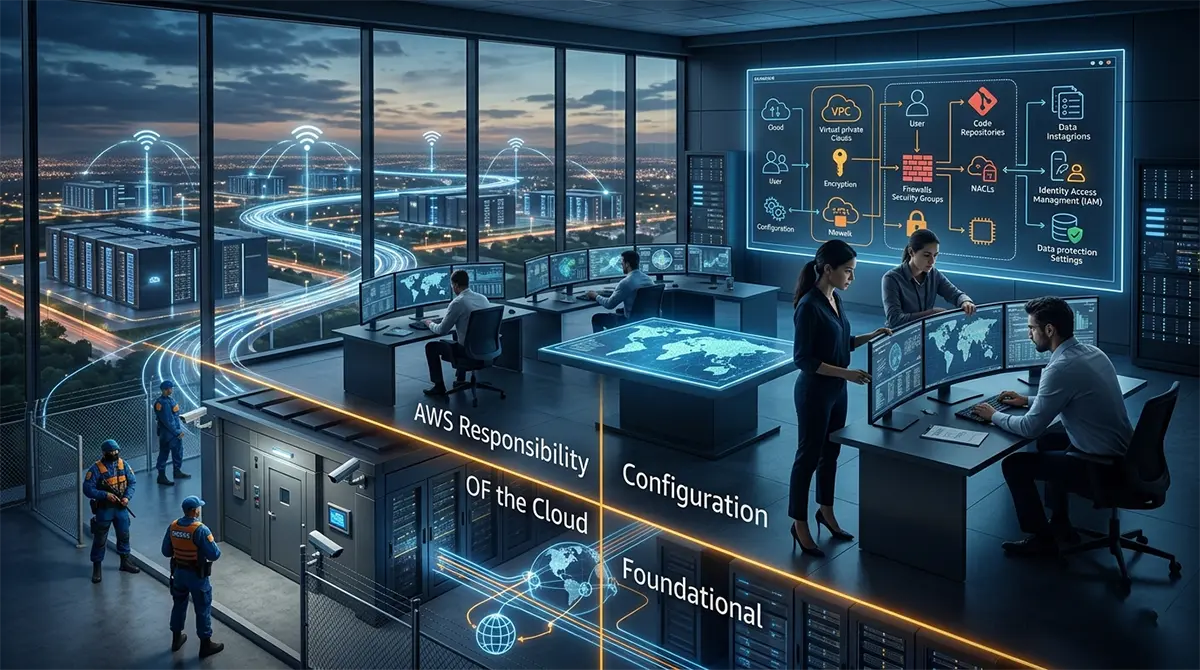
Physical security and regulatory compliance are built into every layer of the AWS infrastructure footprint. Operating across dozens of countries requires strict adherence to diverse legal mandates governing data storage, privacy, and physical access controls.
Physical data center security follows a strict multi-layered defense model:
-
Perimeter Security: Facilities feature concrete vehicle barriers, perimeter fencing, security guards, and electronic intrusion detection systems.
-
Infrastructure Access Control: Physical access requires multi-factor biometric authentication, pre-approved authorization tickets, and continuous video surveillance.
-
Server Floor Isolation: Only authorized hardware technicians are granted entry to server room floors, and equipment access is tightly monitored.
-
Secure Hardware Decommissioning: When storage drives reach the end of their operational life, AWS destroys them on-site using specialized degaussing and shredding equipment in compliance with NIST standards to prevent data recovery.
On the architectural front, the AWS Nitro System provides a underlying foundation for cloud hardware isolation. Nitro offloads virtualization hypervisor functions, networking management, and storage control onto custom-built hardware cards. This physically isolates customer compute workloads from the management host, ensuring that no human operator or system process can access customer memory or storage contents.
To support compliance mandates around the world, AWS regularly undergoes independent third-party audits. The infrastructure is certified under international frameworks including SOC 1/2/3, ISO 27001, PCI-DSS, HIPAA, and FedRAMP. This rigorous security posture allows government agencies, healthcare providers, and global financial institutions to run sensitive workloads safely in the public cloud.
Strategic Guidelines for Designing Your Global AWS Topology
Navigating the vast array of AWS Regions, Availability Zones, and Edge services can be daunting. To maximize performance, resilience, and operational efficiency, systems architects should follow strategic principles when designing their global cloud topology:
-
Architect for Multi-AZ First: Every production workload should be deployed across a minimum of two or three Availability Zones within its primary Region. This is the single most effective step to eliminate single points of physical hardware failure.
-
Leverage Edge Networks for Client Traffic: Use Amazon CloudFront and AWS Global Accelerator to route end-user traffic onto the private AWS backbone as close to the user as possible. This reduces TCP handshake latency and speeds up content delivery globally.
-
Decouple Region Dependencies: Avoid hardcoding regional resource dependencies into application code or deployment pipelines. Ensure that deployment scripts can recreate complete application environments in alternative Regions if disaster recovery procedures need to be invoked.
-
Automate Data Lifecycle Policies: Use managed replication services, such as S3 Cross-Region Replication and Aurora Global Databases, to handle geographical data distribution while managing data retention settings to comply with privacy laws.
-
Continuously Re-Evaluate Infrastructure Costs: Cloud pricing structures update over time and new Regions launch periodically. Periodically audit workload placement to ensure cost efficiency and optimal latency as customer demographics evolve.
The AWS global infrastructure represents a remarkable achievement in modern computer science and civil engineering. By abstracting immense physical hardware systems into programmable APIs, AWS empowers developers and enterprises to build global, resilient, and high-performance applications with ease. Understanding how these physical components fit together is the key to mastering cloud architecture and building systems capable of powering the digital world.