


In the early decades of computing, the relational database management system reigned supreme. Built around rigid schemas, tables, rows, and strict foreign-key relationships, systems like SQL Server, PostgreSQL, and Oracle provided a structured and dependable foundation for software applications. However, as the web expanded, mobile devices multiplied, and real-time big data became an operational requirement, the structural rigidity of traditional tables began to buckle under new demands. Modern software applications generate unstructured, semi-structured, and rapidly evolving data at unprecedented volumes.
To solve these emerging challenges, document-oriented databases emerged as a core pillar of the NoSQL movement. By storing data as self-contained, flexible documents rather than rigid rows across normalized tables, document databases offer a compelling, high-performance alternative for modern developers. This article explores the overwhelming advantages of document-oriented databases, detailing why they have become the default choice for powering today’s dynamic, scalable, and complex digital ecosystems.
1. Ditching the Rigid Mold: The Power of Schema Flexibility
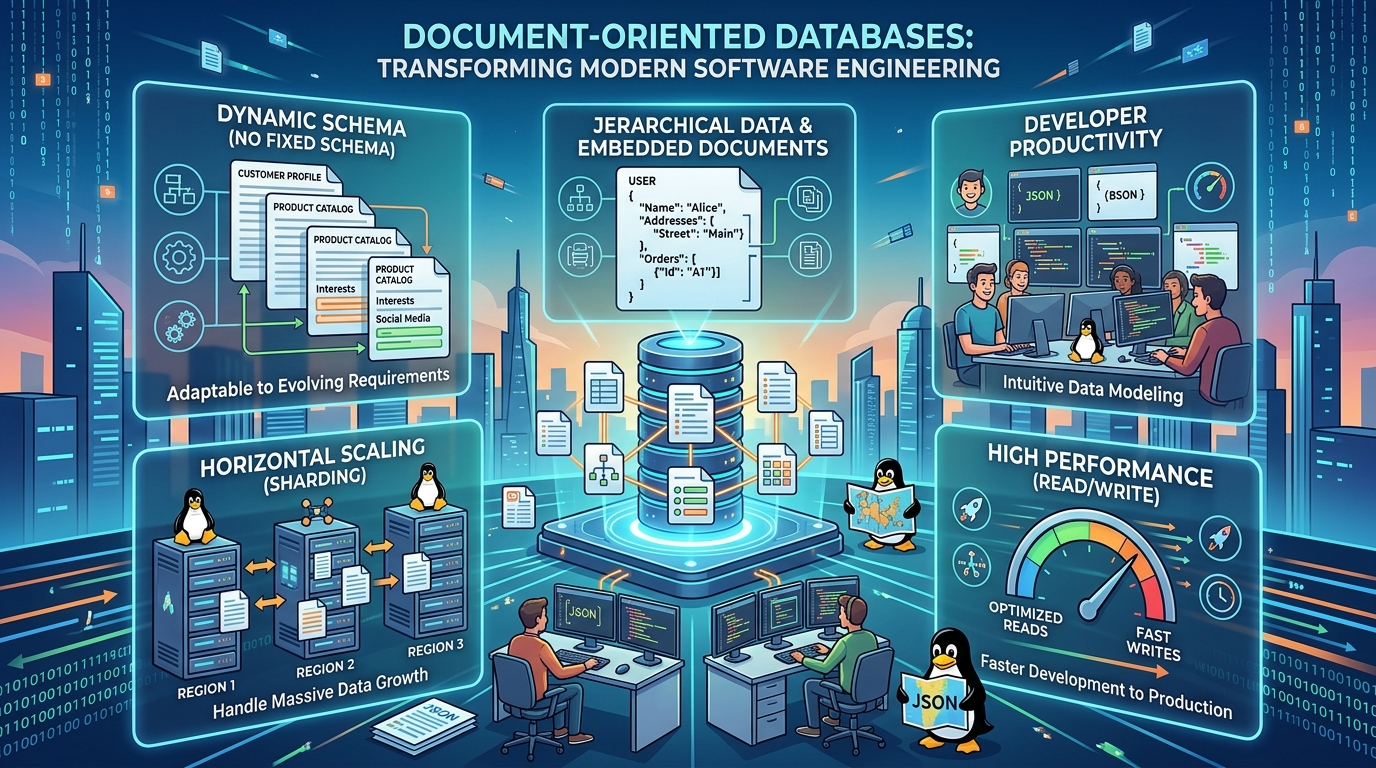
The most defining feature of a document-oriented database is its dynamic schema. In traditional relational systems, creating or altering data structures requires executing Data Definition Language commands, creating complex migrations, and carefully defining every column type in advance. If an application needs to store a new attribute for a user profile, the database administrator must alter the table, which can lock databases, require downtime, or introduce unforeseen breaking changes.
Document databases remove this operational friction entirely. Data is stored in formats such as JSON, BSON, or XML, where every document can maintain its own unique set of fields and attributes. If a new user profile requires a middle name, a preference matrix, or social media links, these fields can be inserted into the document without affecting any other records in the collection.
This schema flexibility empowers engineering teams to iterate rapidly. In modern Agile environments where product requirements change on a weekly basis, developers can modify code and instantly write updated data structures directly to the database. They no longer need to wait for lengthy database migration scripts or perform risky schema updates in production. This seamless evolution of data structures fundamentally accelerates the software development lifecycle.
2. Mapping Reality: Natural Alignment with Object-Oriented Code
For decades, developers building applications in object-oriented languages like Java, Python, JavaScript, and C# have suffered from a friction point known as object-relational impedance mismatch. In application code, data exists as rich, nested objects containing lists, dictionaries, and domain logic. To store these objects in a relational database, developers must shred them into flat rows across multiple normalized tables, only to reconstruct them back into objects whenever they are queried.
Document-oriented databases eliminate this friction by storing data in the exact structural format that application code uses. A JSON document directly mirrors an object in JavaScript or Python, complete with nested child objects, arrays, key-value pairs, and scalar values.
When an application queries a document database, it receives a fully realized object ready for immediate use, without needing complex Object-Relational Mapping frameworks to translate between relational tables and code structures. This natural alignment simplifies the mental model for software engineers, dramatically reduces boilerplate translation code, and eliminates an entire class of subtle mapping bugs that plague relational architectures.
Looking for Enterprise-Grade DevOps Services in Dubai?
Scaling your infrastructure, automating deployments, and ensuring 99.9% uptime shouldn’t be a bottleneck for your business. Whether you need robust CI/CD pipelines, containerization with Docker and Kubernetes, or secure cloud architecture, We can help you streamline your operations. Let’s optimize your IT environment Get in touch with us today to discuss your project.
3. Atomic Independence: Fast Reads Through Self-Contained Records
Relational databases achieve data integrity through strict normalization, splitting complex information across dozens of separate tables to eliminate data redundancy. While normalization avoids duplicated data, it incurs a severe operational cost during read operations: the database must perform expensive SQL JOIN operations to assemble a single coherent view of an entity. As data volumes grow into the millions or billions of records, executing multi-table JOINs across disk arrays severely degrades response times.
Document databases adopt an entirely different philosophy centered on data encapsulation. Instead of shredding an entity across multiple tables, a document database encourages embedding related data directly within a single, self-contained document. For example, an e-commerce order document can contain the buyer details, line items, shipping addresses, and payment receipts all within one record.
Because all relevant data lives inside a single document, reading an entity requires accessing only one location on disk or in memory. The database engine does not need to cross-reference multiple indexes or lock foreign key tables to build the response. This localized, atomic design yields exceptionally fast read performance and predictable low latency, even under massive query loads.
4. Horizontal Growth Made Simple: Built-In Distributed Scale
Scaling a traditional relational database horizontally across multiple server nodes is notoriously difficult. Relational engines rely on cross-table integrity, foreign keys, and distributed transactions, all of which require complex coordination across network boundaries when data is spread across different machines. Consequently, relational databases have historically scaled vertically by upgrading to larger, more expensive hardware with faster CPUs and massive memory footprints.
Document databases were engineered from the ground up to operate seamlessly across distributed clusters of commodity hardware. Because documents are self-contained units of data, dividing them across multiple database servers is a natural architectural fit.
Through a mechanism known as sharding, document databases automatically partition collections of documents across a cluster of nodes based on a chosen shard key. As traffic increases or data storage needs grow, organizations can simply add new commodity servers to the cluster. The database transparently balances the data and queries across the expanded hardware footprint. This native ability to scale horizontally allows document databases to handle massive throughput and petabyte-scale datasets without hitting the artificial physical limits or astronomical costs of single-node vertical scaling.
5. Developer Delight: Intuitive Querying and Expressive Data Manipulation
Writing complex SQL queries with multiple nested joins, subqueries, and temporary views can quickly become difficult to maintain and debug. Document databases modernize the developer experience by offering rich, declarative query APIs that mirror modern programming syntaxes.
Instead of raw string-based SQL queries, developers interact with document databases using native language methods, fluent builders, or JSON-like query documents. These APIs allow developers to perform filtering, projection, sorting, and field-level updates with high clarity.
Furthermore, modern document databases feature powerful aggregation frameworks that allow developers to perform complex data processing pipelines directly on the database cluster. Engineers can filter documents, transform fields, reshape data, perform group-by calculations, and unwind nested arrays in a sequential pipeline. This expressive manipulation capability gives developers the full analytical power required for modern dashboards and reporting engines without sacrificing readable, maintainable codebases.
6. Embracing Complex Structures: Polymorphic Data and Dynamic Attributes
In traditional databases, handling entities that share common characteristics but differ in key attributes is challenging. Consider an online marketplace that sells products ranging from clothing to electronics and digital software downloads. Clothing requires attributes like size, color, and fabric composition; electronics require voltage, warranty terms, and dimensions; software requires file size and license keys.
In a relational database, representing this polymorphic data forces architects into suboptimal trade-offs. They must either create a giant, sparse table filled with hundreds of NULL columns, build dozens of specialized tables connected by complex joins, or construct an unwieldy Entity-Attribute-Value pattern that destroys performance and type safety.
Document databases solve the polymorphic data problem effortlessly. Every document in a collection can hold a different schema tailored specifically to the item it represents, while still sharing common core attributes like price, title, and product identifier. Querying across a collection of polymorphic documents is straightforward because the database indexes fields dynamically, regardless of whether every document in the collection contains that specific field. This adaptability makes document databases the premier choice for content management systems, product catalogs, healthcare records, and IoT data feeds where data shapes vary widely.
7. Performance at Scale: Advanced In-Memory Caching and Indexing
High performance in modern software applications relies on rapid indexing and intelligent memory management. Document databases excel in these areas by offering sophisticated indexing capabilities specifically designed for complex, nested data structures.
Unlike relational databases that primarily index single columns or composite combinations, document databases can index individual fields, deep nested object paths, entire sub-documents, and items within arrays. Multi-key indexing allows an application to instantly query items based on values buried deep inside a list of embedded objects. Additionally, many document databases natively support specialized index types, including:
-
Geospatial indexes for performing real-time location and distance queries
-
Text search indexes for executing full-text searches with linguistic stemming and scoring
-
Wildcard indexes for automatically indexing unknown or user-defined dynamic attributes
-
Time-series indexes optimized for high-frequency event logging and sensor metrics
When combined with built-in in-memory caching engines, document databases ensure that hot datasets and frequently accessed indexes reside in system RAM. This architectural design provides sub-millisecond document retrievals at immense query volumes.
8. Enterprise Readability: JSON, BSON, and Self-Describing Formats
Data readability and auditability are crucial for long-term system maintenance and cross-team collaboration. Document databases store data in self-describing formats like JSON or its binary equivalent, BSON.
In a self-describing format, the field names are stored alongside the values inside the data structure itself. This self-contained layout makes raw database records human-readable and instantly recognizable without requiring access to external schema definitions or metadata dictionaries.
When developers, data analysts, or system administrators inspect a document directly from the database terminal or a management dashboard, the context of every field is clear. This human-centric data presentation simplifies debugging, speeds up onboarding for new developers, and eases integration with external APIs and microservices, which almost universally communicate using JSON objects.
9. Modern Integrity: ACID Transactions Without Relational Rigidity
A historical criticism of early NoSQL document databases was their sacrifice of strong consistency and ACID (Atomicity, Consistency, Isolation, Durability) guarantees in favor of raw speed and eventual consistency. While this trade-off was acceptable for logging systems and social media feeds, it limited the use of early document databases in mission-critical applications like financial ledgers, inventory management, and transaction processing.
Today, that paradigm has shifted entirely. Modern enterprise-grade document databases offer multi-document ACID transactions that match the consistency guarantees of traditional SQL databases.
Because most write operations in a document database affect a single, self-contained document, atomic operations are naturally achieved at the single-record level without heavy transactional overhead. However, when complex operations require atomic updates across multiple documents, collections, or shards, modern document databases execute fully compliant ACID transactions using multi-version concurrency control and distributed commit protocols. Developers no longer need to choose between the flexibility of a document model and the strict data integrity required for enterprise financial software.
10. Perfect Match for Modern Architectures: Microservices and Event-Driven Cloud
Software architecture has evolved from monolithic systems toward decoupled microservices, serverless computing, and event-driven architectures. Document databases are uniquely suited to complement these modern cloud-native patterns.
In a microservices architecture, each service operates independently and owns its isolated data storage layer. Microservices communicate with each other over networks using lightweight RESTful APIs or messaging queues, primarily transmitting JSON payloads. Using a document database as the persistent store behind a microservice eliminates translation layers: incoming API payloads can be stored directly into the database, and database documents can be returned directly to API callers with minimal transformations.
Furthermore, top-tier document databases offer native change streams and event-driven integration hooks. Applications can subscribe to database modification events in real time and trigger automated serverless functions, update search indexes, push notifications to mobile devices, or feed analytical event streams instantly when a document is created, updated, or deleted.
Conclusion: Empowering the Next Generation of Applications
The evolution of modern software demands database solutions that combine high performance, seamless scalability, and operational agility. While traditional relational databases will always retain a place in systems with fixed, highly tabular structures, document-oriented databases provide a versatile solution for the complex demands of today’s digital landscape.
By combining schema flexibility, natural alignment with object-oriented code, powerful indexing, native horizontal scaling, and robust multi-document transactions, document-oriented databases remove structural bottlenecks that slow engineering teams down. They enable developers to build faster, adapt to changing business requirements effortlessly, and scale applications seamlessly from initial prototype to global enterprise production. As software systems continue to grow in complexity, the document-oriented model stands out as a clear path forward for sustainable, future-proof data architecture.