
Building a resilient cloud architecture requires a deep understanding of how cloud resources are bounded, grouped, and billed. At the core of the Microsoft cloud ecosystem sits the Azure subscription, a fundamental logical container that links identity, security, management, and financial responsibility. Organizations moving workloads to the cloud often treat subscriptions as simple billing accounts, yet they serve a far more critical role as governance and isolation boundaries. Understanding how to structure, manage, and scale subscriptions determines whether an enterprise achieves operational efficiency or becomes entangled in administrative overhead.
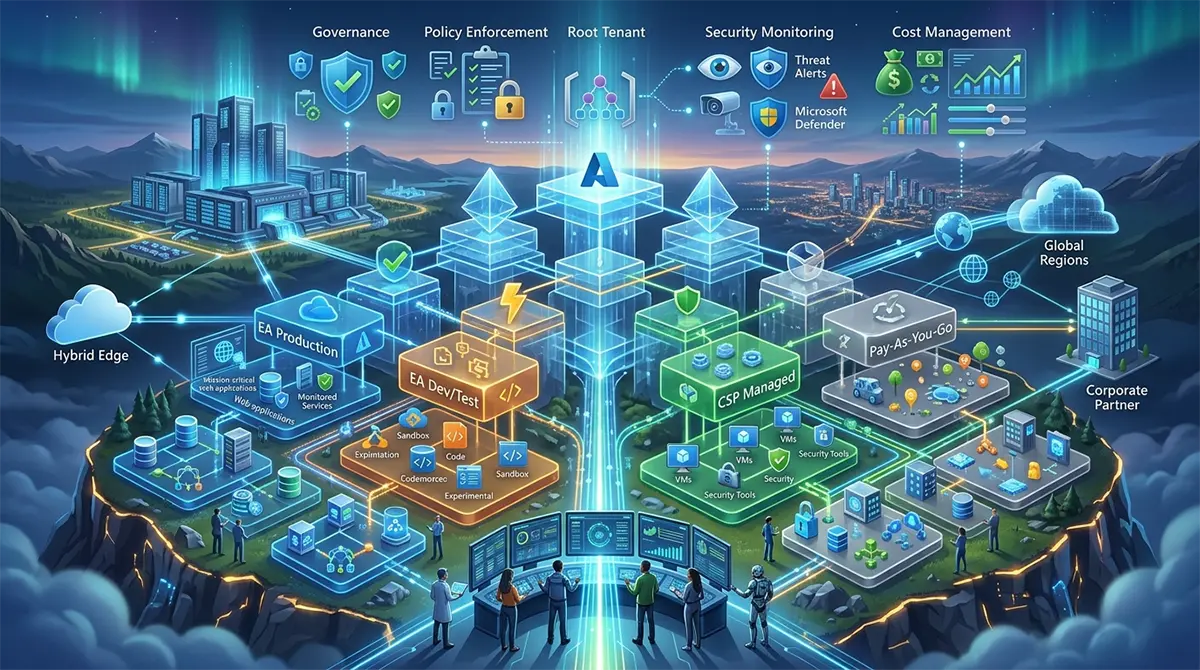
To master subscription management, one must first explore the structural hierarchy that Microsoft Azure uses to organize assets. At the highest level sits the Microsoft Entra ID tenant, formerly known as Azure Active Directory. The tenant represents the organization itself and serves as the ultimate identity boundary. Beneath the tenant, Azure provides a four-level management structure: management groups, subscriptions, resource groups, and individual resources.
Management groups allow organizations to manage access, policy, and compliance across multiple subscriptions simultaneously. Subscriptions exist directly beneath management groups or the root management group, acting as units of management, billing, and scale. Resource groups sit within subscriptions to organize related resources that share the same lifecycle, while resources themselves represent the individual infrastructure and platform components such as virtual machines, databases, and storage accounts.
A subscription functions across three key dimensions:
-
Financial Boundary: It aggregates costs for all contained resources, serving as the itemized basis for invoicing and chargeback models.
-
Administrative Boundary: It acts as a scope for Role-Based Access Control assignments, defining who has permissions to create, modify, or delete assets.
-
Operational and Limit Boundary: It enforces soft and hard platform limits, known as Azure subscription quotas, which govern resource allocation per region and service.
By recognizing subscriptions as structural components rather than mere payment mechanisms, cloud architects can design environments that isolate risks, distribute administrative power, and enforce uniform governance across global estates.
Decoding Azure Subscription Types for Strategic Alignment
Choosing the correct subscription type is a foundational business decision that shapes an organization’s procurement experience, financial flexibility, and operational support. Microsoft offers several distinct subscription models designed to cater to varying organizational sizes, commercial agreements, and technical requirements. Selecting the right combination of subscriptions requires evaluating factors such as billing structures, delegated management privileges, and intended environment lifecycles.
Enterprise Agreement Subscriptions
For large organizations with predictable cloud spending, the Enterprise Agreement remains a cornerstone purchasing channel. An Enterprise Agreement allows organizations to commit to a monetary spend over a three-year period in exchange for discounted rates across Azure services. Within an Enterprise Agreement enrollment, administrators can create two primary sub-types of subscriptions: EA Production and EA Dev/Test.
EA Dev/Test subscriptions offer discounted rates on specific compute workloads, including Azure Virtual Machines and Azure App Services, provided they are used strictly for non-production development and testing scenarios. These subscriptions carry modified Service Level Agreements and eliminate software licensing surcharges on Windows Server and SQL Server workloads. EA Production subscriptions, conversely, carry standard pricing and full Service Level Agreements, ensuring high availability for critical business applications.
Microsoft Customer Agreement Subscriptions
The Microsoft Customer Agreement represents the modern purchasing experience designed to streamline cloud procurement. Under an MCA, the traditional hierarchy of enterprise enrollments is replaced by a simplified structure composed of billing accounts, billing profiles, and invoice sections. Subscriptions are created under specific invoice sections, enabling precise cost segregation without needing complex contract amendments.
MCA subscriptions provide the same technical capabilities as EA subscriptions but offer greater flexibility in payment terms, digital signature workflows, and self-service portal administration through the Azure portal. This structure allows global enterprises to consolidate disparate billing relationships into a single unified contract while retaining granular control over localized departmental spending.
Cloud Solution Provider Subscriptions
The Cloud Solution Provider program caters to organizations that prefer to manage their Azure infrastructure through a certified Microsoft partner. In a CSP model, the partner manages the underlying billing relationship, provides direct technical support, and frequently delivers managed services layered on top of Azure infrastructure.
CSP subscriptions are particularly advantageous for small to medium enterprises or businesses lacking dedicated in-house cloud engineering teams. The partner provisions the subscription on behalf of the client and utilizes Delegated Administrative Privileges or Granular Delegated Administrative Privileges to manage governance, security policies, and resource deployment. This arrangement transfers the operational burden of platform management to external experts while keeping the client’s data isolated within dedicated tenant boundaries.
Pay-As-You-Go and Direct Retail Subscriptions
Pay-As-You-Go subscriptions represent the standard pay-as-you-use direct purchasing model. These subscriptions require no upfront financial commitment or long-term contract, with usage billed directly to a credit card or monthly invoice. While PAYG subscriptions offer maximum agility for rapid prototyping, individual sandbox experiments, or small businesses, they lack the enterprise volume discounts associated with EA or MCA frameworks.
From an enterprise governance perspective, unmonitored PAYG subscriptions present a risk. Developers may deploy ad-hoc infrastructure using corporate credit cards, bypassing centralized security controls and leading to fragmented visibility across the corporate cloud footprint.
Developer and Sponsorship Subscriptions
Microsoft provides specialized subscription types tailored for learning, experimentation, and partnership enablement. Visual Studio subscriptions, formerly known as MSDN, grant individual developers monthly recurring Azure credits. These personal sandbox environments enable engineers to test new services without risking production budgets.
Azure Sponsorship subscriptions are custom non-billing subscriptions granted by Microsoft for specific initiatives, such as startup acceleration programs, proof-of-concept validations, or academic research projects. Additionally, Azure Free Accounts provide entry-level credits and access to popular free services for twelve months. All developer and sponsorship subscriptions come with strict spending limits to prevent accidental overages, making them unsuitable for hosting long-term production workloads.
Architecting Scalable Subscription Models
A common operational anti-pattern is attempting to host an entire corporate IT estate within a single Azure subscription. While a single subscription simplifies initial deployment, it quickly creates operational bottlenecks as organizational usage scales. Cloud platform limits, such as Maximum Azure Resource Manager API requests per hour, virtual network peering constraints, and role assignment thresholds, will eventually disrupt operations in a densely populated single subscription.
To avoid these friction points, enterprise architects implement subscription democratization strategies, distributing workloads across multiple purpose-built subscriptions.
The Enterprise Scale Landing Zone Architecture
Microsoft’s Enterprise-Scale Landing Zone guidance outlines a repeatable framework for multi-subscription architecture. This model categorizes subscriptions into two primary domains: Platform Subscriptions and Application Landing Zone Subscriptions.
Platform subscriptions host centralized, shared operational services utilized across the entire organization. These typically include:
-
Management Subscription: Hosts centralized log analytics workspaces, automation accounts, and operational monitoring dashboards.
-
Identity Subscription: Houses domain controllers, identity synchronization agents, and key management components required for hybrid identity authentication.
-
Connectivity Subscription: Functions as the central networking hub, hosting Azure Virtual WAN or traditional Hub-and-Spoke virtual networks, ExpressRoute circuits, VPN gateways, and centralized Azure Firewalls.
Application Landing Zone subscriptions host actual business applications and operational workloads. These subscriptions are separated based on business domain, application archetype, and environment lifecycle.
Subscription Allocation Strategies
When deciding how to segregate Application Landing Zone subscriptions, organizations generally choose between three core modeling approaches.
The Business Unit model assigns dedicated subscriptions to specific business entities, such as Finance, Marketing, or Human Resources. This approach aligns directly with departmental accounting structures, simplifying financial chargeback. However, it can blur environmental boundaries if development, testing, and production workloads reside within the same subscription boundary.
The Environment model segregates subscriptions strictly by technical maturity lifecycle, such as Production, Staging, Development, and Sandbox. This model enforces security isolation, preventing non-production configurations or developer privileges from affecting critical production systems. However, large organizations may find that a single production subscription quickly hits platform quotas if all departmental applications share it.
The Workload Archetype model combines the strengths of both approaches by creating separate subscriptions based on workload characteristics, security classifications, and business criticality. For example, a mission-critical web application may receive dedicated Development, Testing, and Production subscriptions, while internal line-of-business applications share a common production landing zone.
Implementing Governance and Policy Enforcement
Operating a distributed, multi-subscription Azure environment requires automated governance frameworks. Manual oversight cannot keep pace with dynamic cloud provisioning. Azure Policy, combined with Management Group hierarchies, provides the framework required to maintain compliance across hundreds of subscriptions without slowing down application development teams.
Management Group Hierarchy Design
Management groups form the scaffolding through which governance policies and access controls cascade down to individual subscriptions. A well-designed hierarchy reflects organizational boundaries and governance requirements rather than rigid corporate org charts.
At the top of the structure sits the Tenant Root Group, which should be reserved strictly for global policies that apply universally across the entire enterprise. Beneath the root, organizations typically establish platform-level management groups:
-
Platform Management Group: Contains the Identity, Management, and Connectivity subscriptions, receiving policies tailored for shared central infrastructure.
-
Landing Zones Management Group: Contains sub-groups for Corporate workloads and Online workloads, allowing policies to differentiate between internal-only systems and internet-facing applications.
-
Sandbox Management Group: Contains isolated developer subscriptions where restrictive security policies are relaxed to facilitate experimentation, but financial controls and network connectivity limits are strictly enforced.
-
Decommissioned Management Group: Holds subscriptions scheduled for retirement, applying restrictive policies that block new resource provisioning while data is archived.
Automated Policy Enforcement
Azure Policy enforces operational standards and evaluates resource compliance continuously. By assigning policy definitions and initiatives at the Management Group level, controls inherit automatically down to every underlying subscription.
Essential policies for multi-subscription environments include:
-
Geographic Region Restrictions: Restricts resource deployment exclusively to approved Azure regions, ensuring data residency compliance and preventing accidental deployments in high-cost locations.
-
Allowed Resource Types: Denies the provisioning of unapproved or high-cost Azure services, limiting the attack surface and controlling unmonitored expenditure.
-
Mandatory Tagging Enforcement: Applies Deny or Modify effects to block resource creation if required tags, such as Cost Center or Environment, are missing.
-
Network Security Controls: Mandates that network interfaces connect only to approved virtual networks and prevents public IP address creation on non-gateway resources.
By leveraging Policy Initiatives, which combine multiple individual policy definitions into a single operational package, platform teams can enforce compliance frameworks such as ISO 27001, CIS Benchmarks, or NIST guidelines across all subscriptions in a single deployment step.
Identity and Access Governance
Role-Based Access Control defines security perimeters within Azure subscriptions. RBAC uses security principles, role definitions, and scopes to determine what actions a user, service principal, or managed identity can perform.
To maintain strong security boundaries across subscriptions, access management should follow three core principles:
-
Principle of Least Privilege: Users should be granted only the minimum permissions required to perform their daily duties. Broad roles such as Owner or Contributor should be restricted at the subscription level.
-
Group-Based Access Management: Assign permissions directly to Entra ID Security Groups rather than individual user accounts. Access is managed by modifying group membership rather than reconfiguring subscription-level roles.
-
Just-In-Time Access: Utilize Microsoft Entra Privileged Identity Management to grant time-bound, elevated administrative access. Privileged roles remain inactive until requested, approved, and logged, drastically reducing the exposure window for administrative credentials.
Custom RBAC roles should be authored when built-in roles grant broader permissions than necessary. By scoping custom roles to specific management groups, platform administrators ensure consistent privilege models across all child subscriptions.
Mastering Financial Governance and Cost Management
As cloud consumption grows across multiple subscriptions, controlling expenditure becomes a paramount administrative challenge. Unmonitored cloud usage can quickly lead to budget overruns. Effective financial management requires combining real-time visibility, automated spending controls, tag-driven chargeback models, and strategic purchasing options.
Cost Visibility and Budgetary Controls
Azure Cost Management provides centralized visibility into spending patterns across management groups, billing accounts, and individual subscriptions. Establishing effective cost governance begins with configuring automated budgets and alert thresholds.
Administrators should establish budget alerts at multiple levels within the resource hierarchy. Alerts can trigger when actual spending or forecasted spending reaches predefined percentages of a budget, such as 50%, 80%, or 100%. These notifications can integrate directly with IT Service Management platforms or communication channels using Azure Action Groups and Webhooks, alerting platform engineers before cost overruns occur.
Tagging Frameworks for Chargeback and Showback
Accurate financial reporting relies on a robust resource tagging strategy. Tags are key-value pairs assigned to resources, resource groups, or subscriptions, providing metadata that allows financial engines to categorize usage data.
A enterprise tagging standard should mandate the following key metadata fields:
-
Environment: Identifies the operational maturity tier, such as Production, Staging, Development, or QA.
-
CostCenter: Identifies the internal financial accounting unit responsible for the infrastructure costs.
-
BusinessOwner: Specifies the team lead or manager accountable for the application lifecycle.
-
ApplicationName: Links the infrastructure components directly to a registered service catalog entry.
-
DataClassification: Indicates the sensitivity level of the data processed by the contained assets.
Using Azure Policy, organizations can automatically inherit tags from resource groups down to individual resources or automatically populate billing tags based on subscription-level attributes. This metadata fuels detailed showback reporting, where business units receive visibility into their cloud consumption, and chargeback mechanisms, where cloud expenses are directly debited from departmental budgets.
Strategic Cost Optimization Techniques
Managing enterprise subscriptions requires continuous optimization to eliminate idle capacity and optimize unit economics. Organizations should combine multiple financial optimization mechanisms across their subscription fleet.
Azure Reservations allow organizations to commit to one-year or three-year terms for compute services, such as Virtual Machines, Azure SQL Database, and Azure Cosmos DB, in exchange for discounts compared to pay-as-you-go rates. Reservations can be scoped to a single resource group, a single subscription, or shared across an entire management group, ensuring maximum utilization across multiple teams.
Azure Savings Plans for Compute offer flexible cost savings across compute services regardless of region, instance series, or operating system. By committing to an hourly spend on compute resources, organizations automatically receive discounted rates without locking themselves into specific virtual machine sizes.
Azure Hybrid Benefit allows organizations with existing on-premises software licenses featuring Active Software Assurance to apply those licenses to Azure workloads. This benefit applies to Windows Server and SQL Server instances, as well as Red Hat and SUSE Linux environments, reducing compute execution costs.
Automated right-sizing represents an operational mechanism where machine learning recommendations from Azure Advisor analyze resource utilization metrics. Systems with low CPU, memory, or network usage are identified for automated resizing or shutdown during off-peak hours using Azure Automation runbooks.
Operational Resilience, Security, and Lifecycle Management
Maintaining subscription infrastructure over time requires operational workflows for security posture monitoring, network integration, disaster recovery, and subscription lifecycle management. Without active operational maintenance, subscription fleets can suffer from configuration drift and elevated security risk.
Centralized Security Posture Management
Security management across distributed subscriptions demands unified oversight. Microsoft Defender for Cloud provides Cloud Security Posture Management and Advanced Threat Protection across management groups and subscriptions.
By enabling Defender for Cloud at the management group level, security operations teams gain a centralized view of compliance scores, security recommendations, and active threat detections. Secure Score metrics evaluate subscriptions against security benchmarks, providing actionable remediation steps to fix misconfigurations such as unencrypted storage accounts, open management ports, or missing endpoint protection agents.
Furthermore, integrating Microsoft Defender for Cloud with a centralized Security Information and Event Management platform, such as Microsoft Sentinel, aggregates subscription audit logs, Entra ID authentication events, and network flow data into a single threat analysis dashboard.
Cross-Subscription Networking Topologies
Modern cloud architectures frequently require seamless communication between resources residing in separate subscriptions. Achieving secure inter-subscription connectivity without creating redundant routing mechanisms requires a Hub-and-Spoke topology.
In a multi-subscription Hub-and-Spoke model, the Hub virtual network resides within a central Connectivity Subscription. This network contains shared infrastructure components such as Azure Firewall, Intrusion Detection and Prevention systems, ExpressRoute Gateways, and centralized DNS private resolvers.
Spoke virtual networks reside within application landing zone subscriptions. Spoke networks connect to the central hub using Virtual Network Peering. This configuration enforces all cross-subscription traffic and external internet ingress and egress to route through central security appliances, maintaining isolation between individual application workloads while preserving centralized visibility.
Subscription Lifecycle and Automation
Managing subscriptions manually becomes impractical as organizations expand into hundreds of environments. Modern platform engineering practices rely on subscription vending machines to automate the provisioning, baseline configuration, and decommissioning of subscriptions.
A subscription vending machine utilizes Infrastructure as Code tools, such as Azure Bicep or HashiCorp Terraform, coupled with Azure REST APIs to automate administrative steps when a business unit requests a new environment:
-
Programmatically provision a new subscription under the appropriate Management Group using Enterprise Agreement or MCA APIs.
-
Apply standard role assignments, mapping Entra ID groups to local subscription roles.
-
Deploy core resource groups, baseline tagging, and central Log Analytics workspace diagnostic settings.
-
Establish network peering between the subscription’s spoke virtual network and the central connectivity hub.
-
Apply necessary Azure Policy definitions to lock down unapproved services and regions.
When applications reach the end of their operational lifecycle, an automated decommissioning process transfers the target subscription to a Decommissioned Management Group. Restrictive policies immediately block new deployments, revoke user permissions, and schedule contained resources for graceful deletion, ensuring unused subscriptions do not accumulate recurring charges or orphan assets.
Global Infrastructure and Regional Deployments
As enterprises expand globally, subscription structures must accommodate international data sovereignty laws, latency requirements, and regional availability zones. Azure’s footprint spans numerous global regions, each offering tailored compute, storage, and networking capabilities.
When deploying workloads into international jurisdictions, governance policies must enforce strict regional boundaries. For example, organizations expanding operations into the Middle East can leverage regional infrastructure like microsoft azure uae to ensure sensitive customer records remain within regional geographic boundaries while complying with local data residency mandates.
Assigning regional deployment policies at the subscription or management group level ensures that developers cannot accidentally provision resources outside approved boundaries. This combination of localized landing zones and global governance policies allows enterprises to maintain compliance across complex multiregional operations while delivering low-latency service to localized end-users.
Building an Evolution-Ready Subscription Framework
Subscription architecture is not a static milestone; it is an evolving operational framework that matures along with an organization’s cloud journey. Attempting to design a single perfect topology that accommodates every future scenario often leads to over-engineering. Instead, cloud teams should prioritize adaptability, clear boundaries, and automated governance.
By aligning subscription types with business contracts, establishing robust management group hierarchies, enforcing automated policies, and leveraging programmatic subscription vending, organizations create a scalable foundation for continuous growth. A well-architected subscription strategy eliminates administrative friction, protects corporate assets through granular privilege boundaries, controls cloud spending, and empowers development teams to innovate securely at speed.