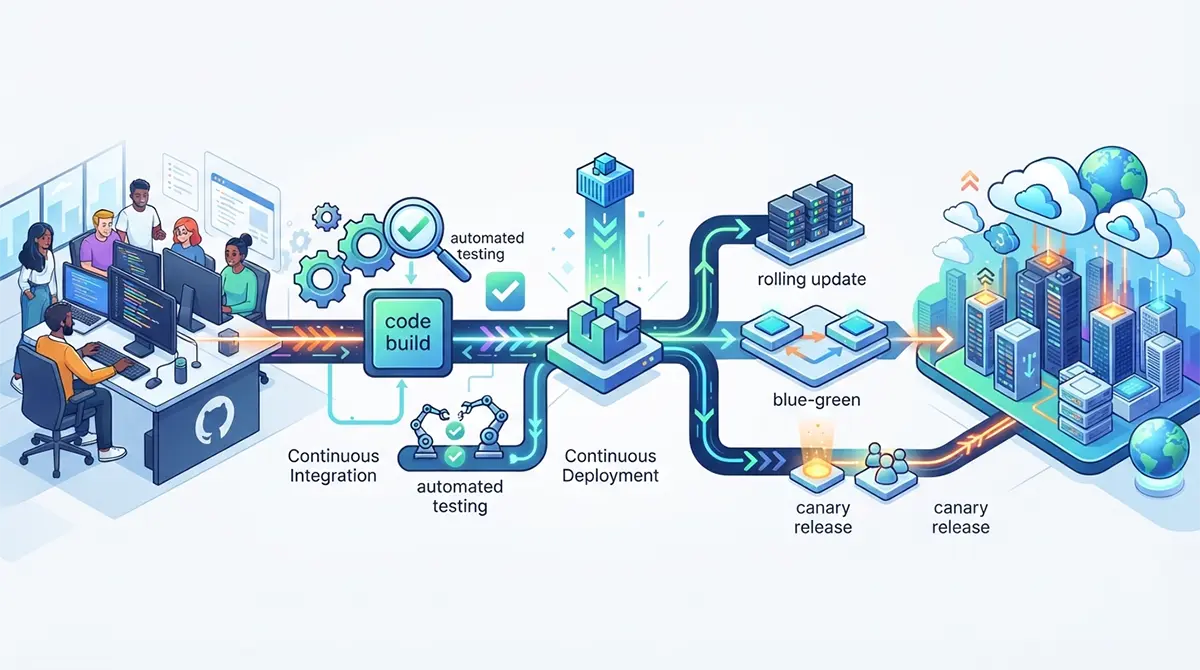



In the contemporary landscape of software engineering, the speed at which an organization can deliver value to its users dictates its market survival. Gone are the days when monolithic releases were coordinated quarterly with high anxiety, manual verification checklists, and overnight maintenance windows. Today, elite engineering teams operate on a rhythm of continuous delivery, pushing dozens or even hundreds of production-ready increments daily. At the heart of this operational agility lies the Continuous Integration and Continuous Deployment (CI/CD) pipeline.
A well-architected CI/CD pipeline acts as the nervous system of modern software architecture. It automates the painful, error-prone rituals of building, testing, securing, and deploying code, replacing human bottlenecks with deterministic, repeatable automation. Among the myriad orchestration tools available today, GitHub Actions has emerged as an exceptionally powerful and native solution. By embedding workflow automation directly into the version control platform where code lives, GitHub Actions bridges the gap between development and operations, fostering a true culture of shared responsibility and rapid feedback.
However, simply setting up a basic workflow that runs `npm test` on every push is far from sufficient for production-grade engineering. A robust pipeline must account for complex dependency caching, secure secret management, multi-stage testing gates, container security scanning, zero-downtime deployment strategies, and rigorous observability. This comprehensive guide will dissect every layer of designing, scaling, and maintaining a bulletproof CI/CD pipeline using GitHub Actions, providing senior engineers and architects with the blueprint needed to transform their software delivery lifecycle.
The Evolution of Software Delivery: From Waterfall to GitOps
To truly appreciate the power of modern CI/CD, it is essential to examine the historical trajectory that brought the software industry to this juncture. For decades, the dominant paradigm was the Waterfall model, characterized by rigid, sequential phases: requirements gathering, system design, implementation, testing, deployment, and maintenance. In this environment, integration occurred at the very end of the cycle, often resulting in massive integration friction, cascading bug discoveries, and prolonged release delays.
The advent of Agile methodologies dismantled sequential silos, emphasizing iterative development and cross-functional collaboration. However, agile development without agile deployment creates a frustrating mismatch: developers could write features in two-week sprints, but getting those features into the hands of users remained a manual, bureaucratic marathon fraught with operational risk.
This friction catalyzed the DevOps movement, which sought to unify development and IT operations. Continuous Integration emerged as the practice of merging all developer working copies to a shared mainline several times a day, accompanied by automated builds and tests to catch regressions early. Continuous Delivery and Continuous Deployment extended this automation further, ensuring that software can be reliably released at any moment or automatically pushed to production upon passing all validation gates.
Today, the industry is transitioning further toward GitOps, a paradigm where Git serves as the single source of truth for both declarative infrastructure and application code. In a GitOps workflow powered by GitHub Actions, every change to infrastructure or application state is proposed via pull requests, reviewed, merged, and automatically reconciled against target environments. This convergence of version control, automated testing, and declarative infrastructure makes GitHub Actions an indispensable cornerstone of modern software engineering.
Core Principles of Robust CI/CD Pipelines
Before writing a single line of workflow YAML, architects must internalize the core principles that govern resilient CI/CD pipelines. Ignoring these foundational tenets often leads to brittle pipelines that suffer from flakiness, slow feedback loops, security vulnerabilities, and developer friction.
Speed and feedback latency represent the most critical metric of pipeline health. If a developer has to wait forty-five minutes for a test suite to complete before discovering a syntax error, the psychological flow state is shattered, and the feedback loop breaks down. A robust pipeline prioritizes fast feedback by executing lightweight linters and unit tests first, deferring heavy integration tests, security scans, and end-to-end suites to subsequent, parallelized stages.
Determinism and isolation are equally paramount. Every pipeline execution must run in a pristine, reproducible environment, completely decoupled from the state of previous runs or external ambient conditions. Relying on pre-existing server states or shared mutable infrastructure introduces ghost bugs that are nearly impossible to reproduce or debug. Containerization and ephemeral virtual machines solve this by provisioning a clean slate for every job and tearing it down upon completion.
Idempotency ensures that running the same pipeline multiple times against the same commit yields identical, predictable outcomes without unintended side effects. Whether deploying a database migration or provisioning cloud infrastructure, automation scripts must gracefully handle repeated executions, checking current states before applying modifications.
Finally, security and least-privilege access must be woven into the fabric of the pipeline from day one. Pipelines handle sensitive cryptographic keys, cloud provider credentials, database connection strings, and proprietary source code. Treating the CI/CD execution environment as a high-security perimeter prevents supply chain attacks and unauthorized privilege escalation.
Anatomy of GitHub Actions: Workflows, Jobs, Steps, and Actions
Mastering GitHub Actions requires a thorough understanding of its hierarchical architectural components. GitHub Actions structures automation around a clear, logical taxonomy that maps directly to software release processes.
At the highest level is the workflow. A workflow is a configurable automated procedure defined in a YAML file located within the `.repository/workflows` directory of a project. A repository can house multiple workflows, each triggered by distinct events such as pull requests, issue creations, scheduled cron expressions, or manual dispatches.
Within each workflow reside one or more jobs. By default, multiple jobs run concurrently in parallel, maximizing resource utilization and reducing total pipeline execution time. However, jobs can also be configured to run sequentially by declaring dependencies using the `needs` keyword. Each job executes within a fresh virtual machine runner provided by GitHub such as Ubuntu, Windows, or macOS or within a self-hosted runner managed by your organization’s infrastructure team.
Every job consists of a sequence of steps. Steps can execute shell commands, run scripts, or invoke third-party actions. Crucially, a step runs sequentially in the shared process space of the job’s virtual machine, allowing state such as checked-out source code or installed dependencies to be passed between steps.
Actions represent the reusable atomic building blocks of GitHub Actions. An action can be a simple JavaScript file or a Docker container that performs a specific, repetitive task, such as authenticating with a cloud provider, setting up a specific programming language runtime, or posting a notification to Slack. Developers can write custom actions for internal organizational use or publish them to the GitHub Marketplace for the global community.
Designing Your First Production-Grade Workflow
To transition from theoretical concepts to practical implementation, let us examine the structural anatomy of a production-grade GitHub Actions workflow designed for a modern web application. A robust workflow must handle code checkout, environment setup, dependency caching, linting, unit testing, security auditing, and artifact packaging.
Consider a multi-stage workflow designed for a Node.js and TypeScript application. The workflow initiates upon every pull request targeting the main branch and upon pushes to main.
name: Production CI/CD Pipeline
on:
push:
branches: [ “main” ]
pull_request:
branches: [ “main” ]
jobs:
validate-and-test:
name: Lint, Typecheck, and Test
runs-on: ubuntu-latest
strategy:
matrix:
node-version: [18.x, 20.x]
steps:
– name: Checkout Repository
uses: actions/checkout@v4
– name: Set up Node.js ${{ matrix.node-version }}
uses: actions/setup-node@v4
with:
node-version: ${{ matrix.node-version }}
cache: ‘npm’
– name: Install Dependencies
run: npm ci
– name: Run Linter
run: npm run lint
– name: Run TypeScript Typecheck
run: npm run typecheck
– name: Run Unit Test Suite
run: npm run test:unit
This foundational job establishes several best practices. By utilizing a matrix strategy, the application is validated across multiple Node.js runtime versions simultaneously, ensuring backward compatibility and future-proofing. The `npm ci` command is utilized instead of `npm install` because it performs a clean, deterministic installation based strictly on the `package-lock.json` file, throwing an error if local dependency trees drift. Furthermore, the built-in caching mechanism integrated into `actions/setup-node` drastically reduces installation overhead by persisting node modules across workflow runs.
Advanced Dependency Management and Caching Strategies
Dependency installation represents one of the most frequent performance bottlenecks in continuous integration pipelines. Without proper caching strategies, every workflow run downloads megabytes or gigabytes of external packages from public registries over the internet, inflating pipeline run times and risking intermittent network failure outages.
GitHub Actions provides the `actions/cache` primitive, allowing engineering teams to cache arbitrary directories such as Node `node_modules`, Python `.venv`, Maven `.m2` repositories, or Go module caches between workflow executions. Caching relies on cache keys, which are typically computed as a hash of dependency lock files. When a dependency file changes, the hash changes, invalidating the stale cache and forcing a fresh download, which is subsequently saved for future runs.
However, advanced caching requires nuance. Over-caching can lead to stale dependency artifacts persisting in ways that corrupt builds. To prevent cache bloat, GitHub enforces strict storage limits on repositories, automatically evicting the least recently used caches when storage quotas are exceeded.
To optimize cache efficiency, teams should structure their cache keys with precise fallback scopes. For example, structuring a cache key to fallback to a broader branch-level hash ensures that even if a specific lock file hash misses, the pipeline can still leverage a recently generated cache from the main branch rather than starting from absolute zero. Additionally, separating build artifacts from immutable third-party dependency caches prevents cache pollution and ensures clean separation of concerns.
Securing Secrets and Managing Environment Configurations
Pipeline security is a non-negotiable requirement for enterprise software delivery. Hardcoding API tokens, database passwords, or private SSH keys into repository source code is a catastrophic security anti-pattern that exposes organizations to immediate breach risks. GitHub Actions provides robust native secret management capabilities designed to safeguard sensitive credentials.
Secrets are encrypted at rest using strong cryptographic algorithms and are injected into workflow run environments as environment variables or input parameters at runtime. Crucially, GitHub automatically redacts any registered secret values from execution logs, preventing developers from accidentally leaking credentials via debug statements or standard output streams.
Beyond repository-level secrets, enterprise organizations frequently manage multi-environment deployment pipelines utilizing GitHub Environments. Environments allow teams to enforce protection rules and deployment branches. For instance, a production environment can be configured to require mandatory manual approval from designated senior engineering leads before any job targeting production is permitted to execute.
Furthermore, modern pipelines increasingly leverage OpenID Connect (OIDC) authentication to interact with cloud providers like AWS, Google Cloud, or Azure. Instead of storing long-lived cloud access keys as static GitHub secrets which carry inherent rotation and leakage risks GitHub Actions requests a short-lived JSON Web Token (JWT) directly from GitHub’s OIDC provider. The cloud provider cryptographically validates this token and issues temporary, scoped cloud credentials for the duration of the job, eliminating static credentials entirely.
Orchestrating Automated Testing and Quality Gates
A CI pipeline is only as reliable as the quality gates it enforces. If failing tests do not block code from merging, the pipeline devolves into a cosmetic ritual rather than a rigorous engineering safeguard. Robust pipelines integrate multiple layers of automated testing, spanning unit tests, integration tests, security static analysis, and dependency vulnerability scanning.
Unit tests verify individual functions and classes in complete isolation, mocking external dependencies to achieve blazing-fast execution speeds. Integration tests, conversely, spin up auxiliary services such as PostgreSQL databases, Redis caches, or message queues using Docker Compose services directly within the GitHub Actions runner environment, validating that application components interact correctly with real infrastructure primitives.
Security scanning must be integrated continuously rather than treated as a pre-release afterthought. Static Application Security Testing (SAST) tools scan source code for common vulnerability patterns, SQL injection vectors, and hardcoded credentials before code ever reaches a staging environment. Simultaneously, Software Composition Analysis (SCA) tools inspect third-party open-source dependencies against vulnerability databases like the National Vulnerability Database (NVD), alerting teams to outdated libraries containing known Common Vulnerabilities and Exposures (CVEs).
Quality gates aggregate these test results, code coverage metrics, and lint reports, establishing strict pass/fail thresholds. If code coverage drops below an agreed-upon organizational percentage, or if a critical security vulnerability is detected, the pipeline fails, blocking the pull request merge button and preserving mainline code health.
Containerization and Multi-Arch Docker Builds in CI
Containers have revolutionized application packaging, providing consistent, immutable runtime environments from developer laptops to production Kubernetes clusters. In a robust CI/CD pipeline, building and publishing container images is a core operational milestone.
GitHub Actions integrates seamlessly with Docker through official actions such as `docker/login-action`, `docker/build-push-action`, and the powerful Docker Buildx builder. Buildx unlocks advanced multi-platform image compilation, enabling teams to build container images targeting diverse architectures such as `linux/amd64` for traditional cloud servers and `linux/arm64` for modern ARM-based cloud instances or Apple Silicon edge hardware simultaneously from a single x86 runner.
To ensure high-performance container builds within CI, teams must leverage advanced layer caching strategies. By configuring Buildx to export and import build caches from external registries or GitHub Actions cache storage, subsequent builds can reuse cached intermediate layers, reducing container build times from ten minutes down to seconds.
Security hardening must extend to container images as well. Container build pipelines should incorporate image vulnerability scanners like Trivy or Grype to inspect compiled image layers for OS package vulnerabilities before pushing images to container registries like GitHub Packages, Amazon ECR, or Docker Hub. Unsafe images must be blocked from entering artifact repositories.
Strategic Infrastructure Provisioning with Terraform and GitHub Actions
Modern applications cannot run in a vacuum; they require underlying cloud infrastructure. Managing infrastructure manually through cloud provider web consoles introduces configuration drift, human error, and a total lack of auditability. Integrating Infrastructure as Code (IaC) tools like Terraform into GitHub Actions pipelines ensures that infrastructure changes follow the exact same rigorous review, testing, and deployment lifecycle as application code.
A standard GitOps workflow for Terraform encompasses two distinct phases: validation and application. When a developer opens a pull request modifying infrastructure definitions, a GitHub Actions workflow executes `terraform init`, `terraform validate`, and `terraform plan`. The output of the Terraform execution plan is automatically serialized and posted as a comment directly on the pull request, giving reviewers complete visibility into exact infrastructure diffs such as which cloud security groups will be modified or which database instances will be scaled before merging.
Upon merging the pull request into the main branch, a separate deployment workflow executes `terraform apply`, reconciling the cloud provider state with the declarative code repository. To manage distributed team state safely, Terraform backends are configured to store remote state files in encrypted cloud object storage with state locking enabled, preventing concurrent race conditions during simultaneous pipeline executions.
Deployment Strategies: Rolling, Blue-Green, and Canary Releases
Deploying code to production without causing user-facing downtime is a hallmark of mature engineering organizations. Simple file-copy deployments or abrupt service restarts inevitably lead to dropped packets, connection resets, and poor user experiences. Robust CI/CD pipelines orchestrate sophisticated deployment strategies tailored to system architecture and business risk tolerance.
Rolling deployments update instances incrementally, replacing old application versions with new ones batch by batch until the entire fleet is upgraded. While effective for stateless microservices behind load balancers, rolling updates can cause transient API contract mismatches if database schemas or API payloads change incompatibly mid-roll.
Blue-Green deployments eliminate this risk by maintaining two identical production environments: Blue (currently serving live traffic) and Green (running the newly deployed version). Once comprehensive smoke tests and health checks pass on the Green environment, a load balancer router instantly switches 100% of incoming user traffic from Blue to Green. If anomalies or critical errors emerge post-switch, instantaneous rollback is achieved by routing traffic back to Blue.
Canary deployments offer an even more granular approach. The new version is deployed to a tiny fraction of production infrastructure for example, routing just 2% of user traffic to the canary cluster while 98% remains on the stable baseline. The pipeline monitors real-time telemetry, error rates, and latency metrics. If the canary proves stable over a defined soak period, traffic is progressively shifted upward until full deployment is achieved. If error rates spike, automated triggers roll back the canary instantly.
Real-World Implementation Challenges and Edge Cases
While GitHub Actions provides a flexible and intuitive automation framework, real-world engineering teams inevitably encounter architectural friction, edge cases, and operational scaling challenges.
One prominent challenge involves managing shared state across parallel jobs. Because matrix jobs and parallel workflow steps execute in isolated virtual machines, passing large files or compiled binaries between jobs requires explicit artifact uploading and downloading using `actions/upload-artifact` and `actions/download-artifact`. Misunderstanding artifact retention policies or storage limits can lead to broken pipelines when downstream jobs attempt to access expired or missing files.
Another frequent pain point is rate limiting. Public GitHub API endpoints and third-party package registries enforce strict rate limits on unauthenticated requests. When large enterprise organizations execute hundreds of concurrent workflow runs, they frequently encounter HTTP 429 Too Many Requests errors. Mitigating this requires utilizing authenticated API requests, establishing local caching proxy registries, and strategically staggering scheduled cron workflows.
Self-hosted runners introduce unique security considerations. While GitHub-hosted runners are ephemeral and securely wiped after every job, self-hosted runners persist on internal corporate infrastructure or private cloud VMs. If a malicious pull request introduces code that compromises a self-hosted runner such as extracting cloud credentials or injecting malicious binaries into shared volumes the entire internal network perimeter could be compromised. Consequently, self-hosted runners must be heavily sandboxed, preferably running inside ephemeral Kubernetes pods or isolated Docker containers that are destroyed immediately after job execution.
Leveraging External Expertise: From Local Refactoring to DevOps Services in Dubai
Designing, securing, and scaling an enterprise-grade CI/CD pipeline requires deep specialized expertise across systems engineering, cloud architecture, security compliance, and developer productivity tooling. Many growing organizations reach a inflection point where internal engineering teams are overwhelmed by the operational overhead of maintaining complex infrastructure pipelines while trying to deliver core product features.
When internal teams require specialized architectural acceleration, partnering with seasoned infrastructure consultants can transform delivery velocity. Organizations frequently engage specialized technology partners to audit existing deployment bottlenecks, implement advanced GitOps workflows, migrate legacy monolithic build servers to cloud-native GitHub Actions runners, and establish enterprise compliance guardrails. For regional enterprises operating across the Middle East, seeking specialized DevOps Services in Dubai enables organizations to collaborate directly with seasoned systems architects who understand regional data sovereignty regulations, low-latency regional cloud topologies, and enterprise-grade security frameworks.
Engaging external consultants allows internal engineering squads to focus on core product innovation while leveraging battle-tested deployment patterns, automated disaster recovery protocols, and optimized infrastructure cost models tailored to their specific business trajectory.
Observability, Monitoring, and Telemetry in CI/CD
A pipeline cannot be treated as a black box; it requires the same rigorous observability and monitoring applied to production application runtimes. When a pipeline fails at two o’clock in the morning, operations teams need clear, contextual telemetry to diagnose and resolve the root cause rapidly.
GitHub Actions provides comprehensive workflow execution logs, capturing standard output and standard error streams from every shell command executed. However, relying solely on raw text log scrolling becomes untenable as pipeline complexity grows. Modern engineering teams augment native logs with structured logging, webhook event forwarding, and centralized log aggregation platforms.
Furthermore, tracking pipeline Key Performance Indicators (KPIs) is essential for continuous process improvement. Key metrics include pipeline success rates, mean time to recovery (MTTR) for failed builds, average build duration, and deployment frequency. By exporting GitHub webhook events to time-series databases and visualization dashboards, engineering leadership can identify chronic flake hotspots such as an integration test suite that fails intermittently due to database lock contention and systematically refactor them.
Scaling CI/CD Across Enterprise Engineering Organizations
As startups scale into multi-hundred-person engineering organizations, CI/CD governance becomes a complex socio-technical challenge. Without centralized standards, individual teams spin up disparate, unmaintained workflows, leading to duplicated build logic, inconsistent security compliance, and runaway cloud compute costs.
Enterprise scaling requires treating the CI/CD pipeline architecture as an internal product. Platform engineering teams are established to build and maintain reusable, hardened workflow templates and composite actions that product squads can easily consume. By enforcing organizational workflows through GitHub repository rulesets and organization-level action whitelisting, platform teams ensure that security scanning, compliance auditing, and standardized testing gates are universally applied across every repository without burdening individual developers with boilerplate configuration tasks.
Moreover, centralizing runner infrastructure allows organizations to negotiate enterprise-tier compute pricing, optimize instance sizing, and implement intelligent auto-scaling groups that scale runner capacity up during peak morning working hours and scale down to zero overnight, drastically reducing cloud infrastructure waste.
Future Horizons: AI-Assisted Pipelines and GitOps Evolution
As software engineering continues its relentless march forward, the landscape of CI/CD is poised for radical transformation driven by artificial intelligence and advanced automation paradigms.
Artificial intelligence is increasingly being integrated directly into the software delivery lifecycle. Next-generation CI/CD pipelines leverage large language models and machine learning classifiers to analyze test failure logs in real time, automatically diagnose whether a test failure is a genuine code regression or an intermittent environmental flake, and even suggest automated pull request patches to fix failing syntax or dependency conflicts before human intervention is required.
Concurrently, the GitOps ecosystem continues to mature. Tools like ArgoCD and Flux are bridging the gap between GitHub Actions and Kubernetes clusters, ensuring that continuous deployment is driven by continuous reconciliation loops rather than imperative push scripts. In this unified future, GitHub Actions handles the heavy lifting of building, testing, security auditing, and publishing immutable artifacts, while GitOps controllers manage the flawless synchronization of those artifacts into distributed production environments across the globe.
Conclusion: Resilient Delivery as a Competitive Advantage
Building a robust CI/CD pipeline with GitHub Actions is far more than an administrative exercise in writing YAML configuration files; it is a fundamental strategic investment in organizational velocity, software quality, and developer satisfaction. By adhering to core principles of speed, determinism, isolation, and least-privilege security, engineering teams can construct a resilient software delivery engine that transforms raw code into reliable customer value with mathematical precision.
From mastering advanced dependency caching and container multi-architecture builds to enforcing automated quality gates and exploring external DevOps Services in Dubai, the journey toward continuous delivery maturity requires deliberate architectural craftsmanship. Organizations that master these practices eliminate operational fear from their release cycles, outpace their competitors, and establish a sustainable foundation for long-term technological excellence.