

The modern enterprise landscape is undergoing an unprecedented structural transformation. For decades, organizations built and maintained their own fortresses of data, housing physical servers in climate controlled rooms, locking down perimeter firewalls, and managing every single layer of the technology stack from the raw concrete floors of corporate data centers to the application code running on bare metal. Today, that paradigm has fundamentally dissolved. Cloud computing has redefined efficiency, agility, and scale, inviting businesses of all sizes to tap into virtually limitless computing power, storage, and advanced machine learning capabilities with a simple click of a button. Yet, this monumental shift in where infrastructure lives introduces profound questions surrounding trust, governance, and control. When your critical assets, customer databases, and intellectual property reside outside your physical office, who is truly guarding the gates?
Entering the digital age without a firm grasp of cloud security governance is akin to navigating uncharted waters without a compass. Organizations moving to Amazon Web Services, commonly known as AWS, often grapple with a central misconception. Some assume that migrating to the cloud means outsourcing all security burdens to the service provider, effectively washing their hands of risk management. Others fall into the opposite trap, believing they must build and maintain every security control from scratch as if they were still managing on premises hardware. Both extremes are dangerously incorrect. The reality lies in a nuanced, highly structured partnership codified in what AWS terms the Shared Responsibility Model. This framework is not merely a legal disclaimer or a contractual boilerplate. It is the operational blueprint that dictates how data is protected, how infrastructure is secured, and how accountability is apportioned between the cloud service provider and the customer.
To thrive in the cloud era, technology leaders, security professionals, and software engineers must master the intricate dynamics of this model. They must understand where AWS stops building fortifications and where the organization must erect its own walls. This comprehensive exploration examines the foundational pillars of the AWS Shared Responsibility Model, dissects the critical distinction between security of the cloud and security in the cloud, and provides a strategic roadmap for maintaining an uncompromised security posture in an era of relentless cyber threats.
The Philosophical Foundation of Shared Security
At its core, cloud computing is built on shared infrastructure, shared economies of scale, and shared trust. When Amazon Web Services designs a data center region, it invests billions of dollars into physical security, environmental controls, high availability power grids, and hardware redundancy. No individual enterprise, regardless of its financial muscle, could easily replicate the sheer depth and sophistication of physical and hypervisor layer protection that AWS implements natively across its global footprint. Consequently, AWS assumes the burden of securing the underlying foundation of the cloud. This foundational division of labor is what makes cloud computing economically viable and technologically revolutionary.
However, sharing infrastructure does not mean sharing risk blindly. While AWS guarantees the integrity and security of the underlying platform, it has zero visibility into or control over the data you choose to store, the applications you deploy, or the users you grant access to. If you leave a database exposed to the public internet because of a misconfigured access control list, AWS has not failed; rather, the boundary of customer responsibility has been breached. Recognizing this distinction is the single most important step in preventing catastrophic data breaches in cloud environments.
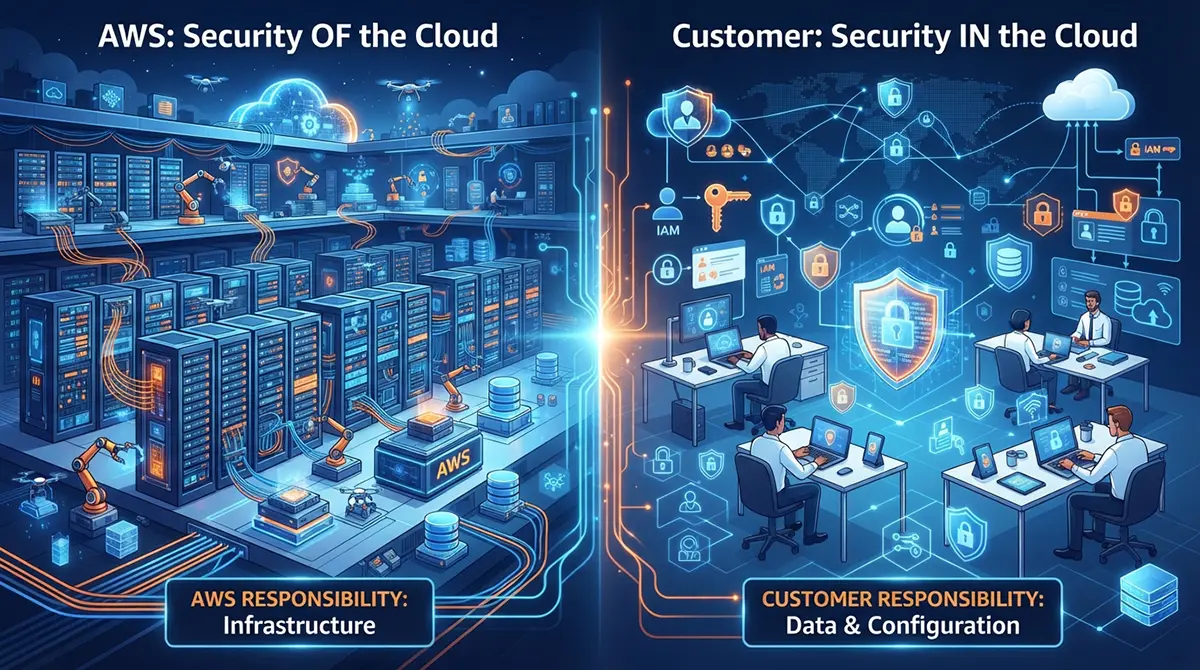
The shared responsibility model eliminates ambiguity by drawing a sharp, unmistakable line across the technology stack. On one side of the line sits AWS, managing the physical and foundational components. On the other side sits the customer, managing the data, configurations, and workloads. Understanding this division requires looking closely at how security duties are categorized, evaluated, and executed on a daily basis.
If you are searching for an expert AWS consultant in Dubai to optimize your cloud architecture, enhance security, or drive digital growth, explore our specialized services on our AWS Consultant Dubai page. Let our certified professionals help you build a resilient, high-performance cloud environment tailored to your business goals.
Security of the Cloud: The Fortresses Built by Amazon
When examining the phrase security of the cloud, we are looking exclusively at the operational domain of Amazon Web Services. This encompasses everything that makes cloud computing physically and digitally possible in the first place. AWS takes on the immense responsibility of protecting the global infrastructure that runs all the services offered in the cloud. This infrastructure includes hardware, software, networking, and facilities that run AWS services.
The physical security of AWS data centers is legendary in the technology sector. These facilities are nondescript, highly fortified buildings protected by perimeter security, professional security guards, multi factor biometric authentication mechanisms, continuous video surveillance, and strict visitor logging. Access to server rooms and hardware components is restricted strictly to authorized personnel whose roles require it, and even then, access is audited and temporary. Environmental controls are equally rigorous, featuring redundant power feeds, advanced fire suppression systems, and precise climate regulation to prevent hardware degradation.
Moving past the physical walls, security of the cloud extends deep into the hardware and virtualization layers. AWS designs custom silicon, manages physical server racks, updates firmware, and secures the hypervisors that partition physical hardware into isolated virtual machines. The virtualization layer is the critical barrier that ensures workloads belonging to one customer cannot read, write, or interfere with workloads belonging to another. AWS invests heavily in continuous vulnerability patching and hypervisor hardening to ensure complete multi tenancy isolation.
Network security forms another core pillar of security of the cloud. AWS manages the massive global network backbone, undersea cables, routers, and edge locations that connect regions and availability zones. Distributed Denial of Service mitigation systems are active continuously at the edge, absorbing massive malicious traffic spikes before they ever reach customer environments. Furthermore, AWS manages the foundational security of its managed services. For instance, when you use a fully managed database service like Amazon RDS, AWS is responsible for patching the underlying operating system and database engine software, freeing your engineering teams from tedious maintenance cycles.
In summary, security of the cloud is about the operational integrity of the platform itself. It is the bedrock upon which you build your applications, providing a level of physical and infrastructural security that would be cost prohibitive for almost any individual organization to achieve independently.
Security in the Cloud: Your Digital Territory
While Amazon secures the foundation, the structure you build upon that foundation is entirely your responsibility. Security in the cloud represents the customer domain, encompassing everything you deploy, configure, configure, manage, and interact with inside your AWS environment. The moment you spin up an EC2 virtual server, create an S3 storage bucket, or deploy a Lambda function, you inherit the responsibility for securing those assets against unauthorized access, data exfiltration, and malicious tampering.
The scope of security in the cloud is vast and multifaceted. It begins with identity and access management. In the cloud, the perimeter is no longer a physical firewall guarding a corporate office. The perimeter is identity. Who can access your resources? What permissions do they hold? How are credentials authenticated? If your administrative credentials are leaked or compromised, malicious actors can walk right through your digital front door regardless of how secure the underlying AWS infrastructure is. Therefore, implementing rigorous identity controls, enforcing multi factor authentication, and adhering to the principle of least privilege are non negotiable duties falling squarely on your shoulders.
Data classification and encryption represent another critical aspect of security in the cloud. AWS provides powerful encryption tools, such as the Key Management Service, but it is up to you to determine which datasets require encryption at rest and in transit, to manage your encryption keys responsibly, and to classify data based on sensitivity and regulatory requirements. If you store unencrypted customer personally identifiable information in a publicly accessible storage bucket, the vulnerability stems entirely from a failure of security in the cloud.
Operating system management and software patching also shift to the customer for infrastructure as a service deployments. If you launch a virtual machine running Linux or Windows, AWS is responsible for the physical server underneath, but you are entirely responsible for patching the guest operating system, installing security updates, configuring host level firewalls, and hardening the software stack against exploits.
Network configuration within your virtual private cloud is another vital customer duty. You must design secure subnets, configure security groups and network access control lists carefully, establish secure VPN tunnels or dedicated connections for hybrid cloud architectures, and monitor traffic flows for suspicious anomalies. Ultimately, security in the cloud requires constant vigilance, automated compliance auditing, and a proactive security mindset across your entire engineering organization.
The Shared Boundary: Where Responsibilities Intersect
The beauty and the danger of the AWS Shared Responsibility Model lie in the boundary where infrastructure meets application. As you move across different cloud service models, such as Infrastructure as a Service, Platform as a Service, and Software as a Service, the line between security of the cloud and security in the cloud shifts dynamically, altering your operational obligations.
Consider Infrastructure as a Service, exemplified by Amazon EC2. In this model, AWS provides the virtualized hardware, storage, and networking. You, the customer, take on the responsibility for the guest operating system, network configuration, firewall settings, identity management, and application code. Your burden is heavy because you maintain administrative control over the entire software stack above the hypervisor.
Now consider Platform as a Service or serverless offerings, such as AWS Lambda or Amazon DynamoDB. In these serverless architectures, AWS absorbs a much larger share of the burden. You no longer manage operating systems, runtime environments, or infrastructure patching because AWS handles those administrative tasks automatically. Your focus narrows down to application code logic, data management, and access permissions. While your operational burden is significantly lighter, your responsibility for securing your data and your identity policies remains absolute.
Understanding this intersection prevents catastrophic gaps in security. Many organizations fail because they assume that utilizing a managed service eliminates all security requirements. They deploy a managed database, assume it is secure by default, and neglect to configure access credentials properly. The shared boundary demands that engineering and security teams consult the official AWS documentation for every specific service they adopt, mapping out exact responsibilities before a single line of production code is deployed.
Identity as the New Perimeter
In traditional data center security, the network perimeter was king. Organizations built thick firewalls around their physical offices, establishing a secure interior where trusted employees and systems operated freely. If you were inside the building or connected via corporate VPN, you were trusted. Cloud computing has shattered this perimeter centric model completely. In a world where applications are distributed globally, developers work remotely, and resources reside in elastic cloud environments, the network perimeter has effectively dissolved.
Identity is the new perimeter. Every API call, every data request, and every administrative action in AWS is authenticated and authorized through digital identities managed by AWS Identity and Access Management. Securing these identities is perhaps the single most critical component of security in the cloud. If an attacker acquires a set of valid administrative credentials, they can provision resources, access sensitive databases, and exfiltrate data without ever needing to breach a physical facility or bypass a network firewall.
To master identity security in the cloud, organizations must embrace modern access paradigms. Hardcoded credentials, long lived access keys, and shared administrative passwords are ticking time bombs that inevitably lead to security incidents. Best practices dictate the implementation of centralized identity providers, integration with corporate single sign on systems, and the mandatory enforcement of multi factor authentication for all human users. Furthermore, machine to machine communication should rely on temporary security credentials, IAM roles, and least privilege permissions rather than static keys embedded in source code.
Monitoring and auditing identity behavior is equally vital. CloudTrail and CloudWatch provide comprehensive audit logs of every API call made within your AWS account. Security teams must leverage automated tooling to detect anomalous behavior, such as sudden root account logins from unusual geographic locations or unexpected permission escalations. Treating identity as your primary line of defense ensures that even if network configurations are imperfect, unauthorized actors cannot pierce the core of your digital operations.
Data Protection and Encryption Strategies
Data is the lifeblood of the modern enterprise. Whether it is proprietary financial models, intellectual property, or sensitive customer records, data represents the ultimate target for cybercriminals. Under the shared responsibility model, AWS provides the high durability storage infrastructure and robust cryptographic tools, but the implementation of data protection strategies is entirely the responsibility of the customer.
Data protection in the cloud begins with comprehensive data discovery and classification. You cannot secure what you do not know you have. Organizations must map their data assets, identifying where sensitive information resides across S3 buckets, relational databases, data lakes, and EBS volumes. Once classified, data must be protected using encryption both at rest and in transit.
Encryption at rest ensures that even if physical storage media or backup files are somehow intercepted or accessed illicitly, the data remains unreadable ciphertext without the corresponding decryption keys. AWS Key Management Service allows organizations to create and control encryption keys with granular precision. Best practices dictate using customer managed keys, rotating keys regularly, and establishing strict access policies that prevent unauthorized users from decrypting sensitive datasets.
Encryption in transit secures data as it moves across networks, whether flowing between users and your application or traversing internal microservices within your VPC. Utilizing Transport Layer Security for all web traffic, enforcing HTTPS endpoints, and encrypting database connections ensure that intercepted network packets yield no usable intelligence to eavesdroppers. Furthermore, data loss prevention tools and automated monitoring can detect unauthorized attempts to copy or download sensitive data repositories, allowing security teams to respond swiftly before a breach escalates into a public catastrophe.
Compliance, Governance, and Regulatory Realities
Migrating to the cloud does not exempt an organization from industry regulations, legal frameworks, and compliance mandates. Whether your business must adhere to Payment Card Industry Data Security Standards, Health Insurance Portability and Accountability Act guidelines, General Data Protection Regulation requirements, or SOC 2 frameworks, compliance remains a shared endeavor between you and AWS.
AWS maintains an extensive portfolio of compliance certifications, attestations, and third party audit reports. Through services like AWS Artifact, customers can access compliance reports detailing how AWS meets rigorous physical and infrastructural security standards. This relieves organizations of the arduous burden of auditing physical data centers themselves. When auditors ask for proof that your underlying data center is secure, you can point directly to AWS compliance documentation.
However, AWS compliance does not equal your compliance. Certification of the underlying infrastructure does not automatically mean your applications, databases, and configurations meet regulatory standards. If your application stores credit card numbers in plain text in an unencrypted database, your organization is in direct violation of compliance frameworks regardless of how secure the AWS cloud infrastructure is. Security in the cloud is where compliance is won or lost.
Effective cloud governance requires continuous compliance monitoring. Organizations should deploy automated posture management tools, such as AWS Config and Security Hub, to evaluate resource configurations against compliance frameworks in real time. Automated remediation scripts can instantly correct misconfigurations, such as revoking public access to a storage bucket the moment it is detected. By treating compliance as a continuous, automated engineering discipline rather than an annual paper audit, organizations can maintain an ironclad security posture and avoid devastating regulatory fines.
Automating Security at Cloud Scale
Manual security operations are fundamentally incapable of keeping pace with the velocity of modern cloud environments. When developers can spin up hundreds of virtual servers, serverless functions, and storage buckets with a few lines of infrastructure as code, security teams cannot rely on manual reviews, static spreadsheets, and human checklists to catch vulnerabilities. Security must scale at the exact same velocity as infrastructure deployment, which demands a total embrace of security automation.
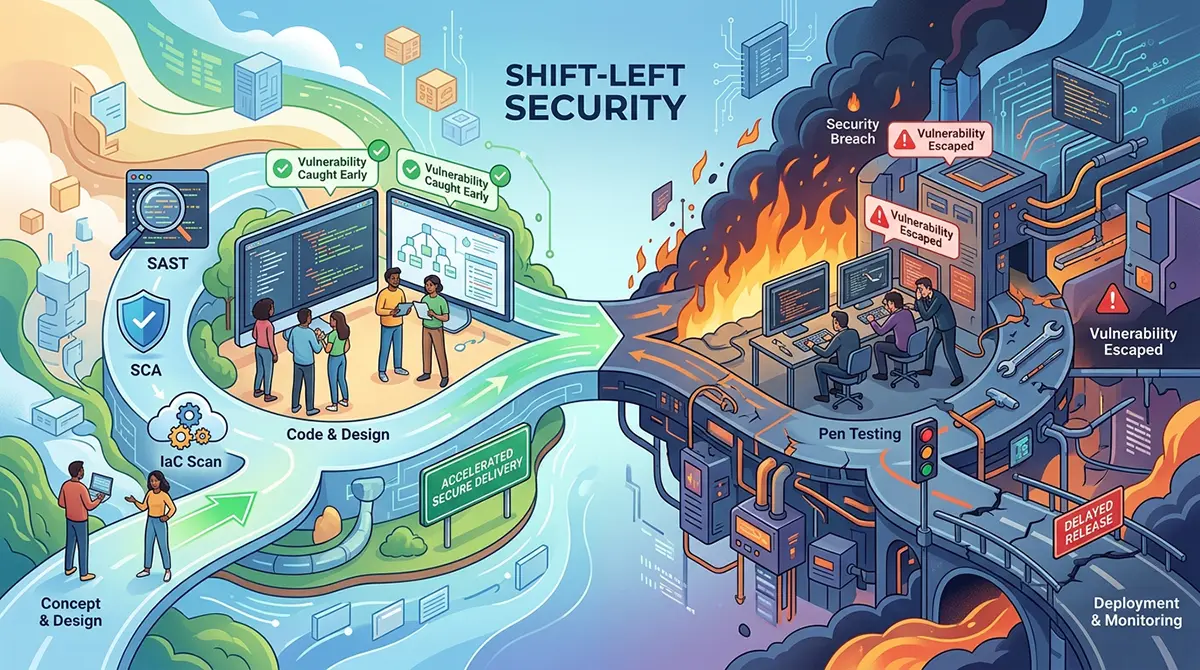
Automating security in the cloud involves embedding security controls directly into the software development lifecycle. This philosophy, commonly known as DevSecOps, shifts security to the left, integrating vulnerability scanning, static code analysis, and infrastructure template linting into continuous integration and continuous deployment pipelines. Before a developer pushes infrastructure code to production, automated tools scan the code for security flaws, such as open security groups, hardcoded credentials, or unencrypted storage volumes.
Furthermore, cloud environments generate massive streams of operational and security telemetry. Sifting through gigabytes of log files manually is an impossible task. Modern security architectures leverage machine learning and automated analytics to detect anomalies, analyze threat patterns, and trigger automated incident response workflows. For instance, if an anomaly detection system identifies compromised credentials or unauthorized data exfiltration attempts, automated runbooks can instantly isolate the affected instance, revoke the compromised IAM role, and notify the security operations team.
Automation also eliminates human error, which remains the leading cause of cloud security breaches. Misconfigurations happen when human engineers make manual mistakes under pressure. By codifying security guardrails, implementing infrastructure as immutable code, and utilizing policy as code engines, organizations ensure that every deployed resource adheres strictly to corporate security baselines without exception.
Incident Response and Resilience in the Cloud
Despite the most rigorous preventive measures, security incidents will inevitably occur in complex distributed environments. Whether facing a sophisticated targeted cyberattack, a zero day vulnerability exploit, or an accidental internal misconfiguration, an organization’s ultimate survival depends entirely on its incident response readiness and operational resilience.
Incident response in the cloud operates under the same shared responsibility principles as prevention. AWS is responsible for mitigating threats directed at the underlying cloud infrastructure and notifying customers if physical or foundational anomalies are detected. However, investigating security incidents within customer workloads, analyzing application logs, isolating compromised virtual machines, and executing remediation procedures are the absolute responsibility of the customer.
Preparing for cloud security incidents requires pre positioning forensic tools, establishing clear communication channels, and defining automated incident response playbooks. Because cloud resources are elastic and ephemeral, traditional forensic techniques that involve unplugging a physical server and examining its hard drive do not work. Instead, security teams must capture volatile memory, take snapshots of EBS volumes for forensic analysis, and inspect CloudTrail logs programmatically.
Resilience goes hand in hand with incident response. Designing resilient architectures in AWS means embracing failure as an inevitability. By distributing workloads across multiple availability zones, implementing robust backup and disaster recovery strategies, and testing disaster recovery runbooks regularly, organizations ensure that even if a catastrophic security incident or ransomware attack compromises a portion of their infrastructure, operations can be restored rapidly with minimal data loss.
Cultivating a Culture of Cloud Security
Technology stacks, encryption algorithms, and compliance frameworks are critical, but the ultimate determinant of cloud security success is human culture. The most sophisticated automated guardrails and multi factor authentication policies can be undermined if employees, developers, and executives view security as an annoying bottleneck rather than a core business enabler.
Cultivating a culture of security requires shifting from a culture of blame to a culture of shared accountability. When a misconfiguration or security vulnerability occurs, punishing engineers creates a toxic environment where developers hide mistakes rather than reporting them. Progressive organizations treat security incidents as invaluable learning opportunities, conducting thorough post mortems to identify systemic flaws in processes, documentation, or tooling.
Education and training form the bedrock of cultural transformation. Every software engineer, product manager, and system administrator interacting with AWS must understand the shared responsibility model and their specific obligations regarding security in the cloud. Providing continuous learning opportunities, internal certification programs, and hands on security workshops empowers teams to build secure architectures by design rather than patching vulnerabilities reactively after deployment.
Executive leadership plays a vital role in championing this cultural shift. When security is prioritized from the top down, adequate resources are allocated, security teams are given a seat at the architecture table, and security is recognized not as a cost center, but as a fundamental pillar of business continuity and customer trust.
Conclusion: Mastering the Shared Vision
The migration to Amazon Web Services represents a monumental leap forward in operational agility, technological innovation, and economic efficiency. Yet, this digital evolution demands a mature, clear eyed understanding of risk and accountability. The AWS Shared Responsibility Model is the definitive framework that makes cloud computing secure, scalable, and manageable.
By internalizing the profound distinction between security of the cloud and security in the cloud, organizations can stop guessing where their obligations begin and end. They can appreciate the immense engineering marvel of the physical data centers, hypervisors, and global networks secured by Amazon, while taking fierce, uncompromising ownership of their own identities, data, network configurations, and application code.
As cyber threats grow increasingly sophisticated and regulatory landscapes tighten, mastering cloud security is no longer an optional technical exercise for specialized engineers. It is an existential business imperative. Organizations that embrace identity as the perimeter, automate security at scale, integrate compliance into their development pipelines, and cultivate a pervasive culture of shared accountability will not only protect their critical assets, but they will unlock the full, transformative potential of the cloud with absolute confidence. The fortresses are built; now it is time to secure your kingdom within them.