


The modern business landscape is defined by velocity, digital expansion, and an unyielding wave of cyber threats. For growing organizations, the journey from a lean startup to a mid-market enterprise is accompanied by a massive increase in digital surface area. Cloud workloads multiply, remote teams connect from diverse global coordinates, and proprietary datasets expand exponentially. With this growth comes heightened vulnerability. Traditional security models, reliant on manual monitoring, static rule sets, and overstretched human analysts, simply cannot keep pace with the sheer volume and sophistication of contemporary cyber attacks. In response, artificial intelligence has emerged as the definitive force multiplier in enterprise defense. Yet, for businesses experiencing rapid expansion, choosing the right AI cybersecurity solutions requires a delicate balance of automation, cost-effectiveness, architectural scalability, and operational agility.
Understanding the unique security challenges of growing businesses is essential before exploring specific artificial intelligence architectures. Rapidly scaling enterprises typically experience decentralized IT infrastructure, rapid software deployment cycles, and fluid organizational structures. Security teams are frequently outnumbered and overwhelmed, trying to protect environments that change daily. Conventional security information and event management systems generate a relentless deluge of alerts, leading to alert fatigue and missed indicators of compromise. Furthermore, cybercriminals increasingly leverage machine learning to automate phishing campaigns, accelerate vulnerability exploitation, and orchestrate polymorphic malware. To neutralize these AI-driven threats, growing businesses must adopt intelligent, adaptive security frameworks that scale seamlessly alongside their expanding operations without requiring a linear expansion of internal security headcount.
The Paradigm Shift from Reactive Defense to Autonomous Prevention
For decades, cybersecurity was fundamentally reactive. Organizations deployed firewalls and antivirus software, waited for an attack to occur, analyzed the signature, and applied a patch or rule to block similar future incidents. In a digital ecosystem characterized by zero-day vulnerabilities and automated threat vectors, this perimeter-based, signature-matching approach is obsolete. Artificial intelligence fundamentally transforms cybersecurity by shifting the paradigm from reactive remediation to autonomous, predictive prevention.
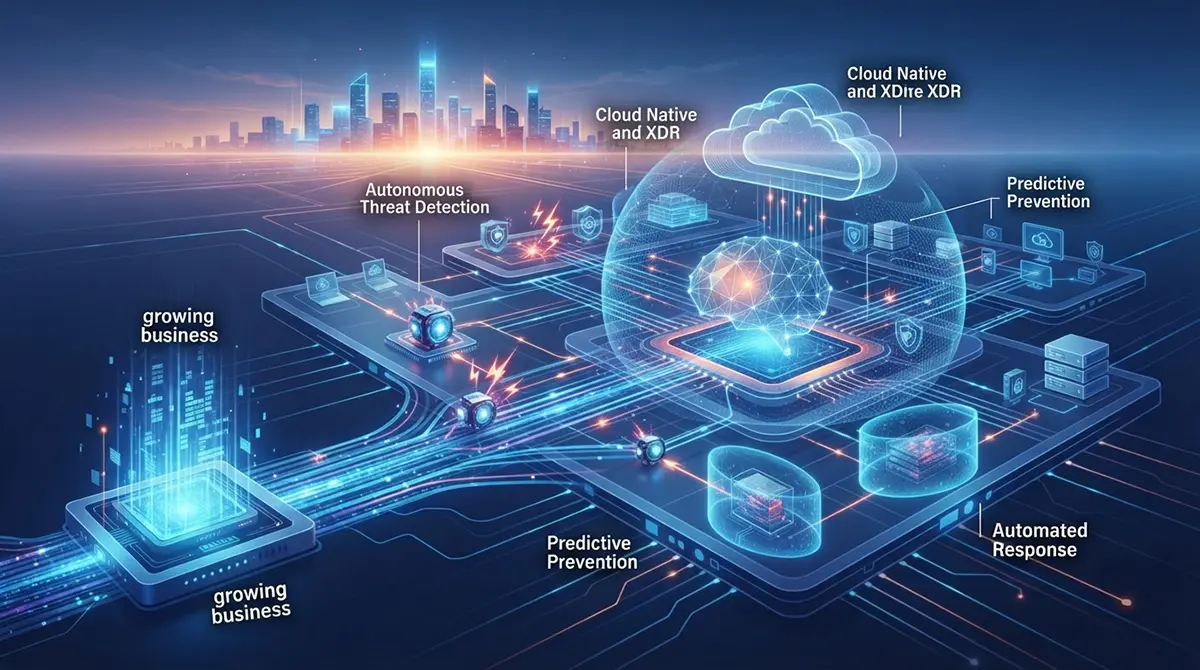
Machine learning algorithms possess the unique capability to ingest vast multi-dimensional datasets, discern subtle behavioral anomalies, and predict threat trajectories long before an actual breach occurs. Instead of relying solely on known signatures of malicious software, advanced AI models establish a dynamic baseline of normal user behavior, network traffic, and application performance. When a deviation occurs, whether it is an anomalous data exfiltration attempt at two in the morning or an unusual privilege escalation by a legitimate service account, the AI system flags, analyzes, and often neutralizes the threat autonomously. For growing businesses, this means security operations can function continuously, providing robust protection even when human teams are offline.
If you frequently encounter such security errors or unauthorized intrusions on your servers, check out our “IT support services in UAE” page for a professional infrastructure audit.
Core Capabilities to Demand in Scalable AI Security Platforms
When evaluating artificial intelligence cybersecurity solutions, decision-makers must look beyond marketing hype and examine core architectural capabilities. Scalability in this context does not merely mean the ability to handle more log data; it encompasses the elasticity of threat detection, the reduction of false positives, the ease of integration across hybrid environments, and the adaptability of the underlying models to novel threat vectors.
Autonomous Threat Detection and Behavioral Analytics
At the heart of any enterprise-grade AI security solution is advanced behavioral analytics. Traditional rule-based systems break down when confronted with novel attack techniques that do not trigger predefined alerts. AI systems utilize unsupervised and semi-supervised machine learning to continuously learn normal operational baselines across endpoints, cloud environments, and identity providers. As a business scales and incorporates new software stacks or business units, the AI model adapts organically, mapping normal behavior without requiring constant manual re-tuning by security engineers.
Automated Incident Response and Orchestration
Detection is only half the battle. In a fast-growing company, the time elapsed between identifying a threat and containing it can mean the difference between a minor operational hiccup and a catastrophic data breach. Modern AI security platforms integrate tightly with security orchestration, automation, and response frameworks. When a high-fidelity threat is detected, the AI can instantly trigger automated containment protocols. These might include isolating a compromised endpoint from the network, revoking compromised user credentials, or blocking malicious IP addresses at the gateway level, all within milliseconds and without human intervention.
Reduction of Alert Fatigue through Contextual Triaging
One of the most insidious threats to a growing security team is alert fatigue. When security tools generate thousands of low-context alerts daily, critical warnings inevitably get buried in the noise. AI solutions excel at context-aware correlation. By linking disparate telemetry data across endpoints, email gateways, cloud storage, and identity management systems into a unified incident graph, AI can accurately score threat severity. Analysts are presented with a coherent narrative of an attack rather than a disjointed list of hundreds of individual alerts, drastically reducing mean time to triage and resolution.
Cloud Native Application Protection Platforms Powered by AI
As growing businesses migrate their infrastructure to multi-cloud and hybrid environments, traditional perimeter security dissolves. Applications are built using microservices, containerized via Docker and Kubernetes, and deployed continuously through automated CI/CD pipelines. Securing this dynamic infrastructure manually is an impossible feat, which has driven the rapid rise of Cloud Native Application Protection Platforms infused with artificial intelligence.
Cloud native AI security solutions continuously monitor cloud infrastructure configurations, container runtimes, and application code repositories for vulnerabilities and misconfigurations. Because cloud environments scale elastically, the security solution must do the same. AI-powered CNAPP tools analyze runtime behavior across thousands of ephemeral containers, instantly identifying anomalous process executions or unexpected outbound network connections. For a growing business expanding its cloud footprint, these platforms provide deep visibility and automated protection without slowing down developer velocity or requiring massive investments in specialized cloud security personnel.
Extended Detection and Response Across Modern Enterprise Surfaces
For growing businesses that lack the resources to build a massive Security Operations Center from scratch, Extended Detection and Response solutions powered by AI offer an exceptionally scalable alternative. Traditional Endpoint Detection and Response tools focus exclusively on user devices like laptops and servers. However, modern cyber attacks traverse multiple vectors, beginning perhaps with a phishing email, moving to compromised cloud credentials, and culminating in unauthorized data access within a SaaS application.
XDR unifies telemetry from endpoints, servers, cloud workloads, email systems, and identity providers into a centralized artificial intelligence engine. This holistic visibility is critical for scalability. As a business adds new departments, remote workers, and software-as-a-service subscriptions, the XDR platform ingests these new data streams and correlates them seamlessly. The AI engine can connect a seemingly benign login from a new geographic location with an unusual file download on a remote endpoint, revealing a sophisticated credential-stuffing attack that siloed security tools would completely miss.
Generative Artificial Intelligence and Natural Language Security Operations
The recent explosion of generative artificial intelligence and large language models has introduced a transformative dimension to enterprise cybersecurity. While malicious actors use generative AI to write convincing phishing lures and automate social engineering attacks at scale, defensive organizations are harnessing these same technologies to democratize security operations and accelerate threat analysis.
In many growing businesses, non-technical executives or junior IT staff may struggle to interpret complex security telemetry or query specialized security databases using arcane query languages. Generative AI security assistants bridge this gap by introducing natural language interfaces to security operations. An IT administrator can simply ask the security platform to explain the nature of a specific threat alert, summarize the scope of a potential compromise across the organization, or suggest remediation steps based on established security frameworks like NIST or CIS controls. This dramatically lowers the barrier to entry for effective security management, enabling smaller teams to operate with the efficiency and insight of much larger enterprises.
Evaluating Cost Efficiency and Return on Investment in Scalable Security
For growing businesses, capital allocation is always a critical consideration. Cybersecurity investments must demonstrate clear return on investment, not merely as an insurance policy against theoretical disasters, but as a direct enabler of business velocity and customer trust. When evaluating AI cybersecurity solutions, financial decision-makers must look beyond initial software licensing costs and examine total cost of ownership.
Traditional security architectures often incur massive hidden costs. These include the expenses associated with hiring scarce and expensive security engineering talent, the operational overhead of managing multiple disparate point solutions, and the productivity losses caused by false positive disruptions. AI-driven platforms significantly reduce these hidden costs through automation and consolidation. By consolidating endpoint protection, cloud security, and threat intelligence into a unified AI-powered platform, businesses reduce software bloat and license overlap. Furthermore, by automating routine triage and incident response, existing IT staff can focus on strategic innovation rather than manual log review, maximizing human capital efficiency.
Implementation Strategies for Growing Enterprises
Deploying artificial intelligence cybersecurity solutions successfully requires a structured, strategic approach. Growing businesses must avoid the trap of haphazardly purchasing shiny new security tools without a cohesive architectural vision.
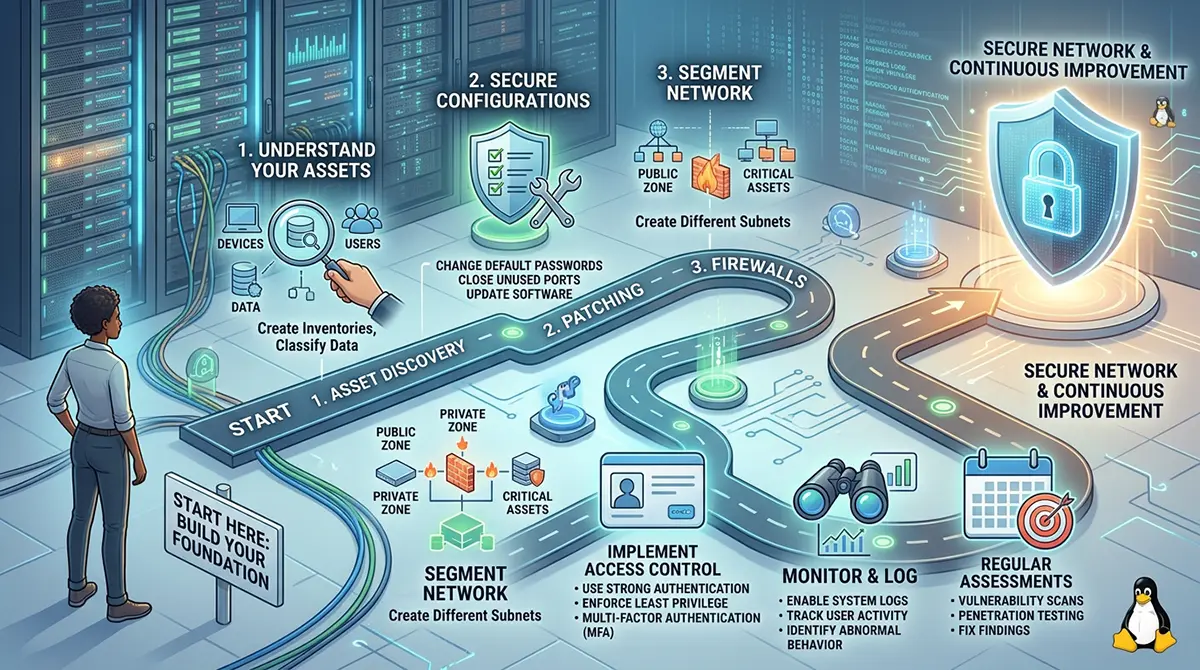
The first step in implementation is conducting a comprehensive data inventory and infrastructure assessment. An AI security model is only as effective as the data it consumes. Organizations must ensure that their telemetry sources, from endpoint agents to cloud logs, are clean, properly configured, and accessible to the chosen security platform. Rushing an AI deployment without proper data hygiene often leads to model drift, high false positive rates, and diminished trust from the internal team.
The second step is adopting a phased rollout methodology. Rather than attempting a sweeping enterprise-wide deployment overnight, businesses should begin with a controlled pilot program in a specific business unit or non-production environment. This allows security teams to observe the AI model in action, fine-tune sensitivity thresholds, evaluate integration with existing workflows, and build confidence in automated response actions before scaling the solution across the entire enterprise.
The third crucial element of successful implementation is continuous human oversight and governance. While artificial intelligence provides unmatched speed and scale, it is not infallible. Adversaries actively experiment with adversarial machine learning techniques designed to blind or confuse AI security algorithms through data poisoning or evasion attacks. Maintaining a human-in-the-loop approach for high-impact decisions ensures that strategic oversight and contextual business judgment complement algorithmic speed.
Future Horizons in Scalable AI Cyber Defense
As we look toward the future, the convergence of artificial intelligence and cybersecurity will only deepen. Threat actors will increasingly rely on autonomous agentic AI to probe networks, discover vulnerabilities, and execute multi-stage attacks at machine speed. In response, defensive architectures are evolving toward autonomous cyber defense systems capable of proactively hunting threats, rewriting vulnerable application code on the fly, and dynamically reconfiguring network defenses in real time.
For growing businesses, building a scalable cybersecurity foundation today is the ultimate prerequisite for future market leadership. Organizations that successfully integrate intelligent, adaptive AI security solutions into their operational fabric insulate themselves against escalating threats while freeing their teams to innovate, expand, and scale with absolute confidence. The question for growing enterprises is no longer whether to adopt artificial intelligence in cybersecurity, but how rapidly and strategically they can deploy it to secure their digital destiny.