

For organizations that depend on uninterrupted digital operations, choosing a data center is fundamentally a reliability decision. Server hardware, cloud platforms, business applications, databases, artificial intelligence workloads, and communications systems can all suffer serious consequences when the underlying facility loses power, cooling, connectivity, or physical access. In Abu Dhabi, the data center market has developed into one of the most resilient infrastructure environments in the Middle East, with facilities ranging from established Tier III commercial colocation sites to highly resilient Tier IV environments.
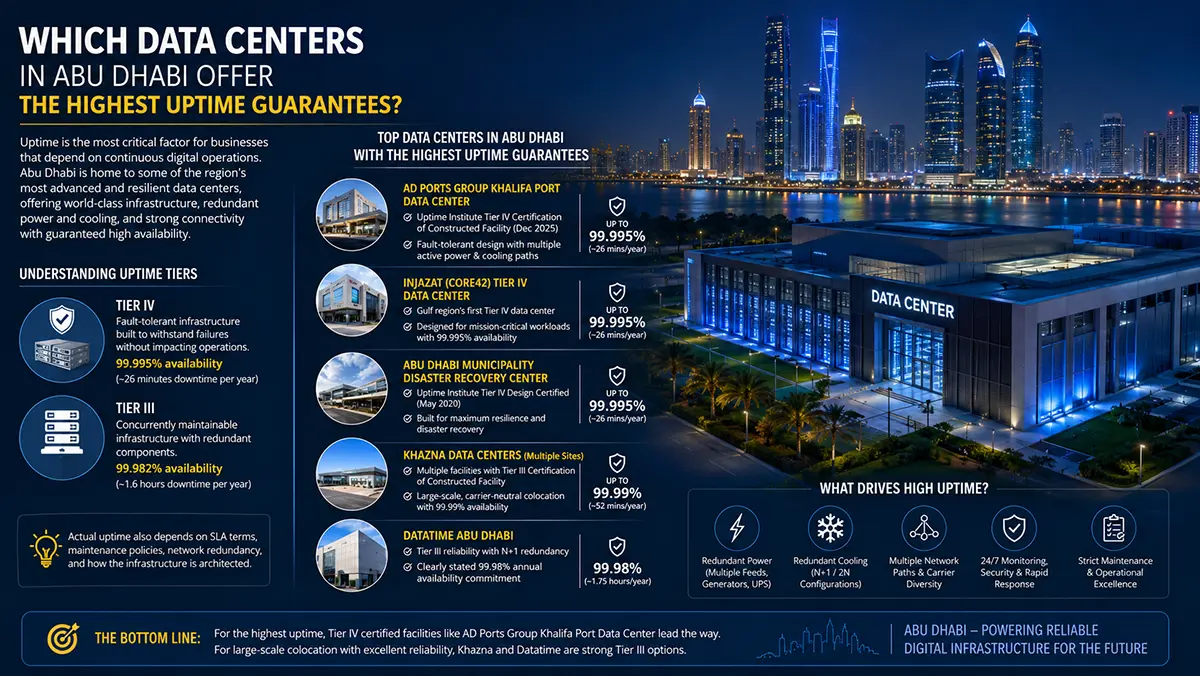
The most important distinction for buyers is that a data center’s certification level and its contractual uptime guarantee are not necessarily the same thing. A Tier IV facility has a higher resilience classification than a Tier III facility, but the customer’s actual service-level agreement, exclusions, maintenance provisions, network architecture, and application design ultimately determine how much availability the customer can expect. Abu Dhabi’s own government data management standards illustrate the distinction clearly: Tier III is associated with 99.982 percent availability and approximately 1.6 hours of annual downtime, while Tier IV is associated with 99.995 percent availability and approximately 0.4 hours of annual downtime.
Based on publicly available certification and provider information, the strongest Abu Dhabi options for maximum facility resilience include the AD Ports Group Khalifa Port Data Center, the Tier IV environment historically operated by Injazat and now associated with the broader Core42 ecosystem, and Abu Dhabi Municipality’s Tier IV disaster recovery facility. For commercial colocation, Khazna’s extensive portfolio of Tier III facilities is among the most significant options, while Datatime offers a clearly stated 99.98 percent annual availability commitment for its Tier III facility.
The following analysis focuses specifically on uptime and infrastructure resilience rather than simply ranking data centers by size, power capacity, reputation, or cloud connectivity.

Why Tier IV Matters When Availability Is the Priority
Uptime Institute’s tier system is one of the most widely recognized frameworks for evaluating data center infrastructure resilience. The four-tier model progresses from basic infrastructure through concurrently maintainable and fault-tolerant designs. The difference between Tier III and Tier IV is particularly important for organizations whose applications cannot tolerate a facility-level interruption.
A Tier III facility is designed for concurrent maintainability. That means maintenance or replacement of individual infrastructure components can generally be performed without shutting down the IT load. This is a major improvement over lower-tier environments because routine maintenance does not necessarily require an outage. However, a sufficiently serious unplanned event can still affect the critical load.
Tier IV goes further by introducing fault tolerance. The design is intended to allow the data center to withstand an individual unplanned failure without affecting the critical IT load. Abu Dhabi government standards describe Tier IV as having multiple active power and cooling distribution paths and redundant components, with an availability target of 99.995 percent.
That difference may appear small when expressed as a percentage, but it becomes meaningful when translated into downtime. A 99.9 percent availability target permits substantially more downtime than 99.99 percent, while 99.995 percent represents only around 26 minutes of downtime in a 365-day year under the simplified mathematical interpretation. The government standard uses approximately 0.4 hours, or 24 minutes, for its Tier IV reference.
For mission-critical organizations, the important question therefore is not simply whether a provider advertises “high availability.” Buyers should ask which facility has been certified, what type of Uptime Institute certification it holds, what availability is contractually guaranteed, and precisely what the SLA considers downtime.
AD Ports Group Khalifa Port Data Center: Abu Dhabi’s Standout Tier IV Facility
One of the strongest publicly documented examples of maximum data center resilience in Abu Dhabi is the Khalifa Port Data Center operated by AD Ports Group. In December 2025, AD Ports Group announced that its data center had received Uptime Institute Tier IV Certification of Constructed Facility, described by the company as the highest standard in data center accreditation.
This distinction is particularly significant because Certification of Constructed Facility is more meaningful to an infrastructure buyer than a design-only certification. A design certification demonstrates that the proposed architecture meets the relevant criteria. Constructed Facility certification goes further by validating the facility that has actually been built.
AD Ports Group said the Tier IV certification demonstrates a fault-tolerant facility capable of withstanding unplanned events without disruption to operations. That makes the Khalifa Port facility one of the clearest choices in Abu Dhabi when the primary requirement is independently certified facility-level resilience.
The facility also benefits from its relationship with Khalifa Port and the broader AD Ports Group ecosystem. For businesses involved in logistics, trade, industrial operations, transportation, or port-related digital systems, locating critical infrastructure within an organization whose operational priorities already emphasize business continuity can be strategically attractive.
There is also evidence that AD Ports Group treats continuity as an operational priority rather than merely a certification exercise. In March 2026, the group stated that it had activated business continuity and crisis-management protocols during regional developments while maintaining operations across its UAE ports and terminals.
That does not constitute a contractual uptime guarantee for a colocation customer, and prospective customers should not interpret it as one. Nevertheless, it demonstrates an organizational emphasis on resilience that complements the Tier IV facility certification.
For organizations that require the highest independently certified infrastructure standard, the Khalifa Port Data Center should therefore be near the top of an Abu Dhabi shortlist.
Injazat and the Legacy of Abu Dhabi’s First Tier IV Data Center
Another major name in Abu Dhabi’s high-availability history is Injazat. The company’s data center was notable because it became the Gulf region’s first Tier IV data center. Contemporary reporting documented that the facility became operational in Abu Dhabi and received Tier IV design certification from Uptime Institute.
The facility was developed in Mohammed Bin Zayed City and was designed around the core principles associated with Tier IV infrastructure, including redundant capacity systems, multiple distribution paths, and dual-powered IT equipment.
Historical sources also describe the facility as offering 99.995 percent availability, consistent with the Tier IV classification.
The Injazat environment is particularly important because of its role in Abu Dhabi’s technology infrastructure history. Research institutions and enterprise customers have used the facility for demanding workloads, and NYU Abu Dhabi documentation, for example, described its high-performance computing cluster as being hosted in a secure Tier IV data center operated by Injazat.
However, prospective buyers should be careful when comparing historical Injazat information with current commercial availability. Corporate ownership, operating structures, facility portfolios, certifications, and commercial offerings can change over time. Consequently, an organization evaluating the current facility should request current certification documents and a current SLA rather than relying solely on older references to Injazat’s Tier IV status.
The broader Injazat infrastructure story is nevertheless important when assessing Abu Dhabi’s ability to support highly available workloads. It established a long-standing local precedent for Tier IV architecture and helped position Abu Dhabi as a serious destination for mission-critical computing.
Abu Dhabi Municipality’s Tier IV Disaster Recovery Environment
Abu Dhabi Municipality provides another compelling example of Tier IV infrastructure, although it should be distinguished from commercial colocation facilities.
The municipality partnered with Huawei to develop a disaster recovery data center based on Tier IV architecture. Huawei’s case study states that the municipality required the highest level of Uptime Institute certification for its disaster recovery environment. The resulting facility received Uptime Tier IV design certification in May 2020.
The facility was designed around 2N redundancy for power and cooling. The objective was not merely to provide a modern server room, but to establish an infrastructure platform capable of supporting municipal services and disaster recovery requirements with extremely high resilience.
This is an important distinction for organizations conducting an Abu Dhabi data center assessment. A Tier IV government disaster recovery facility proves that Abu Dhabi has infrastructure capable of meeting the highest tier requirements, but it does not automatically mean that the facility is available as a commercial colocation option.
Therefore, Abu Dhabi Municipality’s environment is best viewed as evidence of the emirate’s high-end infrastructure capabilities rather than as a straightforward alternative to commercial data center providers.
Khazna: The Strongest Large-Scale Commercial Tier III Option
For enterprises that need commercial colocation rather than a specialized government facility, Khazna Data Centers is one of the most important names in Abu Dhabi.
Khazna has built a substantial UAE data center portfolio and has repeatedly obtained Uptime Institute Tier III certifications. Its Abu Dhabi facilities include sites associated with Masdar City and other locations across the emirate. Khazna announced Tier III Design Certification for its Abu Dhabi and Dubai expansion facilities in 2019, following detailed review of mechanical, electrical, structural, and site requirements.
The company’s certification history continued with constructed-facility certifications. Khazna announced that Apollo 3 and Apollo 4 received Tier III certification in early 2022, followed by Apollo 5 and Apollo 6 later that year. It also announced Tier III Certification of Constructed Facility for IRIS 2 in 2022.
For customers, this certification history is significant because it shows that Khazna’s infrastructure is not merely marketed as “Tier III designed.” Multiple facilities have been subjected to Uptime Institute certification processes involving the constructed environment.
Publicly listed information for Khazna facilities also indicates commercial availability commitments around 99.99 percent for certain Abu Dhabi sites. One current listing for the Khazna AUH1 facility in Masdar City describes a 99.99 percent uptime SLA and identifies Tier III Uptime Institute certifications. Another Abu Dhabi Khazna facility listing similarly identifies a 99.99 percent uptime SLA alongside Tier III design and constructed-facility certification.
These figures should still be verified directly against the provider’s current contract before procurement. A third-party listing is not a substitute for the actual SLA.
Khazna is therefore particularly attractive for enterprises that need a commercial environment, significant capacity, scalability, carrier connectivity, and strong infrastructure resilience without necessarily requiring Tier IV certification.
Datatime: A Clear 99.98 Percent Availability Commitment
Datatime represents a different proposition. Its Abu Dhabi facility publicly states that it operates at Tier III reliability and guarantees 99.98 percent overall service availability annually.
The provider describes its architecture as using N+1 redundancy for critical engineering systems, duplicate power and cooling pathways, advanced security, and continuous monitoring. Its investor information also describes independent high-voltage city-substation supplies, N+1 diesel generator redundancy, UPS systems, and a 12-hour fuel reserve.
The 99.98 percent figure is notable because it corresponds closely to the availability associated with Tier III in Abu Dhabi’s government standards. The government documentation cites 99.982 percent for Tier III, while Datatime publicly states 99.98 percent.
For a buyer, this transparency is useful. Rather than relying solely on a generic statement that the facility is highly reliable, the provider gives a concrete annual availability figure.
Datatime may therefore make sense for organizations that want a clearly stated Tier III availability commitment and do not require Tier IV fault tolerance. It should not, however, be ranked above a certified Tier IV facility when facility-level resilience is the sole criterion.
How the Leading Abu Dhabi Options Compare in Practical Terms
When the question is strictly “which facilities offer the highest uptime guarantees,” the answer begins with Tier IV rather than Tier III.
The strongest publicly documented category is Tier IV constructed-facility certification. AD Ports Group’s Khalifa Port Data Center currently stands out because its Tier IV Certification of Constructed Facility was announced in December 2025.
The historic Injazat Tier IV environment is also highly significant, with extensive documentation of its Tier IV architecture and its role in Abu Dhabi’s mission-critical infrastructure ecosystem.
Abu Dhabi Municipality’s Tier IV disaster recovery environment provides another example of top-tier infrastructure, although its government-specific role makes it different from a standard commercial colocation facility.
Among commercial Tier III providers, Khazna is particularly compelling because of the breadth of its certified portfolio and its large-scale commercial colocation model. Its facilities have obtained multiple Uptime Institute Tier III constructed-facility certifications.
Datatime provides another credible commercial option, particularly for buyers who value a publicly stated 99.98 percent annual service availability commitment and conventional Tier III concurrent maintainability.
The key point is that a facility advertised as “99.99 percent uptime” should not automatically be considered better than a facility with a lower-looking percentage but a stronger independently certified architecture. The contractual definition of downtime can dramatically affect the real-world value of an SLA.
Uptime Guarantees Are Only as Strong as Their SLA Definitions
A common procurement mistake is to compare availability percentages without reading the exclusions.
For example, a provider may advertise 99.99 percent uptime while excluding scheduled maintenance, emergency maintenance, customer equipment failures, upstream carrier outages, cyber incidents, force majeure events, and circumstances outside the provider’s reasonable control. Another provider may offer a lower headline percentage but provide a more favorable definition of downtime and meaningful service credits.
Organizations should therefore request the complete SLA before making a decision.
Important questions include:
- What exactly constitutes downtime?
- Is power availability covered separately from network availability?
- Are scheduled maintenance windows excluded?
- How much notice is provided for planned maintenance?
- Are cooling failures included in the availability guarantee?
- What happens if a customer’s equipment remains powered but external connectivity fails?
- Are cross-connects and carrier services covered by the same SLA?
- What financial credits apply if the provider misses its commitment?
- Is the SLA calculated monthly, quarterly, or annually?
- Are there maximum outage-duration commitments in addition to an annual availability percentage?
These questions often reveal more about practical reliability than the marketing headline.
Power Resilience Should Be Examined Separately
Power infrastructure is one of the most important factors behind data center uptime. A facility can have excellent network connectivity and still experience an outage if its electrical architecture is not sufficiently resilient.
Tier IV architecture is designed around fault tolerance and multiple active distribution paths. Tier III facilities generally focus on concurrent maintainability and redundant components. Abu Dhabi’s government data standards explicitly distinguish the two approaches, describing Tier III with N+1 redundancy and Tier IV with multiple active power and cooling paths and redundant systems.
For high-density computing, the power question becomes even more important. Artificial intelligence systems and GPU clusters can produce much higher rack densities than conventional enterprise servers. A facility’s ability to maintain power and cooling at those densities may therefore matter more than its generic uptime statement.
Prospective customers should ask for details on UPS architecture, generator redundancy, fuel autonomy, electrical distribution paths, maintenance procedures, utility feeds, and testing frequency.
Network Uptime Can Be More Important Than Facility Uptime
A data center can maintain 100 percent electrical availability while an application remains unreachable because its carrier connection has failed.
For this reason, network architecture should be considered independently from facility resilience. Buyers should examine carrier diversity, physical route diversity, meet-me-room design, cross-connect redundancy, internet exchange connectivity, cloud on-ramps, and the provider’s network SLA.
This is particularly important for businesses deploying hybrid cloud architectures. A resilient colocation facility can still become a single point of failure if every cloud connection, WAN circuit, or internet path ultimately uses the same physical route.
Organizations planning regional deployments should consider whether two independent facilities in Abu Dhabi can be connected through physically diverse routes. For extremely critical systems, an active-active or active-standby architecture across two sites may provide substantially greater resilience than relying on even the best single data center.
Geographic Redundancy Is the Next Level of Resilience
No single data center should automatically be treated as immune to every possible disaster.
Even a Tier IV facility has a defined scope of protection. Tier certification primarily evaluates the resilience of the facility’s infrastructure topology. It does not mean that every possible regional, geopolitical, telecommunications, software, supply-chain, or application-level event has been eliminated.
For mission-critical workloads, organizations should therefore distinguish between facility resilience and business continuity.
A sensible architecture might place primary infrastructure in a high-tier Abu Dhabi facility while maintaining replication to a physically separate site. Depending on the business, the secondary site could be in another part of Abu Dhabi, Al Ain, Dubai, or another geographically suitable location.
This approach can be particularly important for regulated workloads, financial systems, national infrastructure, healthcare applications, and large-scale AI platforms.
What Buyers Should Ask During a Data Center Site Evaluation
The best data center selection process goes beyond asking, “What is your uptime?”
A prospective customer should request current certification documentation, not simply a provider brochure. The buyer should verify whether the certification covers the exact facility and whether it is a design certification or a constructed-facility certification.
The buyer should also request the current SLA and review the definition of availability, exclusions, remedies, maintenance policies, and service-credit mechanisms.
A site visit can provide additional insight. During the visit, organizations should ask about generator testing, UPS maintenance, cooling redundancy, security controls, network carrier diversity, incident response, monitoring, remote hands, and disaster recovery procedures.
For customers with demanding workloads, rack-level power density should also be discussed. This is increasingly relevant for AI infrastructure because a data center capable of supporting ordinary enterprise racks may not be equipped for high-density GPU deployments without additional cooling infrastructure.
The Role of Cooling in Abu Dhabi’s Climate
Abu Dhabi’s climate makes cooling resilience especially important. High ambient temperatures place additional demands on mechanical infrastructure, particularly during the hottest periods of the year.
A strong facility should therefore demonstrate not only redundant cooling equipment but also resilient cooling distribution, maintainability, monitoring, and appropriate environmental controls.
The Abu Dhabi Municipality disaster recovery project illustrates the importance of engineering cooling systems for local conditions. Huawei’s case study notes that the project used in-row cooling and containment approaches to improve efficiency in Abu Dhabi’s high-temperature environment.
For organizations deploying high-density servers, it is worth asking whether the facility supports liquid cooling, direct-to-chip cooling, rear-door heat exchangers, or other advanced thermal-management approaches. These capabilities can become critical as AI and accelerated-computing deployments move beyond traditional rack densities.
Why Certification Should Not Be the Only Selection Criterion
Tier certification is valuable because it provides an independent framework for assessing infrastructure resilience. However, it should not be treated as the only factor in a procurement decision.
A business may prefer a Tier III facility with superior carrier diversity, excellent managed services, stronger geographic connectivity, better operational support, and a more suitable commercial SLA over a Tier IV facility that does not meet its networking or operational requirements.
Likewise, a government organization may prioritize data sovereignty, regulatory compliance, security accreditation, and disaster recovery arrangements above raw facility availability.
The best facility is therefore the one whose resilience model matches the business’s actual risk profile.
Organizations also increasingly need support for broader infrastructure transformation. This can involve cloud migration, application modernization, automation, monitoring, security, and operational optimization alongside physical hosting. For businesses combining infrastructure planning with Technology optimization consulting in UAE, the data center should be evaluated as part of the complete technology architecture rather than as an isolated building.
The Best Choice Depends on the Required Level of Resilience
For the highest facility-level resilience, Abu Dhabi’s Tier IV environments deserve the closest attention. AD Ports Group’s Khalifa Port Data Center is especially notable because it has a recent Uptime Institute Tier IV Certification of Constructed Facility, making it one of the clearest current examples of the emirate’s highest certified infrastructure level.
The Injazat Tier IV environment remains another major reference point because it established a landmark standard for Abu Dhabi’s data center industry and has a long history of supporting mission-critical workloads.
Abu Dhabi Municipality’s Tier IV disaster recovery site demonstrates the emirate’s ability to deploy fault-tolerant infrastructure for public-sector continuity, although its availability to commercial customers is a separate question.
For large-scale commercial colocation, Khazna is one of the strongest choices. Its portfolio includes multiple facilities that have achieved Uptime Institute Tier III constructed-facility certification, providing evidence of independently assessed infrastructure resilience.
Datatime is another noteworthy commercial option for organizations seeking a clearly published 99.98 percent annual availability commitment within a Tier III environment.
Final Verdict: Which Abu Dhabi Data Centers Lead on Uptime?
If uptime is the single most important criterion, the first distinction should be between Tier IV and Tier III.
Tier IV represents the highest Uptime Institute infrastructure classification and is associated with fault tolerance and approximately 99.995 percent availability under the Abu Dhabi government standards referenced above. Among current Abu Dhabi examples, the AD Ports Group Khalifa Port Data Center is particularly compelling because it holds Tier IV Certification of Constructed Facility, the highest Uptime Institute facility certification.
The Injazat Tier IV environment and Abu Dhabi Municipality’s Tier IV disaster recovery facility are also important examples of extremely resilient infrastructure, although their commercial accessibility and current operating arrangements need to be confirmed directly with the relevant operator.
For businesses seeking commercial colocation rather than a specialized Tier IV environment, Khazna stands out because of its extensive portfolio of Uptime Institute Tier III certified facilities and large-scale infrastructure capabilities. Datatime offers a more explicitly stated 99.98 percent annual availability commitment and a Tier III architecture focused on N+1 redundancy and concurrent maintainability.
Ultimately, however, the provider with the highest advertised percentage is not automatically the provider offering the strongest real-world resilience. The right procurement decision requires examining certification, SLA language, power architecture, cooling, network diversity, operational procedures, security, geographic redundancy, disaster recovery, and the specific workload being hosted.
For mission-critical workloads, a sensible hierarchy is to start with independently certified Tier IV facilities, then evaluate whether their commercial terms and connectivity meet business requirements. Where Tier IV is unnecessary or unavailable commercially, a mature Tier III provider with a strong constructed-facility certification, robust redundancy, and a well-defined SLA can provide an excellent balance of resilience and cost.
Abu Dhabi is particularly well positioned for organizations that need this combination of resilience, regional connectivity, and access to large-scale digital infrastructure. The emirate’s mix of Tier IV government and enterprise environments and extensive Tier III commercial capacity means buyers can select infrastructure according to their actual risk tolerance rather than settling for a one-size-fits-all approach.
The most important final step is simple: obtain the current certification and contractual SLA for the exact facility under consideration. Certifications establish infrastructure capability, while the SLA establishes what the customer is actually promised. When those two elements align with a properly designed application and disaster recovery strategy, Abu Dhabi can provide an exceptionally strong foundation for high-availability digital operations.