


When examining the vast and intricate architecture of modern computer networking, few systems remain as ubiquitous, resilient, and foundational as electronic mail. From corporate boardrooms to personal correspondence, email serves as the primary asynchronous communication medium for the digital world. At the heart of this global messaging ecosystem lies a fundamental question regarding how messages traverse vast networks between entirely independent computer systems. The protocol that specifically provides the email facility for transferring messages among different hosts is the Simple Mail Transfer Protocol, universally known as SMTP.
SMTP functions as the core engine that drives mail transmission across the internet. While users frequently interact with polished graphical applications to read and write messages, those applications rely entirely on underlying transport layers to move data from one machine to another. When a sender situated on one network host clicks send, their local mail client does not deliver the message directly to the recipient’s inbox. Instead, it hands the message off to an SMTP server. This server then communicates across the internet with the destination mail server, negotiating the transfer of the message payload securely and reliably. Without SMTP, the seamless exchange of messages across disparate domains, servers, and geographical boundaries would be structurally impossible.
Understanding SMTP requires looking beyond its simple acronym to appreciate the sophisticated design choices that have allowed it to survive and evolve for decades. It is a text-based protocol operating typically over Transmission Control Protocol port twenty-five, port four hundred sixty-five, or port five hundred eighty-seven. Through a carefully orchestrated sequence of commands and numeric response codes, two distinct mail servers establish a connection, authenticate their identities, verify recipient addresses, and stream the message content byte by byte. This article explores the mechanics, architecture, security layers, and complementary protocols that surround SMTP, providing a complete picture of how email moves across the globe.
The Triad of Email Architecture: MUAs, MTAs, and MDAs
To fully understand how email travels between different hosts, it is essential to break down the software components that make up the email infrastructure. The email ecosystem is divided into three primary categories of agents, each fulfilling a specialized role in the lifecycle of a message. These components work in synchronized harmony to ensure that data flows smoothly from origin to destination.
The first component is the Mail User Agent, commonly referred to as the MUA. The MUA is the application that the end user interacts with directly. Examples of MUAs include desktop clients like Thunderbird and Microsoft Outlook, mobile applications, and webmail interfaces accessed via browsers. The MUA is responsible for composing messages, displaying incoming correspondence, and managing user folders. When a user writes a message and hits send, the MUA acts as the starting point, formatting the message according to Internet Message Format standards and passing it to the next tier in the architecture.
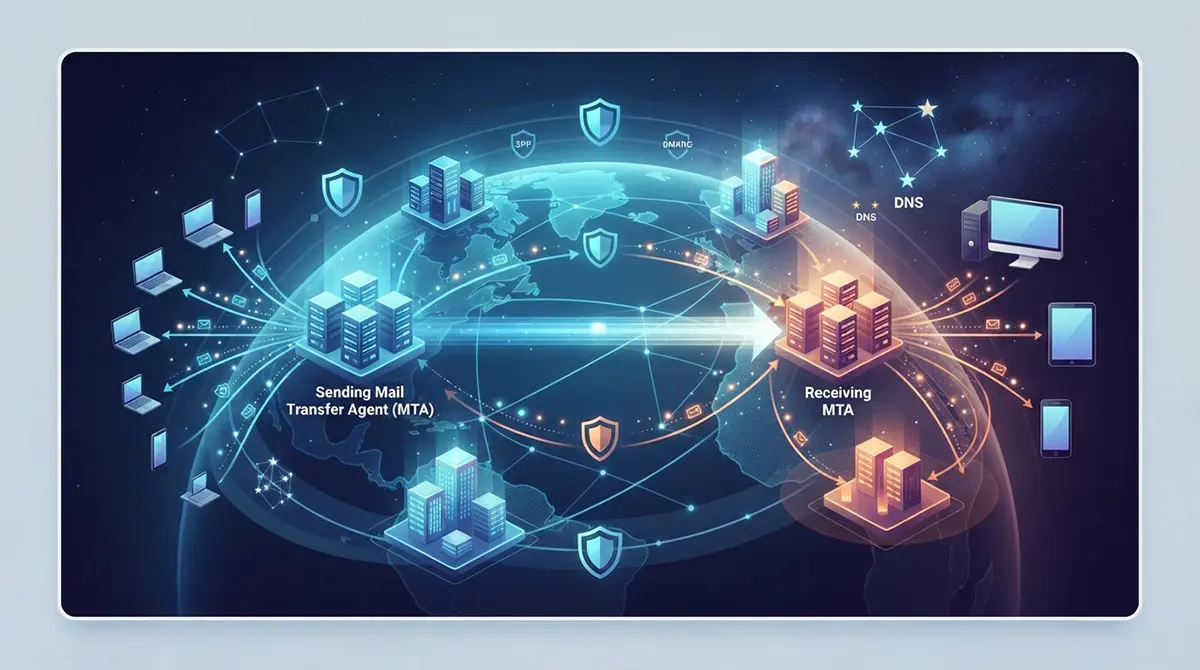
The second component is the Mail Transfer Agent, or MTA. The MTA is the heavy lifter of the email world. Operating on server infrastructure, MTAs are responsible for transferring mail from one host to another across a network using SMTP. When an MUA sends a message, it transmits it to a local MTA. This MTA inspects the recipient address, performs a Domain Name System lookup to find the target server, and establishes an SMTP connection with the remote MTA residing on the recipient’s mail server. Popular implementations of MTAs include Postfix, Exim, Sendmail, and Microsoft Exchange. These systems handle queue management, retry logic for failed deliveries, and routing decisions.
The third component is the Mail Delivery Agent, or MDA. Once an MTA on the destination host receives an incoming message via SMTP, it hands that message over to an MDA. The MDA takes responsibility for placing the message into the correct user mailbox or storage repository on the server. Older systems utilized local delivery mechanisms like mbox files, while modern installations often rely on advanced storage backends, database integrations, or Maildir formats. The MDA may also apply local filtering rules, spam scoring, and Sieve scripts to sort messages before the user ever opens their MUA to retrieve them.
A Step-by-Step Journey of an Email Across Different Hosts
To visualize the role of SMTP in connecting different hosts, consider the complete journey of a single message sent from an employee at a corporate office in London to a client in Tokyo. This journey demonstrates how multiple protocols and servers cooperate to bridge geographical and network divides.
The process begins when the sender opens their MUA, types the recipient email address, drafts the message body, and clicks send. The MUA connects to the local outbound mail server using SMTP with authentication. This initial step ensures that the server validates the user before accepting the outgoing mail stream. Once accepted, the local server queues the message for delivery.
At this stage, the local MTA takes over. It reads the domain portion of the recipient email address to determine where the message needs to go. Because the sending host and the receiving host are entirely different machines managed by different organizations, the sending MTA must locate the correct target IP address. It queries the Domain Name System for Mail Exchange records associated with the recipient domain. The DNS returns a prioritized list of server hostnames authorized to accept mail for that domain.
Armed with the target server IP address, the sending MTA initiates a TCP connection to port twenty-five or port five hundred eighty-seven of the destination host. Once the connection is established, the SMTP handshake begins. The sending server identifies itself, and the receiving server responds with a greeting. The sending server then specifies the envelope sender address and the envelope recipient address.
The receiving MTA validates whether the recipient address exists within its domain or user database. If the address is valid, the receiving server issues a positive acknowledgment, prompting the sending server to transmit the actual data payload, which includes email headers and the message body. After the receiving server confirms safe receipt of the data, both servers gracefully terminate the SMTP session. The receiving MTA then hands the message to its local MDA, which deposits it into the recipient storage vault. Finally, when the recipient opens their MUA, they download or view the message using retrieval protocols.
Need a Reliable DevOps Partner in Dubai?
Managing servers, monitoring performance, and automating workflows can be overwhelming when you’re trying to scale your business. If you’re looking for hands-on expertise in cloud migration, server hardening, and pipeline automation, We are here to bridge the gap. Reach out to us and let’s build a resilient infrastructure tailored to your needs.
The Mechanics of SMTP: Commands, Responses, and Sessions
The beauty of SMTP lies in its simplicity and transparency. As a text-based protocol, every command sent by a client and every response returned by a server consists of human-readable ASCII text strings. This design made debugging and protocol development straightforward for early network engineers.
An SMTP session follows a strict conversational structure. After the initial TCP connection is made, the server initiates the dialogue by sending a greeting code, typically code two hundred twenty, along with its hostname and status information. The client responds with the EHLO command, or the older HELO command, identifying its own hostname. This step informs the receiving server that the client wishes to initiate an email transaction and allows both hosts to negotiate supported extensions, such as security capabilities or message size limits.
Following the handshake, the client issues the MAIL FROM command, declaring the return path or envelope sender for the message. This address is crucial for handling bounce notifications and delivery failure reports. Next, the client issues one or more RCPT TO commands, specifying the intended recipients of the message. The server evaluates each recipient address independently, returning positive confirmation codes for valid mailboxes or error codes for unknown users.
Once the recipients are established, the client issues the DATA command. This signals to the server that the client is ready to transmit the message content. The server responds with an intermediate prompt, instructing the client to send the data and conclude it with a single period on a line by itself. The client then transmits the header fields, including subject, date, sender, and recipient metadata, followed by a blank line and the body of the message.
Client: EHLO mail.senderdomain.com
Server: 250-mail.recipientdomain.com Hello mail.senderdomain.com
Client: MAIL FROM:<sender@senderdomain.com>
Server: 250 2.1.0 Sender OK
Client: RCPT TO:<recipient@recipientdomain.com>
Server: 250 2.1.5 Recipient OK
Client: DATA
Server: 354 Start mail input; end with <CRLF>.<CRLF>
Client: Subject: Quarterly Financial Review
Client:
Client: Please find the attached documents for the upcoming review.
Client: .
Server: 250 2.0.0 Ok: queued as 4Txyz123
Client: QUIT
Server: 221 2.0.0 Bye
This structured exchange ensures that both hosts are synchronized at every stage of the transfer. If an error occurs at any point, such as a full mailbox or a temporary server failure, the numeric response codes allow the sending MTA to intelligently handle the error, either retrying the transmission later or generating a notification to the original sender.
Beyond Transmission: The Role of POP3 and IMAP in Email Retrieval
While SMTP is uniquely responsible for moving messages between different hosts across networks, it is not designed for storing and organizing mailboxes over the long term. Once an MTA delivers a message to the destination server, the user needs a way to access that message from their personal device. This is where retrieval protocols come into play, working in tandem with SMTP to complete the email experience.
The two primary protocols used for retrieving mail are the Post Office Protocol version 3, known as POP3, and the Internet Message Access Protocol, known as IMAP. While both protocols allow users to download messages from a remote mail server, their underlying philosophies and operational workflows are fundamentally different.
POP3 was designed with a simple philosophy: download the mail from the server to a single local device and, optionally, delete the server copy. When a user connects via POP3, the client application logs into the server, retrieves all unread messages, and stores them locally on the hard drive of the computer or phone. This approach was ideal in the early days of computing when server storage was expensive and users typically accessed their email from a single stationary desktop machine. However, in the modern multi-device era, POP3 presents significant limitations. If a user reads an email on their laptop, that message may no longer be available when they check their phone, because it was already pulled down to the laptop.
IMAP was developed to solve the synchronization challenges inherent in POP3. Instead of downloading messages and removing them from the server, IMAP maintains the master copy of all emails and folder structures on the remote mail server. When an MUA connects via IMAP, it downloads headers and displays message previews, synchronizing state flags such as read, unread, flagged, or deleted across all connected devices in real time. If a user deletes an email on their tablet, that change is immediately reflected on their smartphone and desktop client. IMAP empowers users to seamlessly switch between multiple devices without losing their place or duplicating their archives.
Fortifying the Mail Pipeline: Security, Encryption, and Authentication
The original architecture of the internet was built on trust rather than security. Consequently, early iterations of SMTP transmitted all message contents and authentication credentials in plain text across networks. Anyone with access to intermediate network routers could intercept and read sensitive corporate communications or personal messages. As the internet matured into a critical global utility, securing the mail pipeline became an urgent necessity.
Today, modern email infrastructure relies heavily on Transport Layer Security to protect data in transit. When two MTAs communicate, they utilize encryption protocols to secure the communication channel against eavesdropping and tampering. The primary mechanism for achieving this in SMTP is the STARTTLS command. When a client connects to a server, it issues an EHLO command to check for security support. If the server supports encryption, the client issues the STARTTLS command, signaling an upgrade of the plain text connection into an encrypted TLS tunnel before any sensitive data or authentication credentials are exchanged.
In addition to transport encryption, securing email requires robust mechanisms to verify the identity of sending hosts and prevent domain impersonation. Because SMTP historically allowed any server to claim any sender address in the envelope, malicious actors frequently exploited this openness to launch phishing campaigns and spam outbreaks. To combat this, the engineering community developed authentication frameworks that bind domain ownership directly to email delivery.
One foundational framework is the Sender Policy Framework, known as SPF. SPF allows a domain owner to publish a public record in their DNS settings that lists all IP addresses and server networks authorized to send email on behalf of that domain. When a receiving MTA accepts a message, it checks the SPF record of the domain found in the envelope sender address. If the message originates from an IP address not listed in that record, the receiving server can flag, quarantine, or reject the message as unauthorized.
Another critical pillar of email security is DomainKeys Identified Mail, or DKIM. DKIM introduces cryptographic verification to email messages. The sending mail server signs outgoing messages with a private cryptographic key, embedding a digital signature directly into the message headers. The receiving server retrieves the corresponding public key from the sender DNS records and validates the signature. This process guarantees two vital security properties: it proves that the message truly originated from the claimed domain, and it ensures that the message content was not altered or tampered with during transit.
The third component in this modern security trinity is Domain-based Message Authentication, Reporting, and Conformance, commonly known as DMARC. DMARC builds upon SPF and DKIM by allowing domain owners to specify how receiving servers should handle messages that fail authentication checks. Furthermore, DMARC provides reporting mechanisms that send daily feedback data back to the domain owner, detailing every server attempting to send mail on their behalf. This visibility helps organizations identify misconfigured infrastructure and malicious spoofing attempts proactively.
The DNS Ecosystem: MX Records, SPF, DKIM, and DMARC
The Domain Name System acts as the indispensable directory service that makes email routing possible across diverse networks. Without the DNS, human-readable email addresses could not be translated into the machine-readable IP addresses required by SMTP to establish socket connections.
When an MTA needs to deliver a message, it performs a specialized DNS query looking specifically for MX records. Unlike standard address records that map domains to single IP addresses, MX records map a domain name to a prioritized list of mail server hostnames. Each MX record consists of a preference number and a target hostname. The sending MTA sorts these records by preference, starting with the lowest numerical value, which represents the primary mail server. If the primary server is unreachable or offline, the sending MTA automatically attempts delivery to the secondary server, ensuring high availability and fault tolerance across independent network hosts.
Domain: enterprise.com
Record Type: MX
Priority: 10
Target Hostname: mail-primary.enterprise.com

Record Type: MX
Priority: 20
Target Hostname: mail-backup.enterprise.com
Beyond basic routing, DNS text records serve as the foundation for email authentication and security policies. SPF, DKIM, and DMARC configurations are all published and maintained as public DNS entries. When receiving servers process incoming mail, they perform rapid DNS lookups to verify these records in milliseconds. This tight integration between DNS and SMTP highlights the cooperative nature of internet protocols, where directory services and transport layers work seamlessly together.
Modern Challenges in Email Delivery and Infrastructure Management
Operating email infrastructure in the modern digital landscape presents complex operational challenges. While the core protocol remains elegant and straightforward, the surrounding ecosystem has grown fiercely competitive and tightly policed. System administrators must navigate stringent spam filtering algorithms, reputation scoring systems, and complex network configurations to ensure their messages successfully reach user inboxes.
One of the most persistent hurdles is IP reputation management. Major webmail providers and mailbox operators track the historical behavior of every sending IP address and domain. If an administrator configures an SMTP server incorrectly, leaving an open relay or failing to implement proper authentication, malicious actors may compromise the server and use it to blast spam. Once an IP address is blacklisted by major spam prevention networks, legitimate emails sent from that infrastructure will be instantly rejected or dumped into spam folders. Maintaining a clean mail server requires continuous monitoring, log analysis, and rapid incident response protocols.
Another modern challenge involves rate limiting and connection policies. To protect their networks from denial-of-service attacks and abusive automated scripts, receiving mail providers enforce strict limits on how many connections an external host can open, how many messages can be transmitted per session, and how fast data can be streamed. SMTP MTAs must be finely tuned to respect these thresholds, utilizing queuing algorithms and back-off timers to deliver mail smoothly without triggering security blocks.
Additionally, infrastructure engineers must manage cryptographic key lifecycles for DKIM signatures, maintain accurate reverse DNS pointer records to pass server identity checks, and configure robust backup and disaster recovery systems. Despite these operational complexities, SMTP remains the undisputed king of message transport, continuing to power billions of critical communications every single day across every corner of the globe.
Conclusion: The Enduring Legacy of Email Protocols
The Simple Mail Transfer Protocol stands as a monument to robust, scalable engineering. Conceived decades ago during the infancy of networked computing, SMTP was designed with a modularity and simplicity that allowed it to weather exponential growth and radical technological shifts. It successfully bridges the gap between completely independent computer systems, allowing messages to cross organizational boundaries, corporate firewalls, and international borders with remarkable reliability.
By working in harmony with complementary protocols like IMAP and POP3 for message retrieval, and leveraging advanced security frameworks like SPF, DKIM, and DMARC, SMTP provides the dependable foundation upon which modern digital communication rests. Understanding how these protocols interact not only illuminates the mechanics of a daily tool but also reveals the elegant architectural principles that enable global connectivity. As long as humanity relies on asynchronous, open messaging across diverse networks, SMTP will remain a vital pillar of the interconnected world.