
The modern software landscape is defined by an uncompromising demand for velocity, reliability, and scale. As organizations transition from monolithic architectures to sprawling, dynamic cloud-native ecosystems powered by Kubernetes, traditional infrastructure management and deployment methodologies have reached their breaking point. Manual
kubectl apply commands executed from local terminals, brittle shell scripts scattered across disparate developer laptops, and opaque imperative release pipelines introduce human error, configuration drift, and catastrophic downtime. Enter GitOps, a paradigm that fundamentally transforms how infrastructure and applications are defined, deployed, and managed. By treating Git as the ultimate single source of truth for declarative infrastructure, engineering teams can achieve unprecedented transparency, auditability, and operational resilience. At the vanguard of this movement stands ArgoCD, a declarative, GitOps continuous delivery tool explicitly built for Kubernetes.To fully grasp the transformative power of ArgoCD, one must first deconstruct the philosophical and mechanical underpinnings of GitOps. Coined by Weaveworks in 2017, GitOps is not a revolutionary, untested product; rather, it is a set of operational best practices that unifies developer workflows with infrastructure operations. At its core, GitOps relies on four foundational principles: the entire system is described declaratively, the desired state is version-controlled in Git, approved changes to the desired state are automatically applied to the system, and software agents continuously monitor and reconcile actual state with desired state. In a traditional push-based CI/CD pipeline, an external system such as Jenkins, GitLab CI, or GitHub Actions pushes compiled artifacts and manifests directly to a target cluster. This approach requires granting external CI systems persistent administrative credentials to production clusters, creating a massive security attack surface. Furthermore, if a rogue administrator modifies a resource directly on the live cluster using
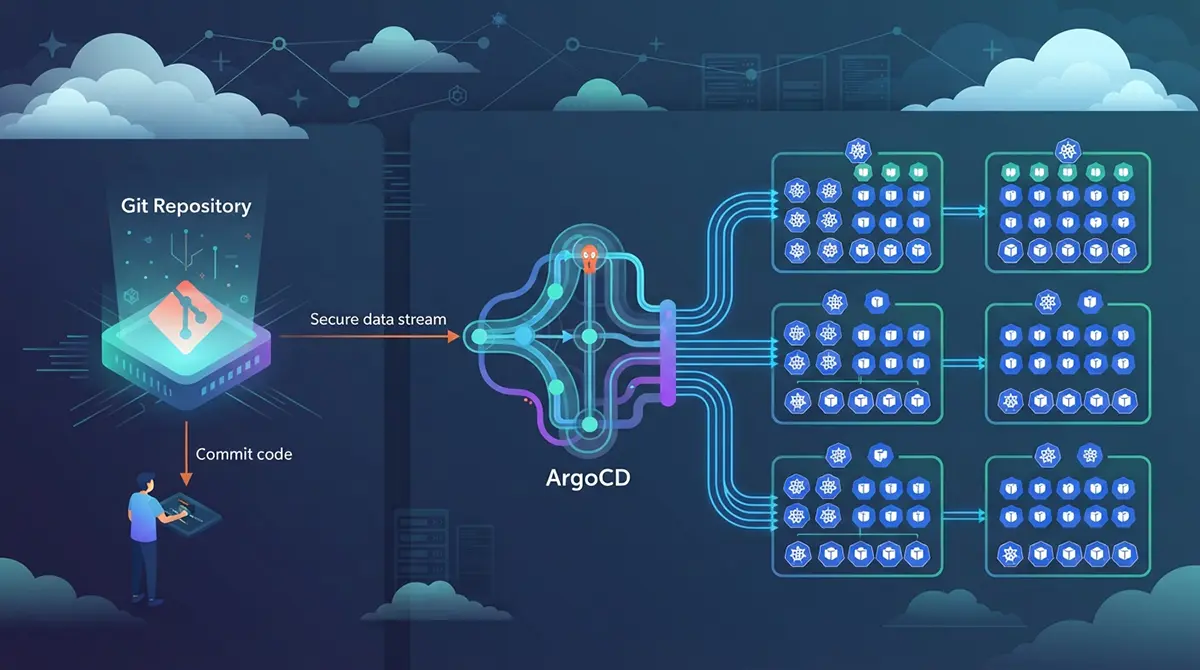
kubectl edit, the CI system remains blissfully unaware, resulting in silent configuration drift that can wreak havoc during subsequent deployments or disaster recovery events.GitOps inverts this security and architectural model entirely through a pull-based mechanism. Instead of external systems pushing changes into production environments, an autonomous agent running securely inside the cluster continuously inspects the Git repository housing the declarative manifests. When a developer or system merges a pull request containing updated configuration files, the in-cluster agent detects the divergence between the live state of the cluster and the desired state declared in Git. The agent then pulls the new manifests and applies them locally. This architectural shift eliminates the need to store cluster credentials in external CI pipelines, drastically reducing exposure to credential theft and lateral movement attacks. Every single change to the infrastructure or application ecosystem leaves an immutable cryptographic trail inside the Git history, providing automatic auditing, accountability, and effortless rollbacks via standard
git revert commands.Looking for Enterprise-Grade DevOps Services in Dubai?
Scaling your infrastructure, automating deployments, and ensuring 99.9% uptime shouldn’t be a bottleneck for your business. Whether you need robust CI/CD pipelines, containerization with Docker and Kubernetes, or secure cloud architecture, We can help you streamline your operations. Let’s optimize your IT environment Get in touch with us today to discuss your project.
ArgoCD was born out of the CNCF ecosystem to operationalize these GitOps principles specifically for Kubernetes environments. It is engineered as a Kubernetes controller that continuously monitors running applications and compares their live state against the desired target state specified in a Git repository. ArgoCD supports a vast array of configuration management tools and templating engines, including plain Kubernetes YAML manifests, Kustomize overlays, Helm charts, Jsonnet, and custom configuration plugins. This flexibility ensures that organizations are not forced to refactor their existing tooling portfolios just to adopt GitOps. Instead, ArgoCD acts as the unifying orchestration layer that brings order, predictability, and automation to complex, multi-cluster topologies.
The architecture of ArgoCD is elegantly modular, revolving around several key components designed for high availability, scalability, and separation of concerns. The ArgoCD API Server is the front-facing gateway responsible for handling gRPC and HTTPS requests originating from the command-line interface, the web user interface, and external automation tools. It performs authentication, authorization checks, and delegates application management operations to the underlying components. The Repository Server is a dedicated microservice responsible for maintaining local caches of target Git repositories. It checks out the source code, resolves dependency trees, and renders the final Kubernetes manifests using the appropriate configuration tool, whether that involves executing
helm template, running kustomize build, or evaluating raw YAML files.The crown jewel of ArgoCD is the Application Controller. Operating as an active reconciliation loop, the Application Controller continuously queries both the Repository Server for the desired manifests and the target Kubernetes cluster API server for the live resource states. It computes the diff between these two states and determines whether the application is synchronized or out of sync. When configured in automated synchronization mode, the Application Controller instantly applies the necessary corrective actions to align the cluster state with the Git repository. For organizations requiring strict change management gates, ArgoCD can be configured for manual synchronization, allowing operators to inspect the diff visually within the dashboard or CLI before approving the rollout.
Transitioning an enterprise infrastructure to an ArgoCD-managed GitOps workflow requires a deliberate, methodical approach to repository structuring and branch management. Designing a clean repository strategy is the single most critical factor in determining the long-term maintainability and scalability of a GitOps implementation. Organizations generally gravitate toward one of two primary structural patterns: the monorepo approach or the polyrepo approach. In a monorepo setup, both application source code and deployment manifests reside within a single, centralized repository. While this approach simplifies cross-cutting refactorings and atomic commits that update both code and configuration simultaneously, it can quickly become unwieldy as the organization scales, leading to sprawling directory trees and excessive CI/CD noise.
Conversely, the polyrepo approach separates application source code repositories from infrastructure and deployment configuration repositories. In this model, developers push application code changes to dedicated repositories, which trigger CI pipelines to build container images and publish them to a container registry. Once the new image tag is available, an automated process updates the image tag reference inside a separate, dedicated GitOps configuration repository. This clear separation of concerns ensures that operations teams retain granular access control over production infrastructure definitions while granting developers freedom within their application codebases. Many mature organizations adopt a hybrid variant, maintaining a dedicated infrastructure repository per environment, such as development, staging, and production, to enforce strict promotional lifecycles.
Managing multi-environment configurations at scale demands robust templating frameworks. Writing duplicate YAML manifests for development, staging, and production clusters violates the fundamental DRY principle and invites human error. ArgoCD integrates natively with Kustomize and Helm to solve this challenge elegantly. Kustomize allows engineers to define a common base set of Kubernetes resources and construct environment-specific overlays that patch, append, or modify attributes such as replica counts, resource quotas, and environment variables without altering the core templates. Helm packages complex Kubernetes applications into reusable charts with parameterized values files, enabling teams to parametrize deployments effortlessly across diverse target environments. ArgoCD seamlessly interpolates parameter values and renders manifests dynamically during the synchronization cycle.
Security and access control are paramount when implementing an enterprise-grade GitOps workflow. Because ArgoCD possesses the authority to deploy arbitrary workloads into Kubernetes clusters, securing its access planes is non-negotiable. ArgoCD provides comprehensive role-based access control out of the box, allowing administrators to map enterprise identity providers via OpenID Connect and SAML protocols. Organizations can define granular policies that restrict users and service accounts to specific projects, applications, and operations. For instance, a junior developer might be granted permissions to view the health status of production applications and trigger manual syncs in staging environments, while senior platform engineers retain full administrative privileges across all clusters.
Furthermore, secret management in a GitOps workflow presents a unique architectural challenge. Because Git repositories are intended to be transparent, auditable, and often shared or public, storing plain-text secrets such as database passwords, TLS certificates, and API tokens directly in Git is a critical security vulnerability. To overcome this limitation, the ecosystem has spawned powerful native extensions and third-party tools that integrate seamlessly with ArgoCD. Tools like Bitnami Sealed Secrets allow operators to encrypt sensitive values client-side into a secure ciphertext object that can be safely committed to public or private Git repositories. The in-cluster Sealed Secrets controller then decrypts these objects into standard Kubernetes secrets at runtime. Another industry standard is Mozilla SOPS, which encrypts entire YAML files or specific fields using cloud-native key management services such as AWS KMS, Google Cloud KMS, or Azure Key Vault, allowing encrypted files to live safely alongside standard manifests in Git while ArgoCD decrypts them on the fly during the rendering phase.
Observability and health assessment are core pillars that elevate ArgoCD beyond a simple deployment script runner. In traditional deployment models, verifying whether a release was successful often meant checking if the CI pipeline returned a green exit code. However, a green CI build only indicates that the manifests were applied to the cluster; it provides zero insight into whether the application pods successfully started, passed their liveness and readiness probes, or began serving production traffic successfully. ArgoCD solves this blindness by introducing sophisticated health assessment logic. Beyond evaluating whether a Kubernetes resource exists in the API server, ArgoCD understands the semantic lifecycle of native and custom resources. For example, a Deployment resource is not considered healthy by ArgoCD merely because the object is created; ArgoCD actively monitors the rollout status, ensuring that the desired number of replicas are available, updated, and passing health checks before marking the application synchronization status as healthy.
For complex applications whose health cannot be evaluated by standard Kubernetes resource checks, ArgoCD offers Custom Health Checks written in Lua. Platform engineers can author custom Lua scripts embedded within the ArgoCD configuration map to inspect arbitrary status fields of custom resource definitions. This capability is exceptionally valuable for modern cloud-native architectures utilizing custom operators, service meshes, and distributed databases such as operators for PostgreSQL, Elasticsearch, or Kafka. By defining custom Lua health checks, teams ensure that ArgoCD accurately reflects the operational reality of highly specialized workloads, preventing false positives and ensuring that automated rollouts halt immediately if a database cluster fails to achieve consensus.
Advanced deployment strategies such as canary releases and blue-green deployments find their ultimate expression when orchestrated alongside ArgoCD. While ArgoCD excels at declarative state synchronization, progressive delivery frameworks like Argo Rollouts extend these capabilities to execute sophisticated, risk-mitigated traffic shifting. Instead of performing a destructive all-at-once rolling update that can instantly expose a breaking bug to the entire user base, Argo Rollouts replace standard Kubernetes Deployments with a custom Rollout resource. Combined with service mesh technologies or ingress controllers like Istio, Linkerd, or NGINX, Argo Rollouts allow platform teams to shift a tiny fraction of live production traffic to the new version, monitor key performance metrics and error rates via Prometheus integration, and automatically promote or rollback the release based on real-time telemetry. ArgoCD visualizes these progressive delivery stages natively in its user interface, providing operators with deep visibility into the exact phase of the canary rollout.
Handling drift detection and remediation is another domain where ArgoCD demonstrates its architectural superiority. Configuration drift occurs organically over time as hotfixes are applied directly to production clusters during middle-of-the-night incidents or as automated operators mutate resource fields. When ArgoCD detects a divergence between the Git repository and the live cluster state, it flags the application status as out of sync. Operators can inspect the rich visual diff viewer in the ArgoCD UI, which highlights additions, modifications, and deletions with intuitive color coding. Depending on organizational policy, teams can configure automated synchronization to instantly overwrite unauthorized manual changes, enforcing absolute compliance with the declarative source of truth. Alternatively, teams can configure automated notifications via Webhooks, Slack, PagerDuty, or Microsoft Teams, alerting on-call engineers to investigate the drift before any automated reconciliation occurs.
Scaling ArgoCD to manage hundreds of clusters across multiple cloud providers and edge locations requires a deliberate architectural pattern known as the ArgoCD Cluster Sharding model. Running a single ArgoCD instance to manage thousands of applications spread across dozens of disparate clusters can introduce performance bottlenecks in the application controller’s reconciliation loop. To mitigate this, ArgoCD supports distributed architectures where multiple application controllers are deployed and sharded across designated target clusters or namespaces. By leveraging Kubernetes labels and cluster secrets, organizations can partition their workload landscape, ensuring that dedicated controller instances manage specific clusters or business units. This horizontal scalability guarantees that the control plane remains highly responsive and resilient, even as the enterprise infrastructure expands exponentially.
Auditing, compliance, and governance are critical drivers for enterprise adoption of GitOps workflows. In highly regulated industries such as finance, healthcare, and government defense, proving who made a change, when the change was made, and what authority approved the deployment is a strict regulatory requirement. Traditional environments often struggle to produce comprehensive audit logs because permissions are scattered across multiple CI systems, cluster admin tokens, and manual terminal sessions. ArgoCD centralizes all deployment activities through its API server and logs every user action, synchronization event, and configuration change. Combined with Git’s immutable commit history and pull request review mechanisms, organizations achieve a bulletproof compliance posture that satisfies the most stringent auditing frameworks effortlessly.
Implementing an ArgoCD-driven GitOps workflow is not merely a technical upgrade; it is a cultural transformation that empowers development and operations teams to collaborate within a unified, transparent framework. By eliminating manual toil, eradicating configuration drift, and establishing Git as the single source of truth for the entire software and infrastructure lifecycle, organizations unlock unprecedented levels of stability and velocity. As cloud-native ecosystems continue to evolve in complexity, mastering GitOps with ArgoCD represents the definitive standard for modern, resilient infrastructure management.