
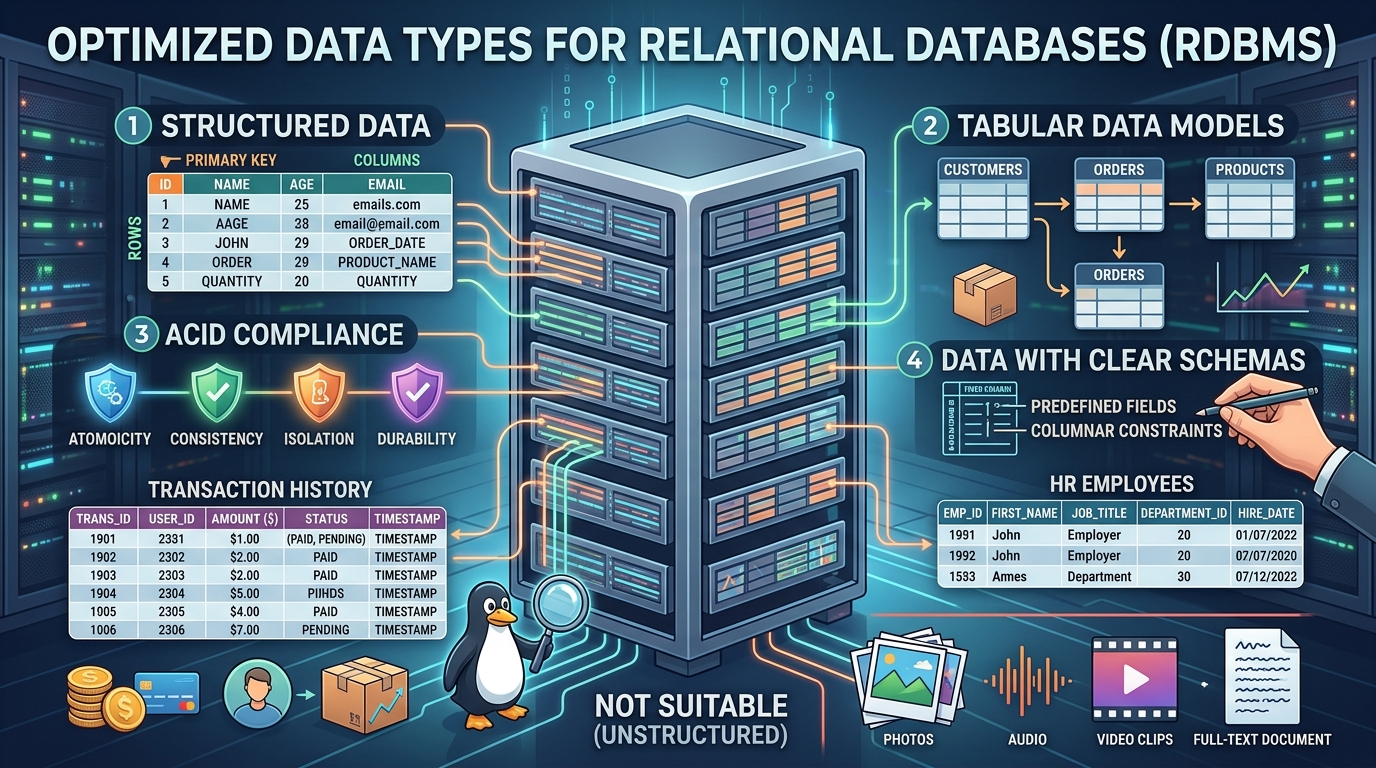



When designing system architectures, choosing the right database paradigm is one of the most critical foundational decisions software engineers, database administrators, and IT leaders face. While non-relational or NoSQL databases have gained immense popularity for handling unstructured, high-velocity, or document-centric data, relational databases continue to serve as the bedrock of enterprise software engineering. Understanding precisely which types of data thrive inside a relational database management system, often abbreviated as an RDBMS, requires examining both the technical structure of the data itself and the rigorous integrity guarantees the application demands.
At its core, a relational database organizes information into clear, predefined tables composed of rows and columns. Each row represents a discrete record, while each column defines a specific attribute of that record. Relationships between tables are established using primary and foreign keys, enabling complex interactions between data points without duplicating information across the system.
To determine whether a specific dataset belongs in a relational engine, architects evaluate data predictability, structural relationships, transactional requirements, and analytical query needs. Below is a detailed exploration of the exact types of data that are best suited for relational database systems.
Data Demanding ACID Compliance and Financial Integrity
The single most defining feature of a relational database is its adherence to ACID properties: Atomicity, Consistency, Isolation, and Durability. These guarantees ensure that every database transaction is processed reliably and that the system remains in a valid state regardless of hardware failures, network interruptions, or concurrent user requests. Consequently, any dataset where financial accuracy, state consistency, and auditability are non-negotiable is best stored in a relational database.
Financial Transactions and Ledger Records
Financial data is the quintessential use case for relational databases. In a financial ledger, money is never created or destroyed out of thin air; every credit to one account must correspond to an equal debit from another. Relational engines enforce this balance through atomic transactions, meaning either both operations succeed or neither does.
Key attributes of financial datasets best stored in an RDBMS include:
-
Double-entry bookkeeping ledgers requiring strict debit and credit balancing across accounts.
-
Bank account balances, deposit logs, and withdrawal histories that cannot tolerate eventual consistency or phantom reads.
-
Payment processing records, invoice line items, and payout logs where data corruption leads directly to monetary loss.
-
Audit trails for compliance frameworks like SOC 2, PCI-DSS, and Sarbanes-Oxley, which require immutable, fully consistent historical records.
In these environments, even a microsecond window of data inconsistency or a dropped update can lead to severe operational and legal consequences. The strong consistency model of relational engines ensures that when a transaction commits, the state change is immediately visible to all subsequent queries and safely persisted to storage.
Need a Reliable DevOps Partner in Dubai?
Managing servers, monitoring performance, and automating workflows can be overwhelming when you’re trying to scale your business. If you’re looking for hands-on expertise in cloud migration, server hardening, and pipeline automation, We are here to bridge the gap. Reach out to us and let’s build a resilient infrastructure tailored to your needs.
Core E-Commerce Inventory and Order Fulfillment Data
While e-commerce product catalogs with varying attributes might sometimes be stored in document stores, the transactional engine of an e-commerce platform specifically stock levels and order fulfillment must reside in a relational database.
Consider a high-traffic online store during a flash sale where thousands of users attempt to purchase the last five items in stock. Relational databases manage this concurrency through sophisticated locking mechanisms and isolation levels:
-
Real-time physical inventory counts that must accurately decrease as items are reserved or purchased.
-
Order processing workflows tracking status changes from pending, to paid, to shipped, to delivered.
-
Shopping cart line items linked directly to current pricing tables, promotional discount structures, and tax rules.
-
Multi-item order receipts that mandate all items exist in inventory before the transaction is finalized.
If inventory data were stored in an eventually consistent system, over-selling would occur frequently during high-concurrency bursts. Relational systems prevent overselling by enforcing strict isolation levels, ensuring that concurrent operations do not write conflicting inventory states.
Highly Structured and Schema-Defined Data
Relational databases rely on a “schema-on-write” approach. This means the structure of the data its data types, lengths, non-null constraints, and range checks must be defined before any data can be inserted. Data that naturally fits into a rigid, uniform structure is ideal for relational storage.
Enterprise Resource Planning and Operations Data
Enterprise Resource Planning, or ERP, systems form the central nervous system of large organizations. They coordinate manufacturing schedules, supply chain logistics, human resources, and facility management. These datasets are deeply interconnected, highly structured, and governed by strict business rules.
Examples of ERP datasets ideal for relational structures include:
-
Bill of Materials documentation detailing exact physical components required to manufacture a finished product.
-
Supply chain purchase orders, vendor master records, and shipment tracking milestones.
-
Employee organizational structures, payroll records, benefit elections, and time-tracking entries.
-
Asset management registries tracking equipment serial numbers, maintenance schedules, and depreciation values.
Because ERP datasets involve standardized forms and predictable processes, schema rigidity is an advantage rather than a liability. The database itself acts as a enforcement boundary, refusing to store corrupt, partial, or malformed records that do not adhere to predefined business rules.
Customer Relationship Management Data
Customer Relationship Management systems aggregate customer interactions, contact details, sales pipelines, and support histories. This information is inherently relational, as a single customer entity links directly to multiple contacts, communication logs, active deals, and support tickets.
Relational databases excel at managing CRM structures through key constraints:
-
Primary contacts and corporate entities with well-defined foreign key relationships to historical interactions.
-
Sales opportunity pipelines with structured stages, probability percentages, and monetary values.
-
Contract details including renewal dates, service-level agreements, and assigned account representatives.
-
Customer support ticket routing histories linking users, technical support agents, and product issues.
Using a relational database for CRM software prevents orphaned records such as a support ticket existing without an associated customer account and allows complex queries across sales metrics, pipeline velocity, and customer retention rates.
Multi-Entity Datasets with Complex Relationships
When a domain consists of numerous distinct entities that interact with one another in one-to-one, one-to-many, or many-to-many configurations, relational databases offer unmatched flexibility. Non-relational databases often force developers to choose between duplicating data across documents or performing application-level joins. Relational databases resolve this through normalized tables and native SQL join capabilities.
Healthcare, Medical Records, and Patient Management
Healthcare data requires exceptional structural discipline, as clinical decisions rely on complete and accurately associated patient histories. A single patient visits multiple clinics, sees different specialists, receives various medications, and undergoes distinct diagnostic tests.
A relational schema handles complex medical structures effectively:
-
Patient demographic profiles linked via foreign keys to longitudinal medical records.
-
Prescription logs connecting physicians, patients, specific drug compounds, and dosage instructions.
-
Health insurance coverage policies, claims history, and pre-authorization approvals.
-
Appointment scheduling systems requiring non-overlapping time slots across doctors, examination rooms, and specialized equipment.
By normalizing this data across relational tables, updates to a physician’s contact information or a medication’s standard dosage automatically propagate across the entire system. This eliminates data redundancy and prevents dangerous inconsistencies in patient treatment plans.
Educational Administration and Academic Performance
Academic institutions manage intricate networks of students, faculty members, departments, courses, prerequisites, and physical classrooms. The relationships between these entities are highly dynamic and deeply interconnected.
Relational databases effectively store educational records including:
-
Course registration catalogs enforcing prerequisite course completions prior to enrollment.
-
Student academic transcripts mapping historical grades to specific term courses and degree tracks.
-
Class scheduling matrices mapping faculty availability, room capacities, and student course loads without scheduling conflicts.
-
Tuition billing accounts linked to credit-hour registrations, financial aid awards, and housing fees.
A many-to-many join table, for instance, cleanly maps students to their enrolled courses while preserving individual attributes like registration date and final letter grade for each connection.
Data Requiring Dynamic Ad-Hoc Querying and Reporting
In many business environments, the engineering team cannot anticipate every analytical question that management, auditors, or data analysts will ask six months or two years in the future. Non-relational databases are typically optimized for specific, pre-calculated query patterns. In contrast, relational databases use Structured Query Language, or SQL, which allows powerful, open-ended querying across any combination of tables.
Business Intelligence and Regulatory Reporting Datasets
Organizations constantly generate operational metrics that must be aggregated, filtered, grouped, and analyzed across arbitrary dimensions. Because SQL is a declarative and universal query language, relational databases provide an ideal substrate for operational reporting.
Relational stores thrive on reporting datasets that require:
-
Aggregations across multiple dimensions, such as total sales grouped by region, product category, and sales representative over variable timeframes.
-
Cohort analysis comparing customer retention patterns across different registration months or marketing channels.
-
Compliance auditing reports requiring complex filtering based on user permissions, access timestamps, and data modification logs.
-
Comparative historical analysis where business metrics from current quarters are benchmarked against historical baselines.
Because the data is normalized and decoupled from specific application access patterns, analysts can query the database directly using standard Business Intelligence tools like Tableau, PowerBI, or custom SQL queries without restructuring the underlying data store.
User Authorization, Authentication, and Identity Management
Security models rely heavily on role-based access control, abbreviated as RBAC, or attribute-based access control, known as ABAC. Access management datasets consist of users, groups, roles, granular permissions, and resource objects.
Relational database engines are perfectly suited for identity management datasets:
-
User authentication tables containing hashed credentials, multi-factor authentication metadata, and account status indicators.
-
Role-to-permission mapping tables establishing exact operational privileges across system modules.
-
Enterprise directory structures mapping organizational units, manager-employee hierarchies, and group memberships.
-
Session management stores requiring instantaneous invalidation and strict timeout enforcement.
Using foreign key constraints in identity databases ensures that when a user account is deleted or revoked, all associated security tokens, temporary access grants, and role assignments are cleaned up automatically or flagged per security policy, leaving no security backdoors.
Technical Characteristics of Data Suited for Relational Storage
Beyond functional domain examples like finance or healthcare, data can be evaluated based on its underlying technical properties. When evaluating new software features or microservices, data engineers look for specific structural traits that indicate a relational database is the correct choice.
High Read-to-Write Ratios with Complex Filters
Data that is written once or modified infrequently but read constantly using diverse query criteria benefits significantly from relational storage. Relational engines utilize advanced indexing structures, such as B-trees and hash indexes, along with sophisticated query optimizers to execute complex lookup operations efficiently.
Examples of datasets matching this technical pattern include:
-
Geolocation and physical address databases used for distance calculations, routing, and territory assignment.
-
Master data management registries containing reference values, postal codes, currency conversion rates, and country codes.
-
Knowledge base content where metadata tags, author attributes, category hierarchies, and publish dates are queried simultaneously.
-
Software configuration settings that govern application behavior across different deployment environments.
The query optimizer in a modern relational database analyzes index statistics, execution plans, and memory allocation to deliver fast results even when filtering across millions of normalized records.
Low to Moderate Data Volume per Record with Strict Schema Boundaries
Relational databases perform exceptionally well when individual records are compact, structured, and predictable in size. Unlike unstructured media files, logs, or massive JSON payloads, relational table rows are optimized for fixed-size data types like integers, booleans, timestamps, fixed-length strings, and precise decimals.
Ideal technical data profiles feature:
-
Numerical values requiring exact mathematical precision, such as monetary values stored as exact decimals rather than floating-point approximations.
-
Categorical attributes with known, enumerable option sets enforced via check constraints or foreign key lookup tables.
-
Time-series metadata where every entry contains identical attributes like device identifier, timestamp, status code, and reading metric.
-
Text fields with strict length boundaries that prevent database bloat and optimize memory allocation during index scans.
When individual records adhere to predictable sizes, the relational storage engine packs rows efficiently into storage blocks, maximizing cache hit ratios and reducing disk input/output operations during sequential scans.
Low Structural Volatility Over Time
While relational schemas can be modified using schema migration scripts, systems where the data structure changes every day or varies wildly from record to record can introduce friction in a relational system. Conversely, datasets where the schema is stable and evolves predictably through planned releases are ideal candidates for relational storage.
Datasets exhibiting schema stability include:
-
Standardized regulatory reporting templates mandated by government bodies.
-
Core transactional models that represent fundamental domain concepts like invoices, users, and shipments.
-
Scientific measurement records collected from standardized sensor hardware configurations.
-
Operational state machines tracking predefined workflow states from initialization to completion.
In these scenarios, the overhead of maintaining database migrations is minimal compared to the immense value provided by structural constraints, static typing, and schema validation at the database layer.
When Relational Storage Is Not the Optimal Choice
To fully appreciate where relational databases excel, it is equally important to understand where their architectural tradeoffs become liabilities. Relational databases prioritize consistency and structural integrity, which can create friction under specific operational conditions.
Relational databases are typically not the best choice for:
-
Unstructured or semi-structured data with highly variable schemas, such as arbitrary web scraping dumps, polymorphic IoT payloads, or unstructured document stores where every record features entirely different keys.
-
Massive-scale horizontal write workloads, such as distributed application log ingestion, telemetry streams producing millions of writes per second, or global clickstream tracking systems that favor extreme ingestion speed over immediate consistency.
-
Large binary files, including raw video streams, high-resolution media assets, disk images, and large PDF documents, which are far more efficiently stored in dedicated object storage systems like Amazon S3.
-
Highly connected graph networks where the primary query pattern involves traversing arbitrary, deep relationship paths across billions of nodes, such as social network friend graphs or fraud detection networks, where graph databases perform significantly better.
-
Full-text search and unstructured natural language processing workloads, where specialized search engines like Elasticsearch or OpenSearch provide advanced tokenization, relevance scoring, and fuzzy matching capabilities.
Recognizing these boundaries allows system architects to adopt polyglot persistence strategies, combining relational databases for core transactional data with document stores, search indexes, and object stores for supplementary workloads.
The Enduring Value of the Relational Model
Despite decades of innovation in database technologies spanning key-value stores, document databases, column-family engines, and graph platforms the relational database remains the most reliable and versatile tool in modern software engineering.
Data that is best stored in a relational database possesses distinct characteristics: it demands strict transactional consistency, relies on predictable schemas, features complex inter-entity relationships, and requires flexible ad-hoc reporting capabilities. Whether managing bank ledgers, e-commerce orders, patient records, or corporate resource planning systems, the relational model provides an unmatched combination of correctness, safety, and query capability.
By matching the technical requirements of the dataset with the core strengths of relational engines specifically ACID compliance, normalized schemas, foreign key integrity, and powerful declarative SQL querying organizations build software systems that are not only performant today, but maintainable, auditable, and resilient for years to come.