
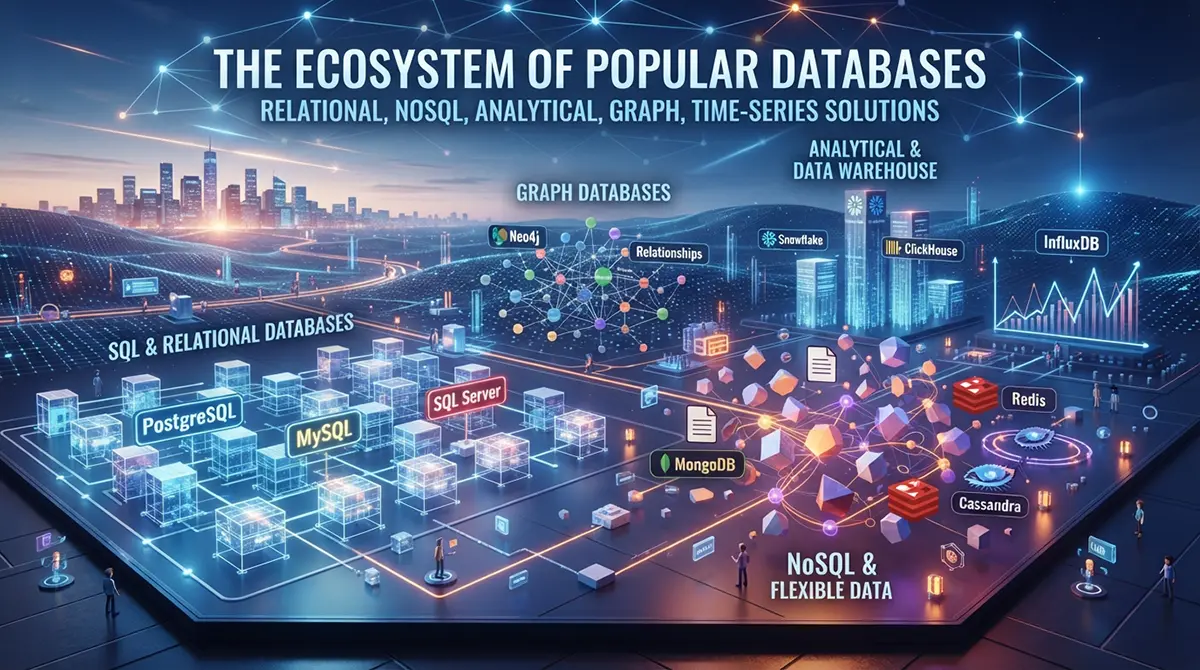



Data is the lifeblood of the modern digital economy. Every single transaction, click, message, sensor reading, and analytical query relies on a robust database system to store, process, and retrieve information with lightning speed and absolute reliability. Selecting the right database is one of the most critical architectural decisions any engineering team can make. It dictates application performance, scalability limits, maintenance overhead, and operational costs.
Understanding the vast array of available options requires looking beyond simple buzzwords to evaluate the underlying data models, storage engines, and architectural paradigms. This exploration dives into the most popular databases driving modern software engineering, web development, enterprise systems, and scientific research.
The Relational Foundation: SQL and Structured Data
Relational Database Management Systems have served as the bedrock of enterprise applications for decades. Built on the relational model introduced by Edgar C. Frank, these systems store data in structured tables consisting of rows and columns. They enforce strict schemas, ensuring that every piece of data adheres to predefined types and constraints.
MySQL: The Open Source Workhorse
MySQL stands as one of the most widely deployed relational databases in the world, particularly within the LAMP stack ecosystem. Its enduring popularity stems from its speed, reliability, and ease of use. MySQL supports a variety of storage engines, most notably InnoDB, which provides ACID compliance, foreign key support, and row-level locking.
Developers frequently rely on MySQL for content management systems, e-commerce platforms, and web applications that require fast reads and reliable transactional integrity. Its massive community means that troubleshooting guides, optimization techniques, and integration libraries are readily available for nearly any programming language or framework.
PostgreSQL: The Advanced Object-Relational Powerhouse
Often hailed as the world’s most advanced open-source relational database, PostgreSQL extends traditional relational concepts with powerful object-oriented features. It supports native JSON storage, custom data types, array fields, and robust indexing mechanisms like Generalized Inverted Indexes. This flexibility allows engineers to combine the safety of structured schemas with the agility of semi-structured document storage.
PostgreSQL excels in complex analytical workloads, financial systems, and geographic information systems thanks to extensions like PostGIS. Its strict adherence to SQL standards and commitment to data integrity make it a preferred choice for applications where correctness is paramount.
Microsoft SQL Server: Enterprise Grade Performance
Microsoft SQL Server is a cornerstone of enterprise IT environments, offering deep integration with the Windows operating system and the broader Azure cloud ecosystem. It provides robust tools for business intelligence, reporting services, and massive data warehousing.
Enterprise organizations lean on SQL Server for its high availability features, such as Always On Availability Groups, advanced security auditing, and seamless scalability across corporate infrastructure. While historically tied to Windows, modern versions offer robust Linux support, broadening its deployment flexibility.
Need a Reliable DevOps Partner in Dubai?
Managing servers, monitoring performance, and automating workflows can be overwhelming when you’re trying to scale your business. If you’re looking for hands-on expertise in cloud migration, server hardening, and pipeline automation, We are here to bridge the gap. Reach out to us and let’s build a resilient infrastructure tailored to your needs.
The NoSQL Revolution: Flexibility and Horizontal Scale
As web applications scaled to millions of concurrent users and data grew unstructured and varied, traditional relational databases occasionally hit bottlenecks regarding horizontal scalability. This led to the rise of Not Only SQL databases, which trade strict immediate consistency or rigid schemas for immense scalability, flexible data models, and high ingestion throughput.
MongoDB: Document Storage for Rapid Iteration
MongoDB is the premier document database, storing data in flexible, JSON-like documents called BSON. This design allows related information to be embedded within a single document rather than normalized across multiple tables and joined at query time.
The schema-less nature of MongoDB makes it immensely popular among fast-moving development teams building dynamic web applications, user profiles, content management systems, and real-time analytics pipelines. Developers can evolve their data models organically without running complex database migration scripts during every feature release.
Redis: In-Memory Speed and Caching Excellence
Redis operates entirely in-memory, achieving sub-millisecond response times that make it an indispensable tool for modern architectures. While technically classified as a key-value data store, Redis supports rich data structures including strings, hashes, lists, sets, sorted sets, bitmaps, and hyperloglogs.
Engineers routinely deploy Redis as a high-performance caching layer to reduce database load, as a real-time message broker for pub/sub architectures, or as a session store for web applications. Its atomic operations and persistence options ensure that extreme speed does not come at the complete expense of data safety.
Cassandra: Decentralized Wide-Column Storage
Apache Cassandra was engineered to handle massive volumes of data across commodity servers with no single point of failure. Inspired by Google Bigtable and Amazon Dynamo, Cassandra utilizes a masterless, peer-to-peer architecture where every node in the cluster is identical.
This design delivers exceptional write throughput and linear scalability, making it the go-to solution for time-series data, Internet of Things telemetry streams, fraud detection systems, and global messaging platforms that require continuous uptime across multiple data centers.
Analytical Engines: Uncovering Insights in Big Data
While operational databases are optimized for transactional processing, analytical workloads require entirely different storage layouts. Online Analytical Processing systems prioritize fast aggregation and scanning of billions of rows over quick single-row inserts.
ClickHouse: Blazing Fast Columnar Analytics
ClickHouse is an open-source columnar database management system designed specifically for real-time analytical reporting. By storing data in columns rather than rows, ClickHouse minimizes disk input and output during queries, enabling complex aggregations across massive datasets in milliseconds.
Data-driven enterprises deploy ClickHouse for log analytics, user behavior tracking, ad-tech reporting, and business intelligence dashboards where instant feedback loops on historical data are essential for operational decision-making.
Snowflake: Cloud-Native Data Warehousing
Snowflake revolutionized data warehousing by architecturally separating storage and compute. This decoupled design allows organizations to scale storage and processing independently, paying only for the exact resources consumed during query execution or data loading.
Snowflake integrates seamlessly across major cloud providers, enabling data sharing without data movement, multi-tenant concurrency, and robust data governance. It serves as a centralized single source of truth for modern data stacks, powering machine learning models and executive dashboards alike.
Specialized Paradigms: Graph, Search, and Time-Series
Different problems demand specialized data structures. When relationships, text search, or chronological sequencing take precedence, specialized databases provide capabilities that general-purpose engines struggle to replicate.
Neo4j: Mapping Connected Data
Neo4j is the leading graph database, built from the ground up to store and navigate relationships. While relational databases use foreign keys and expensive join operations to connect data, graph databases use nodes, edges, and properties, allowing traversal algorithms to execute with constant performance regardless of overall database size.
Organizations leverage Neo4j for recommendation engines, fraud detection networks, identity and access management, and knowledge graphs where the connections between data points carry as much value as the data points themselves.
Elasticsearch: Distributed Search and Log Analytics
Built on top of Apache Lucene, Elasticsearch is a distributed, RESTful search and analytics engine. It excels at full-text search, structural logging, and geospatial data processing through inverted indices that allow for rapid matching of terms across massive text corpora.
Development teams rely on Elasticsearch to power in-app search bars, aggregate application logs for debugging, and monitor security events in real time, often paired with Kibana and Logstash in the popular ELK stack.
InfluxDB: Chronological Precision
InfluxDB is tailored specifically for time-series data, which encompasses metrics, sensor measurements, and event logs collected over chronological intervals. Its custom storage engine optimizes high write speeds, efficient compression of historical data, and time-based retention policies.
Engineers deploy InfluxDB within infrastructure monitoring systems, financial trading platforms, and industrial automation networks to track system health, predict maintenance needs, and analyze trends over time.
Making the Right Choice for Your Architecture
Choosing the ideal database requires careful evaluation of several competing factors. Teams must balance consistency, availability, and partition tolerance while analyzing expected read and write ratios, query complexity, and expected data growth over a three to five-year horizon.
Often, modern enterprise architectures reject the notion of a single monolithic database in favor of polyglot persistence. In a polyglot architecture, different microservices utilize the database best suited to their specific domain requirements, whether that is a relational store for financial ledgers, a document store for product catalogs, or an in-memory cache for session management.
Researchers and academic institutions navigating large datasets often evaluate the most popular databases for research to ensure reproducibility, community support, and compatibility with specialized scientific libraries. By aligning technological capabilities with domain requirements, architects can build resilient, high-performing systems capable of weathering the data demands of tomorrow.