




The architectural blueprints of modern software engineering have undergone a profound transformation over the past two decades. In the early days of corporate computing, software development was characterized by distinct, linear phases. Requirements were gathered, systems were designed, code was written, tests were executed, and eventually, software was deployed into production environments. Security was traditionally treated as an external gatekeeping function, situated squarely at the tail end of the delivery cycle. Specialized security teams would conduct penetration tests, vulnerability scans, and code audits just prior to launch, acting as the final checkpoint before code met the real world.
This legacy model, while functional in an era of annual or bi-annual release cadences, has proven utterly incompatible with contemporary software delivery methodologies. Today, businesses operate in a ecosystem defined by continuous integration, continuous delivery (CI/CD), cloud-native infrastructure, and agile iteration. Software updates are deployed not once a year, but hundreds or even thousands of times a day. When security evaluations remain sequestered at the end of this rapid pipeline, they transform into severe operational bottlenecks, delaying deployments, inflating remediation costs, and frustrating both development and security teams.
To resolve this fundamental tension, the software engineering industry has undergone a major paradigm shift known as shifting left. The shift-left security paradigm redefines security from a delayed, reactive inspection phase into a continuous, proactive responsibility integrated directly into the earliest stages of the software development lifecycle (SDLC). By embedding security principles, automated scanning, and threat modeling into the daily workflow of developers, organizations seek to identify and remediate vulnerabilities at the exact moment they are introduced. This systematic review explores the evolution, core mechanisms, structural benefits, operational challenges, and future trajectory of the shift-left security paradigm.
The Historical Foundations: From Castle-and-Moat to Rapid Iteration
To fully appreciate the significance of the shift-left paradigm, one must trace the historical trajectory of software security practices. In the era dominated by the Waterfall methodology, security was conceptually straightforward. Applications were developed within centralized, tightly controlled perimeter networks. The dominant security strategy relied on a castle-and-moat architecture, where network firewalls, intrusion detection systems, and strict access controls guarded the perimeter, assuming that everything inside the network boundary was inherently trustworthy.
Under this regime, application security testing occurred at the pre-release stage. Security engineers received a frozen release candidate and spent weeks conducting manual penetration testing and static analysis. If vulnerabilities were discovered, the software was sent back to development for remediation, forcing developer teams to context-switch back to code they had written months prior. Alternatively, if release deadlines were tight, security findings were deferred, accumulating as technical and security debt that festered in production environments.
The rise of Agile development methodologies in the early 2000s began to unravel this model. Agile emphasized iterative sprints, customer collaboration, and rapid response to change. The linear checkpoints of Waterfall dissolved, replaced by bi-weekly releases that left little room for month-long security audits. Shortly thereafter, the emergence of DevOps united development and operations teams, breaking down organizational silos and leveraging automation to accelerate deployment speeds through continuous integration and continuous deployment pipelines.
While DevOps dramatically accelerated feature delivery, security was initially left behind. Security teams, operating with legacy tools and manual processes, found themselves overwhelmed by the sheer volume and velocity of code changes. They were increasingly viewed by business leadership as the department of no, an impediment to innovation and speed. It became clear that applying traditional security practices to automated delivery pipelines was fundamentally unsustainable. Security needed to adapt to the speed of DevOps, leading directly to the birth of DevSecOps and the core principle of shifting left.
“Don’t let cyber threats compromise your growth scale confidently with trusted website security maintenance dubai.”
Deconstructing Shift-Left: What It Means in Practice
At its core, the shift-left paradigm is guided by a simple premise: the earlier in the development lifecycle a bug or vulnerability is identified, the easier, faster, and cheaper it is to fix. In a conventional left-to-right SDLC diagram running from planning to deployment, security testing traditionally sat on the far right. Shifting left means pulling security activities toward the far left, embedding them into planning, architecture, coding, and building.
Shifting left does not mean simply running late-stage penetration tests earlier in the cycle. Instead, it represents a comprehensive overhaul of how security is conceptualized, automated, and distributed across an organization. It encompasses several foundational practices:
-
Security in Requirements and Design: Security begins before a single line of code is written. During the initial planning phase, teams conduct threat modeling to identify potential attack vectors, architectural flaws, and data flow vulnerabilities in the proposed design. Security requirements are defined alongside functional requirements as explicit user stories and acceptance criteria.
-
IDE-Integrated Feedback: Rather than waiting for a centralized pipeline build to discover code flaws, developers are provided with security tooling directly within their Integrated Development Environments (IDEs). Like a developer-centric spellchecker for vulnerabilities, these tools analyze code as it is typed, providing real-time alerts on insecure functions, SQL injections, or hardcoded secrets.
-
Automated Pipeline Gates: Security checks are embedded as automated steps within the CI/CD pipeline. Every pull request or code commit automatically triggers static code analysis, software composition analysis, and container image scans. If critical vulnerabilities are detected, the build is automatically failed or flagged, preventing vulnerable code from progressing down the delivery pipeline.
-
Continuous Dependency Management: Modern applications rely heavily on open-source libraries and third-party frameworks, which often make up eighty to ninety percent of a modern application’s codebase. Shifting left involves continuously tracking and auditing these external components for known vulnerabilities (CVEs) and licensing compliance early in the build cycle.
-
Developer Empowerment and Security Champions: Shifting left shifts the operational burden of day-to-day security tasks onto development teams. To facilitate this, organizations cultivate security champions developers embedded within feature teams who receive advanced training to serve as local security advocates, peer reviewers, and liaisons to the central security team.
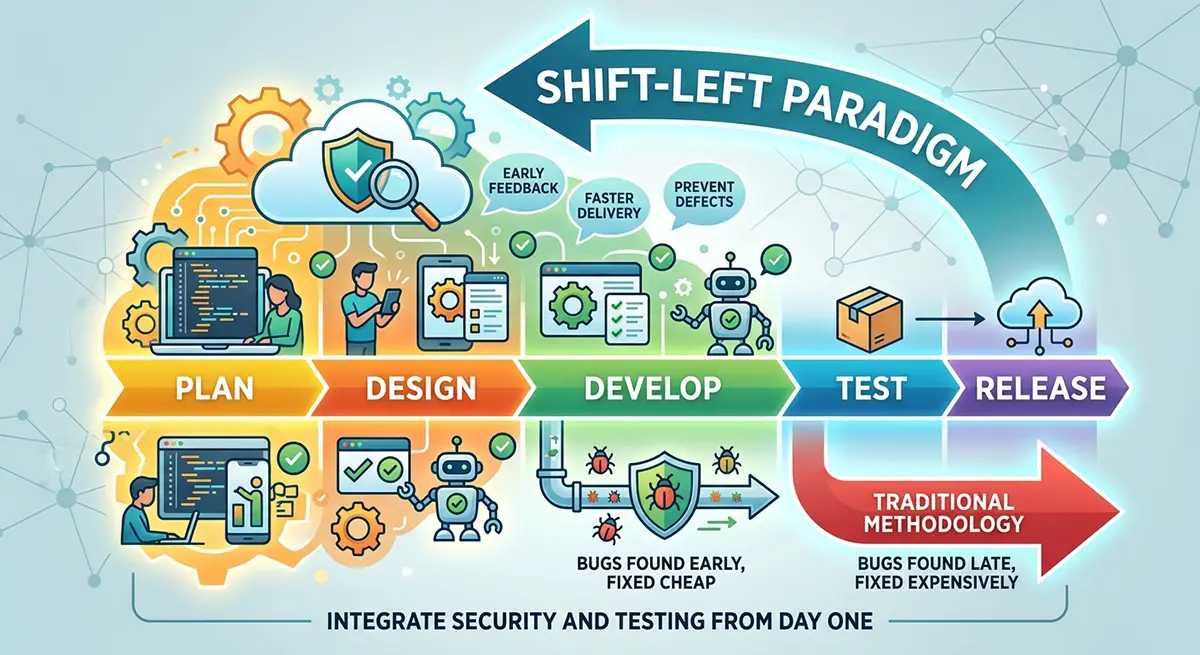
The Economic and Operational Imperative: Why Shifting Left Matters
The adoption of the shift-left security paradigm is driven not merely by theoretical elegance, but by compelling economic and operational realities. Decades of software engineering research demonstrate a stark exponential relationship between the stage at which a defect is discovered and the cost required to remediate it.
When a developer introduces a flaw such as an unvalidated input field and catches it seconds later via an IDE plugin, the remediation cost is virtually zero. The developer retains full mental context, understands the code logic intimately, and can refactor the flaw immediately. If that same flaw bypasses local checks and is caught during CI pipeline execution, remediation requires a brief context switch to review the build logs and submit an updated pull request, incurring a minor cost in time and resources.
However, if the vulnerability survives undetected until the pre-release testing phase or, worse, reaches production, the costs escalate exponentially. Remediation in production requires:
-
Emergency incident response mobilization and forensic analysis.
-
Interruption of planned feature roadmaps to divert engineering cycles toward emergency hotfixes.
-
Complex context switching for developers who must re-familiarize themselves with legacy code written months or years earlier.
-
Rigorous regression testing and re-deployment procedures under intense time pressure.
-
Potential legal liabilities, regulatory fines, reputational damage, and loss of customer trust stemming from a active data breach.
By systematically shifting vulnerability detection to the left, organizations flatten this cost curve. Issues that would have cost tens of thousands of dollars and weeks of emergency engineering in production are resolved in minutes at the desktop level. Furthermore, from an operational perspective, shifting left eliminates the high-stakes deployment friction that traditionally plagued release days. Security shifts from an unpredictable, binary gatekeeper into a continuous, deterministic quality metric.
The Technological Arsenal: Tooling That Drives the Shift
The execution of a successful shift-left strategy relies on a robust ecosystem of automated security technologies tailored for seamless integration into development environments and CI/CD pipelines. These tools provide the automated analysis necessary to keep pace with rapid deployment schedules.
Static Application Security Testing (SAST)
SAST tools perform inside-out analysis of application source code, byte code, or binaries without executing the program. Operating much like a static analysis compiler, SAST analyzes code syntax and data flow paths to uncover well-known structural vulnerabilities, such as cross-site scripting (XSS), buffer overflows, command injection, and insecure cryptography usage. Because SAST operates directly on raw source code, it can be deployed at the developer workstation or triggered immediately upon pull request submission, providing rapid feedback right where code is created.
Software Composition Analysis (SCA)
Given the heavy reliance on open-source packages in modern software development, SCA tools have become an indispensable component of the shift-left arsenal. SCA engines scan project dependency manifests and lockfiles, mapping third-party libraries against public vulnerability databases and security advisories. They identify out-of-date components, alert teams to disclosed vulnerabilities in dependencies, and verify open-source license compliance to mitigate intellectual property risks.
Dynamic Application Security Testing (DAST)
While SAST and SCA operate on static source code, DAST takes an outside-in approach by evaluating running applications. DAST tools simulate external cyberattacks against staged environments, probing active endpoints, forms, and authentication mechanisms for exploitability. Although DAST is traditionally situated further to the right due to the requirement for a compiled, running application, modern shift-left strategies incorporate lightweight, localized DAST instances into automated staging and integration testing pipelines.
Interactive Application Security Testing (IAST) and Runtime Protection
IAST combines elements of both static and dynamic testing by leveraging instrumentation agents placed inside the application runtime environment. As functional automated tests run against the application, the IAST agent monitors real-time execution, memory usage, and data flow from within the runtime engine. This provides highly accurate vulnerability identification with significantly lower false-positive rates than pure static analysis, offering immediate feedback during integration testing cycles.
Infrastructure as Code (IaC) Scanning
In cloud-native architectures, infrastructure is defined, provisioned, and managed using code files such as Terraform, CloudFormation, Kubernetes manifests, and Ansible playbooks. Shifting left applies security principles to infrastructure definitions just as it does to application logic. IaC scanners evaluate template files prior to deployment, identifying misconfigurations such as overly permissive access controls, unencrypted storage buckets, exposed administrative ports, and non-compliant network security groups before infrastructure is ever provisioned in the cloud.
Cultural Transformation: Navigating the Human Element
While the technological aspects of shifting left are critical, the most complex and frequently underestimated obstacles are cultural and organizational. Technology alone cannot achieve a successful shift-left transformation; it requires a fundamental realignment of organizational culture, responsibility models, and inter-departmental relationships.
Historically, development and security teams operated with conflicting incentives and cultural postures. Development teams were evaluated on velocity, feature throughput, and meeting release deadlines. Security teams were evaluated on risk mitigation, compliance enforcement, and system stability. This misalignment created inherent tension: developers viewed security as an adversarial roadblock disrupting momentum, while security professionals viewed developers as reckless coders oblivious to risk.
Shifting left demands a cultural evolution toward shared responsibility, often referred to as DevSecOps cultural alignment. Security can no longer be viewed as the exclusive mandate of a centralized security department; it must become an intrinsic quality metric owned by everyone involved in software creation. To foster this cultural evolution, organizations must focus on several core human factors:
-
Empathy-Driven Security Tooling: Security teams must select tools that integrate natively into developer environments rather than forcing developers to log into disconnected, third-party security portals. If security tooling creates excessive friction, developers will inevitably bypass or ignore it.
-
Developer Education and Upskilling: It is unreasonable to expect developers to write secure code if they are never taught how vulnerabilities operate. Organizations must invest in continuous, practical application security training, moving away from annual compliance lectures toward interactive, hands-on coding challenges and real-world threat exercises.
-
Eliminating Friction and False Positives: Security tools notorious for high false-positive rates erode developer trust. When developers are repeatedly forced to triage non-existent risks, security alert fatigue sets in. Security teams must actively tune, curate, and refine scanning engines to ensure that alerts sent to developers are highly accurate, contextual, and actionable.
-
Constructive Governance over Blame: Organizations must cultivate a blameless culture around vulnerability discovery. Finding a vulnerability early during code creation should be celebrated as a systemic win, not penalized as a developer failure. Punitive responses encourage developers to obscure risks rather than address them openly.
The Counter-Perspective: Risks, Pitfalls, and the Over-Shift Left
Despite its overwhelming adoption and undeniable benefits, the shift-left movement is not without its limitations and potential pitfalls. An uncritical, dogmatic application of the shift-left paradigm can lead to operational imbalances and secondary challenges that threaten development momentum and overall security posture.
One primary concern is the risk of developer overload. Modern developers are already tasked with mastering application architecture, database design, cloud infrastructure, containerization, and continuous delivery. Demanding that they also become experts in application security, penetration testing, and compliance frameworks can lead to cognitive overload and burnt-out engineering teams. Expecting developers to remediate every minor flaw flagged by aggressive scanning tools disrupts primary development goals and can severely slow feature delivery.
Another significant issue is tool fatigue and noise proliferation. Deploying multiple uncalibrated SAST, SCA, and IaC tools directly into pull request checks can flood developers with hundreds of alerts, many of which may be low-severity, irremediable, or false positives. Without proper triage and centralized security orchestration, developers spend disproportionate amounts of time managing security alerts rather than writing high-value code.
Furthermore, industry experts caution against the dangerous myth that shifting left eliminates the need for traditional right-side security practices. Shifting left is a risk-reduction strategy, not a silver bullet. Certain categories of security flaws such as complex business logic vulnerabilities, sophisticated concurrency issues, multi-service authorization bypasses, and zero-day exploits cannot be reliably detected by static analysis tools during early development.
A balanced, resilient security posture requires a holistic approach often described as shift left and stretch right. Early development-centric security must be complemented by robust late-stage and post-deployment defenses, including runtime application self-protection (RASP), threat intelligence, bug bounty programs, continuous penetration testing, and centralized security operations center (SOC) monitoring.
Systemic Comparison: Traditional vs. Shift-Left Security Models
To clearly illustrate the fundamental differences between legacy security postures and the modern shift-left methodology, the following key operational dimensions highlight the strategic evolution:
-
Primary Security Ownership: In the traditional model, security ownership belonged exclusively to dedicated central security and audit teams. In the shift-left paradigm, ownership is shared collaboratively across development, operations, and security teams (DevSecOps).
-
Timing of Testing: Traditional security conducted evaluations at the end of the SDLC during pre-release staging or post-deployment audits. Shift-left security performs continuous automated testing throughout the planning, coding, building, and deployment phases.
-
Remediation Cost and Effort: Legacy approaches suffered from high remediation costs due to late discovery, complex context switching, and emergency hotfixes. Shift-left achieves low remediation costs through immediate feedback loops at the developer desktop and pull-request levels.
-
Primary Tooling Ecosystem: Traditional security relied heavily on manual penetration tests, periodic network vulnerability scans, and standalone auditing suites. Shift-left utilizes IDE plugins, automated SAST, SCA, IaC scanners, and container checks integrated directly into CI/CD pipelines.
-
Impact on Velocity: Legacy gatekeeping caused significant release friction, creating deployment bottlenecks and operational delays. Shift-left fosters accelerated delivery velocity by transforming security checks into continuous, predictable automated pipeline gates.
-
Cultural Posture: Traditional security environments were frequently characterized by adversarial dynamics between developers and auditors. Shift-left encourages a collaborative culture centered on developer enablement, shared accountability, and blameless improvement.
Future Horizons: The Next Frontier of Application Defense
As software engineering continues to evolve, the shift-left paradigm is adapting to meet new technological realities and emerging architectural trends. Several key trajectories are defining the next phase of early security integration:
Artificial Intelligence and Automated Remediation
The integration of artificial intelligence and machine learning into security tooling is revolutionizing early code security. Traditional static analysis tools excel at pattern matching but struggle with contextual understanding, leading to false positives. Next-generation AI-powered security engines analyze code context, reducing false positives and identifying complex logic vulnerabilities.
Moreover, AI tooling is shifting from simple vulnerability detection to automated remediation. Modern IDE plugins now generate contextual auto-fixes and secure code patches directly within the developer’s editing interface, allowing developers to review, accept, and commit secure implementations with a single click.
Security as Code and Policy as Code
The paradigm of defining infrastructure and operational rules as code is extending fully into governance and compliance. Policy-as-Code frameworks allow security teams to define compliance rules, access boundaries, and operational guardrails as declarative code files. These policies are version-controlled, testable, and automatically enforced across pipelines and cloud environments, ensuring that security governance scales seamlessly with developer output.
Software Supply Chain Security and SBOMs
In light of high-profile supply chain attacks targeting open-source ecosystems, shifting left has expanded beyond code analysis to encompass complete software supply chain integrity. Organizations are increasingly adopting Software Bills of Materials (SBOMs) nested inventories of every component, library, and module contained within a piece of software. Modern shift-left pipelines automatically generate, sign, and verify SBOMs at build time, ensuring complete visibility into component provenance and cryptographic chain-of-custody before software enters production.
Cloud-Native Developer Security Platforms
The fragmented toolsets of the past are consolidating into unified developer security platforms. Rather than stitching together disparate SAST, SCA, IaC, and container scanning utilities, organizations are migrating toward integrated security platforms that provide a single pane of glass. These platforms orchestrate security checks across the entire developer lifecycle, correlating findings, removing duplicate alerts, and presenting developers with prioritized, contextual risk insight.
Conclusion: Synthesizing Speed, Scale, and Security
The evolution of software security from a delayed, reactive gatekeeping exercise to an integrated, proactive shift-left strategy represents one of the most critical advances in modern software engineering. As the velocity and complexity of software development continue to accelerate, traditional security paradigms are no longer viable. Waiting until deployment to assess risk guarantees operational friction, inflated costs, and elevated vulnerability exposure.
Shifting left offers a sustainable path forward. By embedding security into early requirements, architecture design, developer IDEs, and continuous integration pipelines, organizations transform security into a continuous quality dimension. The economic benefits are undeniable: catching flaws early flattens the remediation cost curve, protects engineering velocity, and prevents costly production incidents.
However, achieving the full potential of the shift-left paradigm requires more than purchasing automated scanning tools. It demands a thoughtful, empathetic cultural transformation that empowers developers, minimizes operational friction, and fosters shared responsibility across multidisciplinary teams. Crucially, it requires organizational balance recognizing that shifting left does not mean abandoning late-stage, runtime defenses, but rather harmonizing early proactive enablement with robust post-deployment protection.
Ultimately, the shift-left security paradigm redefines the relationship between security and innovation. Far from being a impediment to progress, early, automated, and continuous security serves as an essential catalyst for digital acceleration, empowering organizations to build rapidly, iterate fearlessly, and deliver resilient software in an increasingly complex threat landscape.