
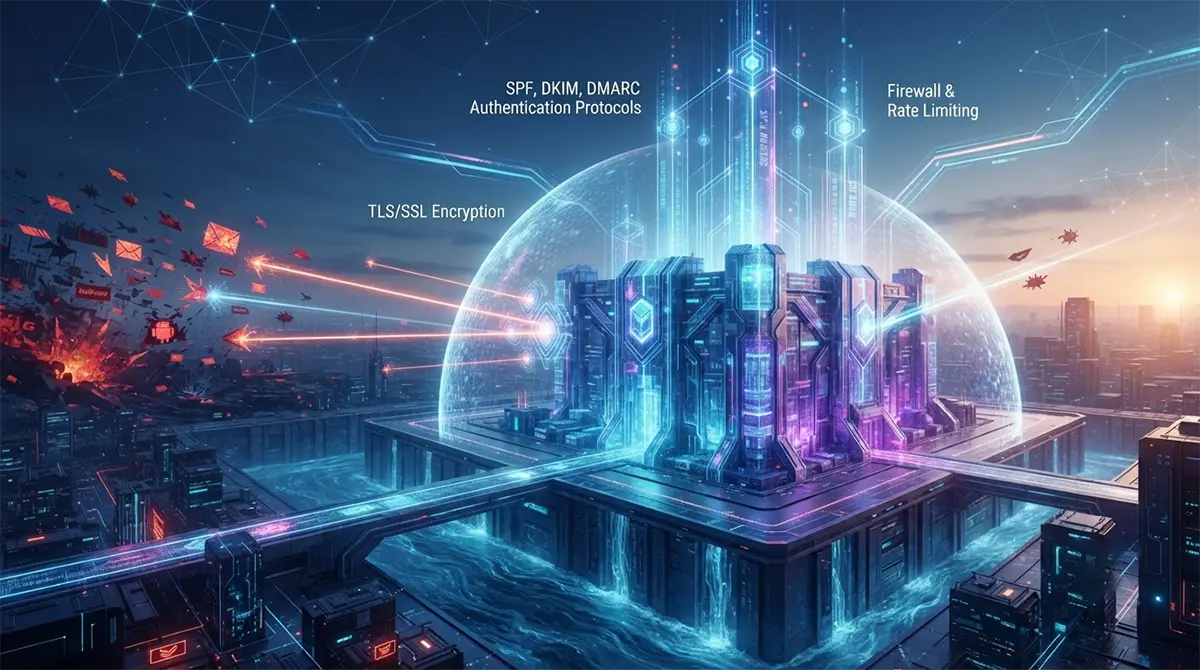



Introduction: The Unyielding Fortress of Enterprise Email
Email remains the lifeblood of global communication, serving as the primary digital conduit for business transactions, confidential agreements, and everyday operational coordination. Because of its critical role, the electronic mail infrastructure is perpetually targeted by sophisticated threat actors ranging from opportunistic script kiddies to advanced persistent threat groups. Among the various Mail Transfer Agents available in the open-source ecosystem, Postfix has earned a stellar reputation for its performance, modular design, and robust security model. However, out-of-the-box configurations are rarely sufficient to withstand the sophisticated cyber threats of the modern digital landscape.
Securing a Postfix mail server is no longer a set-it-and-forget-it administrative task. It requires a comprehensive, defense-in-depth strategy that spans cryptographic enforcement, strict authentication protocols, intelligent rate limiting, aggressive spam filtering, and rigorous continuous monitoring. As cybercriminals leverage automation, artificial intelligence, and distributed botnets to launch credential stuffing campaigns, sophisticated spear-phishing attacks, and massive denial-of-service disruptions, system administrators must adopt an equally advanced hardening posture. This guide explores the multi-layered methodologies required to transform a standard Postfix installation into an unyielding fortress capable of neutralizing contemporary email-borne cyber threats.
The Modern Threat Landscape for Email Servers
Before diving into specific configuration directives and security controls, it is essential to understand the adversaries and vectors targeting enterprise mail servers today. The threat landscape has evolved drastically from the days of simple text-based spam and rudimentary dictionary attacks. Today, attackers exploit every layer of the email delivery chain, from the network socket to the end-user’s inbox client.
One of the most persistent threats is email spoofing and domain impersonation. Cybercriminals routinely forge the sender address in the Simple Mail Transfer Protocol envelope or header to deceive recipients into believing an email originated from a trusted internal executive or partner organization. This tactic forms the foundation of Business Email Compromise scams, which cost organizations billions of dollars annually. When combined with credential harvesting pages hidden behind compromised links, spoofed emails become devastatingly effective weapons.
Furthermore, brute-force attacks and automated credential stuffing campaigns target the SMTP authentication mechanisms of mail servers relentlessly. Botnets constantly probe exposed Postfix ports, attempting to guess weak passwords or exploit misconfigured relay settings to turn the mail server into an open relay for spam distribution. If successful, attackers can weaponize your server, leading to immediate blacklisting by major mailbox providers, reputational damage, and operational paralysis.
Denial-of-service attacks also pose a significant risk. By flooding the Postfix daemon with malformed handshakes, simultaneous connections, or massive message volumes, malicious actors can exhaust system resources such as memory, CPU, and file descriptors, rendering the mail service unavailable to legitimate users. Mitigating these multi-faceted threats demands a rigorous, structured approach to configuration and system hardening.
Securing Transport Layer Security and Cryptographic Foundations
Encryption in transit is the absolute baseline of modern email security. Without robust Transport Layer Security enforcement, every message traversing the public internet is vulnerable to interception, tampering, and passive eavesdropping by malicious intermediaries or nation-state actors. Hardening Postfix begins with modernizing its cryptographic posture.
By default, older Postfix versions may support legacy protocols and weak cipher suites to maintain backward compatibility with antiquated mail clients. Administrators must explicitly disable obsolete protocols like Secure Sockets Layer version 2 and 3, as well as Transport Layer Security version 1.0 and 1.1. Modern compliance frameworks and security standards dictate the exclusive use of Transport Layer Security version 1.2 and version 1.3.
To achieve this in your main configuration file, you must define strict TLS parameters. Here are the core practices for cryptographic hardening:
-
Enforce minimum protocol versions by setting
smtpd_tls_mandatory_protocolsandsmtp_tls_mandatory_protocolsto prohibit everything below Transport Layer Security version 1.2. -
Restrict cipher suites to high-grade, forward-secret algorithms, disabling anonymous ciphers, export ciphers, and outdated encryption blocks like triple Data Encryption Standard or Rivest Cipher 4.
-
Implement robust Diffie-Hellman parameters by generating a strong custom parameter file rather than relying on default system values, effectively mitigating discrete logarithm attacks against key exchange mechanisms.
-
Enable inbound and outbound Opportunistic Transport Layer Security by default, while enforcing strict TLS policies for sensitive partner domains using transport maps where necessary.
-
Configure DNS-based Authentication of Named Entities to bind your mail server certificate directly to the Domain Name System, providing cryptographic verification of server identity and preventing man-in-the-middle downgrade attacks.
By enforcing these strict cryptographic controls, you ensure that all data traversing your Postfix server remains secure against modern interception techniques.
Mastering Authentication and Domain Reputation
Encryption protects data while it is in transit, but cryptographic protocols alone cannot prove that the entity sending an email is genuinely authorized to speak on behalf of the domain found in the header. To combat domain spoofing, phishing, and direct inbox delivery failures, administrators must implement the triad of email authentication frameworks: Sender Policy Framework, DomainKeys Identified Mail, and Domain-based Message Authentication, Reporting, and Conformance.
While Postfix itself does not generate DomainKeys Identified Mail signatures natively, it integrates seamlessly with external signing policies and daemon filters such as OpenDKIM or OpenSPF. Configuring these systems correctly is vital for establishing and preserving your organization’s domain reputation across the global mail ecosystem.
Sender Policy Framework operates by publishing a specialized text record in your domain’s Domain Name System zone file, explicitly declaring which Internet Protocol addresses and subnets are authorized to send mail on behalf of your domain. When a remote server receives an email claiming to be from your organization, it queries your Domain Name System records to verify the connecting server’s IP address against your published policy.
DomainKeys Identified Mail adds a layer of cryptographic accountability by appending a digital signature to the email headers. The sending mail server signs specified headers and the message body using a private cryptographic key, while the receiving server fetches the corresponding public key from your domain’s Domain Name System records to verify the signature’s integrity. This ensures the message has not been altered in transit and genuinely originated from the claimed domain.
Domain-based Message Authentication, Reporting, and Conformance ties Sender Policy Framework and DomainKeys Identified Mail together through policy alignment and reporting mechanisms. It instructs receiving mail servers on how to handle emails that fail authentication checks, allowing administrators to choose between a quarantine policy, a strict rejection policy, or a monitoring-only policy. Implementing a strict policy effectively eliminates unauthorized domain impersonation attempts.
Additionally, organizations seeking broader infrastructure efficiency and alignment with international security frameworks often engage in technology optimization consulting in UAE to fine-tune their domain reputation workflows and ensure compliance with regional data sovereignty mandates.
Advanced Anti-Spam and Anti-Malware Integration
Even with strong cryptographic and authentication mechanisms in place, a Postfix mail server will constantly attract a deluge of unsolicited commercial email, phishing lures, and malware-laden attachments. Postfix is designed to be a high-performance mail transfer agent rather than an exhaustive content filter, meaning it relies heavily on external Milters, access maps, and policy daemons to analyze message payloads.
Leveraging the Postfix Postscreen daemon is one of the most effective ways to shield your infrastructure from botnets before heavy content scanning even begins. Postscreen sits in front of the actual Postfix Simple Mail Transfer Protocol server daemon, performing rapid, non-blocking pre-connection checks. It inspects connecting clients using techniques such as DNS Blocklists, deep protocol tests to catch misbehaving clients that violate RFC standards, and whitelist or blacklist evaluations.
Beyond Postscreen, integrating content filtering engines like SpamAssassin and ClamAV through the Postfix Milter interface provides deep inspection capabilities. The content filter evaluates message bodies, embedded URLs, heuristic markers, and file attachments for malicious payloads. When scaling secure mail infrastructure across distributed operational environments, enterprises frequently leverage specialized DevOps Services in Dubai to automate the deployment and scaling of these complex filtering pipelines.
To maximize the effectiveness of your anti-spam and anti-malware architecture, adhere to these operational guidelines:
-
Configure multiple reputable DNS Blocklists within Postscreen to filter out known spam sources, zombie hosts, and compromised residential IP ranges instantly.
-
Implement strict attachment policies that block executable file extensions, scripts, and double-extension archives commonly used to deliver ransomware and trojans.
-
Enable greylisting via policy daemons to temporarily reject unknown senders on their first delivery attempt, forcing legitimate mail servers to retry and instantly defeating many automated spam bots that lack retry queues.
-
Regularly update malware signature databases and spam heuristic rulesets to ensure real-time protection against zero-day phishing campaigns and emerging malware strains.
Access Control, Relaying, and Network Security
One of the most catastrophic misconfigurations in mail server administration is leaving the server exposed as an open relay. An open relay allows any external entity to route arbitrary emails through your infrastructure to third-party recipients. Cybercriminals actively scan the internet for open relays to distribute millions of spam messages, which quickly results in your server’s IP address being blacklisted by major email providers, halting all legitimate business communication.
Hardening Postfix requires a tightly controlled access restriction framework defined within the main configuration file using parameters such as
smtpd_recipient_restrictions. The order of evaluation in these restrictions is critical, as Postfix evaluates rules sequentially from top to bottom.To maintain a secure access control posture, your restriction lists should enforce the following logic:
-
Explicitly reject requests from clients that fail basic syntax checks or send invalid Domain Name System hostnames.
-
Permit connections from trusted local networks and authenticated clients via the
mynetworksand Simple Authentication and Security Layer parameters, while strictly prohibiting unauthenticated relaying for external domains. -
Reject mail destined for non-existent local recipients early in the transaction flow using relay recipient maps, preventing backscatter and resource exhaustion.
-
Utilize reject_unauth_destination to ensure the server only accepts mail where your organization is the final destination or a legitimate authorized relay hop.
-
Enforce explicit sender domain validation to drop messages where the sender envelope domain does not have a valid Mail Exchange record or has a structurally malformed domain name.
Beyond software-level access controls, the underlying operating system firewall must be configured to drop all incoming traffic except for essential mail ports, such as port twenty-five for inbound server-to-server mail transfer, port four hundred sixty-five or five hundred eighty-seven for secure client submission, and secure shell access restricted to administrative jump hosts.
Rate Limiting, Mitigating Denial of Service, and Resource Exhaustion
Even when unauthorized relays and spam bots are successfully filtered, your Postfix server remains vulnerable to resource exhaustion attacks. Sophisticated botnets can weaponize valid communication channels by opening hundreds of simultaneous Simple Mail Transfer Protocol connections, overwhelming the server’s process pool, depleting available memory, and starving legitimate users of mail delivery services.
Postfix provides an array of built-in rate-limiting and connection-throttling parameters designed specifically to mitigate denial-of-service attempts and abusive client behavior. By tuning these parameters, administrators can ensure that their mail infrastructure remains resilient under heavy load or targeted volumetric attacks.
Effective rate-limiting configurations involve controlling concurrency, delivery rates, and error thresholds:
-
Configure
smtpd_client_connection_rate_limitto restrict the number of new connection requests a single client IP address can initiate within a specified time window. -
Set
smtpd_client_connection_count_limitto cap the maximum number of simultaneous active connections permitted from any single IP address, preventing resource monopolization. -
Implement
smtpd_recipient_limitto cap the number of distinct recipients allowed per message transaction, mitigating bulk harvesting and mass-mailing abuse. -
Utilize
smtpd_error_sleep_timeandsmtpd_soft_error_limitto introduce intentional delays when a client triggers repeated protocol errors, effectively slowing down automated scanners and brute-force scripts. -
Tune queue management parameters, such as
maximal_queue_lifetimeandbounce_queue_lifetime, to prevent undeliverable messages from clogging disk storage indefinitely during massive outbound bounce attacks.
Combining these native rate-limiting directives with kernel-level network tuning, such as increasing SYN backlog limits and optimizing TCP window scaling, ensures your mail server can absorb high-volume anomalies without service degradation.
Logging, Monitoring, and Intrusion Detection Systems
Security hardening is an iterative, ongoing process rather than a static configuration milestone. No matter how meticulously a Postfix server is configured, zero-day vulnerabilities, novel attack vectors, and persistent intrusion attempts will occur. Consequently, comprehensive logging, centralized monitoring, and automated intrusion detection are mandatory components of a resilient email infrastructure.
Postfix generates detailed operational logs routed through the system logging daemon. These logs record every connection, authentication attempt, relay check, TLS handshake failure, and message delivery status. However, raw log files are vast and difficult to parse manually in real time. Administrators must deploy log analysis and monitoring pipelines to extract actionable security intelligence.
Intrusion detection tools such as Fail2ban play an indispensable role in automated threat response. Fail2ban monitors Postfix logs for recurring failure patterns, such as repeated authentication failures, excessive protocol errors, or persistent Postscreen blocks from specific IP addresses. When a defined threshold is breached, Fail2ban dynamically updates firewall rules to ban the offending IP address for a configurable cooling-off period, instantly neutralizing brute-force campaigns and credential stuffing scripts.
Furthermore, integrating Postfix logs into a centralized Security Information and Event Management platform allows security operations teams to correlate mail server events with wider enterprise network telemetry. Establishing automated alerting for anomalous spikes in outbound volume, sudden surges in delivery deferrals, or repeated authentication anomalies ensures that administrative staff can intervene before a minor security incident escalates into a full-scale compromise.
Keeping Postfix and the Operating System Maintained
The final pillar of a robust Postfix hardening strategy is proactive maintenance, patch management, and software lifecycle governance. Even the most sophisticated access controls, encryption configurations, and rate-limiting rules can be bypassed if the underlying mail server software contains unpatched vulnerabilities.
Software flaws are continuously discovered in mail transfer agents, cryptographic libraries, and operating system kernels. Maintaining a rigorous patch management schedule ensures that known security defects are remediated swiftly before threat actors can exploit them in the wild.
To maintain an airtight maintenance routine, administrators should follow these structured practices:
-
Subscribe to official security mailing lists, project advisory feeds, and vulnerability disclosure databases associated with your operating system distribution and the Postfix development team.
-
Establish a staging environment that mirrors your production mail infrastructure, allowing you to test major updates, configuration modifications, and security patches before deploying them live.
-
Automate minor security updates for underlying cryptographic libraries and system packages, while maintaining a controlled, tested upgrade path for major Postfix version transitions.
-
Conduct periodic security audits, configuration reviews, and external penetration testing against your mail server infrastructure to identify hidden misconfigurations or drifting security baselines.
-
Implement immutable infrastructure principles or containerized deployments where applicable, ensuring that mail server nodes can be rapidly wiped, redeployed, and restored from clean baseline images in the event of an emergency.
Conclusion: Achieving Enduring Email Security
Hardening a Postfix mail server against modern cyber threats demands a comprehensive, multi-layered approach that addresses every stage of the email delivery lifecycle. By moving beyond default configurations and implementing robust cryptographic enforcement with modern Transport Layer Security standards, administrators establish a secure foundation for data in transit. Pairing these cryptographic controls with rigorous domain authentication frameworks like Sender Policy Framework, DomainKeys Identified Mail, and Domain-based Message Authentication, Reporting, and Conformance neutralizes domain spoofing and protects organizational reputation.
Furthermore, integrating advanced anti-spam tools like Postscreen and content filtering engines shields infrastructure from botnets and malware payloads, while strict access control lists and rate-limiting directives prevent unauthorized relaying and resource exhaustion. Supported by continuous logging, Fail2ban intrusion detection, and a disciplined patch management routine, a hardened Postfix installation transforms from a vulnerable entry point into an unyielding, resilient fortress capable of withstanding the most sophisticated cyber threats in the modern digital ecosystem.