


Artificial intelligence is undergoing a massive paradigm shift. The era of static, prompt-response chatbots is rapidly giving way to autonomous AI agents, entities that can perceive their environment, reason through complex tasks, write code, execute terminal commands, browse the web, and continuously adapt to achieve high-level goals. Building, training, and deploying these autonomous agents requires a resilient computing environment. While macOS and Windows offer accessible desktop interfaces, Linux remains the undisputed backbone of artificial intelligence infrastructure.
Selecting the right Linux distribution for hosting and running AI agents is not merely a matter of personal preference. It directly impacts hardware acceleration efficiency, software ecosystem compatibility, memory management, and overall system stability. An AI agent is a dynamic workload. It often demands simultaneous GPU execution via CUDA or ROCm, persistent background daemon processes, container orchestration through Docker or Kubernetes, vector database operations, and sandboxed execution environments to safely run agent-generated code. Understanding how different Linux distributions handle these demands is essential for AI engineers, system architects, and tech enthusiasts alike.
The Technical Demands of Autonomous AI Agents
To evaluate Linux distributions effectively, one must first understand what makes AI agent workloads unique compared to traditional software or static machine learning inference. AI agents are fundamentally dynamic and stateful. Unlike a standard LLM request that completes in seconds, an agent framework such as AutoGen, LangGraph, CrewAI, or BabyAGI operates in iterative loops. The agent creates plans, executes actions, monitors outputs, corrects errors, and updates its short-term and long-term memory structures.
This operational flow imposes specific demands on the host operating system. Hardware acceleration is the primary bottleneck. AI agents rely heavily on local or cloud-based graphics processing units (GPUs) and neural processing units (NPUs) to run core language models, embedding models, and vision models. A Linux distribution must offer seamless, zero-friction integration with NVIDIA drivers, CUDA toolkits, cuDNN libraries, or AMD ROCm stacks. A distribution that routinely breaks proprietary driver dependencies during kernel updates can completely stall agent operations.
Sandboxing and execution isolation represent another critical requirement. Because autonomous agents generate and execute arbitrary code, read and write to local filesystems, and interact with network endpoints, running them in an unconstrained environment poses severe security risks. The ideal Linux distribution must provide robust containerization primitives, including out-of-the-box support for Docker, Podman, AppArmor, or SELinux. Furthermore, memory management and kernel scheduling play a vital role. Agent architectures often run multiple concurrent processes, including a local LLM server like Ollama or vLLM, a vector store like Qdrant or Chroma, and the agent runtime itself. Efficient swap handling, Linux kernel scheduler tuning, and minimal baseline RAM consumption ensure that system memory is reserved for context windows and model weights rather than host OS overhead.
Accelerate Your Digital Transformation
Looking to optimize your IT infrastructure, streamline business operations, and stay ahead of the competition? Discover how tailored technology advisory services uae can transform your organization. From strategic cloud adoption to cutting-edge cybersecurity, get expert guidance to drive measurable business growth in today’s fast-evolving market.
Ubuntu Server and LTS: The Undisputed Industry Standard
When searching for maximum compatibility, extensive documentation, and widespread cloud adoption, Ubuntu Server, particularly its Long-Term Support (LTS) releases, stands as the default choice for AI agent development and deployment. Canonical’s flagship distribution has long been the primary target OS for machine learning frameworks, meaning that virtually every major AI agent framework is developed, tested, and benchmarked on Ubuntu first.
The greatest advantage of Ubuntu LTS lies in its ecosystem dominance. When an AI developer encounters a niche dependency issue with Python bindings, CUDA path configurations, or PyTorch build flags, a quick search almost always yields an Ubuntu-specific solution. NVIDIA prioritizes Ubuntu for its official CUDA repository releases and container runtimes. The installation of the
nvidia-driver packages and container toolkits on Ubuntu is streamlined, minimizing the likelihood of driver mismatches that can cripple GPU-accelerated agent pipelines.Ubuntu LTS releases provide a stable foundation with five years of guaranteed security updates, expandable to ten years under Canonical’s expanded support plans. This stability ensures that long-running agent servers do not suffer unexpected breaking changes to core system libraries like glibc or systemd. However, Ubuntu is not without its trade-offs. Standard desktop or full server installations can come bloated with unnecessary background services and Snap packages, which consume memory and CPU cycles that could otherwise feed agent workloads. To maximize performance, system administrators typically opt for Ubuntu Server Minimal, stripping away non-essential packages to create a lightweight, highly efficient base environment.
Debian GNU/Linux: Rock-Solid Stability for Production Workloads
For deployments where uptime, security, and absolute minimal system overhead are paramount, Debian GNU/Linux serves as an exceptional foundation for AI agent workloads. Known as the universal operating system, Debian provides the rock-solid base upon which Ubuntu itself is built, but without the corporate add-ons, telemetry, or enforced Snap packaging.
Debian Stable is renowned for its conservative release cycle and meticulous package testing. In a production environment where autonomous AI agents run continuously 24 hours a day, system crashes or kernel panic events can cause lost state, corrupted vector databases, or abandoned API transactions. Debian minimizes these risks by shipping only thoroughly tested software versions. Its baseline memory consumption is remarkably low, often idling under 300 megabytes of RAM on headless server installations. This leaves maximum system memory available for large context windows, local model caches, and multi-tenant agent execution.
The trade-off for Debian’s legendary stability is its adherence to older software versions in the stable repositories. Running cutting-edge AI software on Debian can sometimes require manual compilation of recent Python versions or backporting newer Linux kernels to support the latest hardware. Installing proprietary NVIDIA drivers on Debian requires enabling the non-free repository, which involves a slightly more manual process than Ubuntu’s automated helper scripts. Nevertheless, for containerized AI agent hosts where the host OS merely needs to run Docker, Podman, or K3s reliably, Debian Stable remains one of the safest and most efficient choices available.
Arch Linux: Cutting-Edge Kernels and Bleeding-Edge Hardware Support
While enterprise production environments lean toward long-term stability, developers and researchers building next-generation AI agents often require the absolute latest software stack. Arch Linux, a rolling-release distribution built around simplicity, minimalism, and user control, offers a compelling environment for cutting-edge AI experimentation.
Unlike point-release distributions like Ubuntu or Debian, Arch Linux operates on a continuous rolling release model. Users receive the latest Linux kernels, Mesa drivers, Python runtimes, and system libraries within days or hours of their upstream release. For AI agent developers utilizing brand-new GPU architectures, novel NPU chips, or experimental framework features, Arch Linux eliminates the need to manually build recent kernels or wait months for distribution upgrade cycles.
A standout feature of the Arch Linux ecosystem is the Arch User Repository (AUR). The AUR contains user-maintained PKGBUILD scripts for virtually every open-source tool, driver, and AI utility in existence. Setting up complex dependencies like specific PyTorch variants, ROCm libraries for AMD GPUs, or emerging vector database binaries can often be accomplished with a single command via an AUR helper. Additionally, Arch allows developers to construct a tailored operating system from the ground up, installing only the exact components necessary for their agent host. This eliminates background bloat and ensures peak computational performance.
However, Arch Linux demands a high level of technical competency. Rolling releases carry the inherent risk that an update might break system dependencies or driver configurations. In an autonomous agent setup, an unexpected update to a core library could break an agent framework’s underlying Python environment or CUDA binding. Therefore, Arch Linux is best suited as a workstation OS for AI agent development and local prototyping, rather than a unattended production server.
Fedora Workstation and Fedora Server: The Modern Innovation Bridge
Fedora, backed by Red Hat, represents the sweet spot between the cutting-edge packages of Arch Linux and the enterprise stability of Red Hat Enterprise Linux (RHEL). Released on a predictable six-month cycle, Fedora delivers recent software innovations while maintaining strict quality assurance and automated testing.
For AI agent development, Fedora offers significant advantages in modern Linux technologies. Fedora is consistently an early adopter of modern kernel features, advanced filesystems like Btrfs with built-in compression and snapshotting, and container innovations. Containerization is central to safe AI agent execution, and Fedora serves as the primary showcase for Red Hat’s container stack, including Podman, Buildah, and Skopeo. Podman provides a rootless, daemonless alternative to Docker, allowing developers to execute agent-generated code inside unprivileged containers securely.
Fedora Workstation provides a polished, modern GNOME environment for developers who prefer a desktop OS to write code, inspect agent logs, and monitor system resources visually. Meanwhile, Fedora Server delivers a lean, server-focused variant optimized for background agent hosts. Fedora also maintains dedicated SIGs (Special Interest Groups) focused on machine learning and containerization, making package installation for tools like PyTorch, TensorFlow, and ROCm straightforward.
The main limitation of Fedora is its short six-month lifecycle per release, with each version supported for roughly 13 months. This rapid lifecycle requires developers to perform system upgrades once a year, which may be inconvenient for long-lived, set-and-forget production server setups.
Rocky Linux and AlmaLinux: Enterprise-Grade Stacks for Unattended Agents
When AI agents transition from local research prototypes to mission-critical business tools, enterprise stability becomes non-negotiable. Organizations deploying autonomous agents to manage internal infrastructure, interact with customer support databases, or process financial workflows require a host OS built for enterprise reliability. Rocky Linux and AlmaLinux, both open-source, downstream builds binary-compatible with Red Hat Enterprise Linux, fill this exact role.
These enterprise Linux distributions prioritize absolute stability, security compliance, and long support cycles, often spanning ten years per major version. They utilize SELinux (Security-Enhanced Linux) out of the box, providing granular access control policies that can constrain agent processes at the system level. If an autonomous agent attempts to execute an unauthorized system call or access restricted file paths outside its designated environment, SELinux can block the action instantly, preventing potential security breaches.
Rocky Linux and AlmaLinux are ideal host operating systems for enterprise Kubernetes clusters, OpenShift installations, or standalone bare-metal agent servers. They provide a predictable, rock-solid environment where core libraries never change unexpectedly. The primary trade-off is package freshness. Core repositories carry older software versions, meaning developers must rely heavily on containerized execution environments like Docker or Podman to run the latest AI agent code, PyTorch models, and Python runtimes.
NixOS: Declarative Systems for Reproducible Agent Environments
Autonomous AI agents often suffer from complex dependency pipelines. An agent framework might require specific Python virtual environments, exact C++ compiler versions for native extensions, specialized spatial database libraries, and precise CUDA toolkit drivers. Managing these dependencies across different development machines and production servers frequently leads to the classic problem where code works on one machine but breaks on another. NixOS offers a radical, modern solution to this problem through declarative configuration and purely functional package management.
NixOS operates on a completely different paradigm than traditional Linux distributions. Instead of installing packages imperatively with package managers like apt or dnf, the entire system state, including installed applications, service configurations, kernel modules, and environment variables, is defined in a central configuration file. When changes are made, NixOS builds a new system generation alongside the old one, allowing atomic upgrades and instantaneous rollbacks if an update breaks system functionality.
For AI agent engineering, NixOS provides unparalleled environment reproducibility. Using Nix flakes and shell environments, developers can declare the exact, bit-for-bit software stack needed to run an agent network. An entire multi-agent environment, including local LLMs, vector indexes, network tools, and Python libraries, can be version-controlled in a Git repository and reproduced on any machine running NixOS.
Furthermore, NixOS handles multi-version library isolation flawlessly. You can run one agent framework requiring CUDA 11 alongside another requiring CUDA 12 on the same host without driver collisions or library path conflicts. The learning curve for NixOS is steep, as it requires mastering the Nix expression language and adapting to a non-standard filesystem layout. However, for DevOps teams and senior systems engineers managing complex AI agent infrastructure, the payoff in stability and reproducibility is unmatched.
Tailoring Distribution Selection to AI Agent Paradigms
Selecting the absolute best Linux distribution depends heavily on where your AI agent framework sits in the development lifecycle and the specific hardware architecture powering it. Different operational profiles dictate different distribution choices.
Local Development and Prototyping Workstations
When building, debugging, and testing AI agents on a local workstation, developer velocity is the primary goal. You need quick access to recent Python packages, easy driver management, and intuitive visual monitoring tools.
-
Top Pick: Ubuntu Desktop or Fedora Workstation
-
Why: They offer immediate compatibility with NVIDIA drivers, wide tool support, and modern desktop interfaces to inspect agent logs, terminal outputs, and web interfaces side by side.
-
Alternative for Power Users: Arch Linux, provided the developer is comfortable managing rolling updates.
Cloud Deployments and Headless Server Nodes
When running autonomous agents continuously on cloud virtual machines, bare-metal servers, or GPU instances, low overhead, predictability, and security are essential.
-
Top Pick: Ubuntu Server Minimal or Debian GNU/Linux
-
Why: Ubuntu Server provides instant image availability across every major cloud provider (AWS, GCP, Azure, Lambda Labs) with optimal CUDA initialization. Debian provides the ultimate lean foundation with minimal memory usage.
Enterprise Production and High-Security Environments
For AI agents executing tasks within enterprise networks, processing proprietary data, or interfacing with corporate APIs, strict security controls and long-term support are required.
-
Top Pick: AlmaLinux, Rocky Linux, or RHEL
-
Why: Mandatory access control via SELinux, enterprise compliance certifications, and a ten-year stability guarantee ensure that the host OS remains secure and predictable.
Complex Multi-Agent Infrastructure and Reproducible Labs
For engineering teams managing scaled multi-agent orchestration environments across heterogeneous hardware clusters.
-
Top Pick: NixOS
-
Why: Declarative configuration ensures every node in the cluster runs an identical environment, eliminating configuration drift and dependency bugs completely.
Optimizing Your Linux OS for AI Agent Workloads
Regardless of the distribution you select, running AI agents efficiently requires specific post-installation tuning to maximize hardware throughput and system reliability.
First, configure container storage and execution properly. Since autonomous agents should run within sandboxed environments, ensure Docker or Podman is configured to use the overlay2 storage driver on a fast NVMe storage volume. If agents write frequent temporary files or execute code in scratchpads, create RAM-backed temporary filesystems (tmpfs) to prevent excessive read/write wear on physical storage drives and accelerate execution speed.
Second, manage swap space and memory limits carefully. Running local language models or dense vector indexes can easily saturate system VRAM and RAM. When an AI agent triggers an out-of-memory (OOM) event, the Linux kernel OOM killer may abruptly terminate the model server process or the agent runtime. To mitigate this, set up a dedicated swap file on high-speed NVMe storage and configure the kernel
swappiness parameter to a low value, such as 10 or 20. This encourages the OS to keep active model weights and agent memory contexts in physical RAM while swapping out idle background processes.Third, ensure seamless GPU passthrough and power management. If using NVIDIA hardware, enable persistent mode on the GPU via
nvidia-smi -pm 1. This prevents the GPU driver from unloading when idle, eliminating the startup latency when an AI agent initiates an inference call after a period of inactivity. Additionally, verify that the NVIDIA Container Toolkit is correctly installed so that sandboxed agent containers can access GPU acceleration directly without root privileges.Essential Considerations for Hardware Acceleration
A discussion on Linux distributions for AI agents is incomplete without examining hardware architecture choices, specifically the split between NVIDIA CUDA and AMD ROCm.
NVIDIA remains the dominant force in AI hardware acceleration. Their CUDA platform, cuDNN libraries, and TensorRT engines are heavily optimized for Linux. Every distribution listed in this guide supports NVIDIA hardware, but Ubuntu and Fedora offer the easiest automated driver setup scripts. If your agent stack relies heavily on proprietary NVIDIA features or specialized vLLM optimizations, choosing Ubuntu or Debian ensures the smoothest path with the fewest configuration obstacles.
AMD’s open-source ROCm platform has made substantial progress, offering a compelling alternative for AI workloads. However, ROCm driver support is more sensitive to specific Linux kernel versions and distribution releases. AMD officially targets specific versions of Ubuntu, RHEL/AlmaLinux, and SUSE Linux Enterprise Server. Running AMD ROCm on unsupported distributions or custom kernels can lead to frustrating setup errors. If you intend to power your AI agent infrastructure with AMD Radeon or Instinct GPUs, aligning strictly with AMD’s officially supported Linux distributions, specifically Ubuntu LTS or AlmaLinux, is strongly advised.
The Verdict: Strategic Recommendations
There is no single Linux distribution that fits every scenario, but clear winners emerge based on your primary objectives:
-
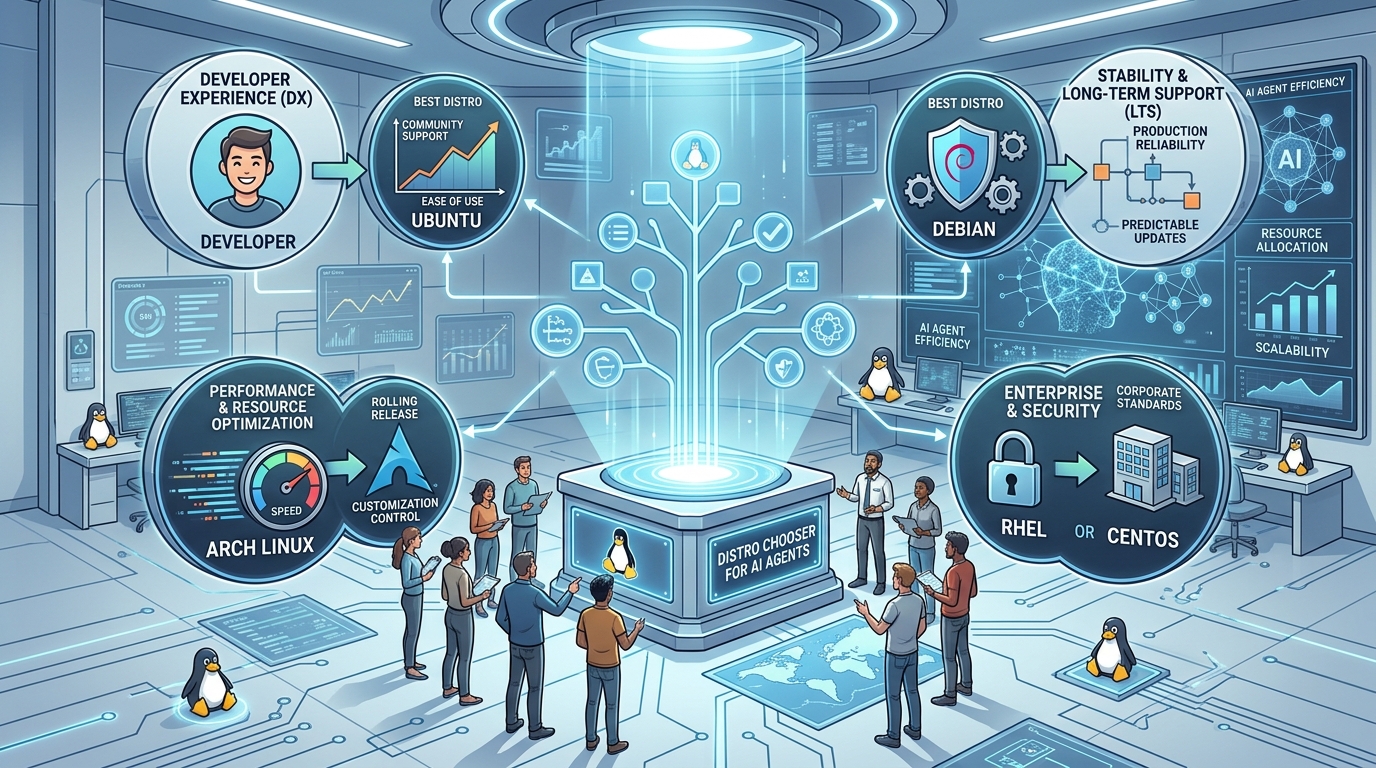
For 80% of Developers and Organizations: Ubuntu Server LTS remains the overall best Linux distribution for AI agents. Its unmatched documentation, cloud ubiquity, flawless CUDA integration, and native support across all AI agent frameworks make it the path of least resistance.
-
For Production Uptime and Low Overhead: Debian Stable offers the best balance of minimalist resource usage and bulletproof system stability for running persistent agent daemons.
-
For Enterprise Security and Compliance: AlmaLinux / Rocky Linux provides the ideal hardened foundation with SELinux integration and long-term lifecycle support.
-
For Advanced DevOps and Reproducibility: NixOS is the ultimate choice for declaring, version-controlling, and recreating complex multi-agent execution environments without dependency drift.
Selecting the right Linux distribution empowers you to build a resilient platform for autonomous intelligence. By matching your OS selection to your environment requirements and hardware constraints, you ensure that your autonomous agents operate with maximum speed, rock-solid stability, and robust security.